


Loading profile. Please wait . . .
Carex impressinervia Bryson, Kral & Manhart
Impressed-nerve Sedge




Federal Protection: No US federal protection
State Protection: No Georgia state protection
Global Rank: G3
State Rank: S1
Element Locations Tracked in Biotics: Yes
SWAP 2015 Species of Greatest Conservation Need (SGCN): No
SWAP 2025 Species of Greatest Conservation Need (SGCN): No
2025 SGCN Priority Tier:
Element Occurrences (EOs) in Georgia: 3
Habitat Summary for element in Georgia: Moist to wet hardwood forests, including bottomlands; perhaps in perched wetlands?
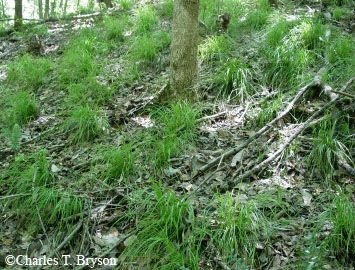
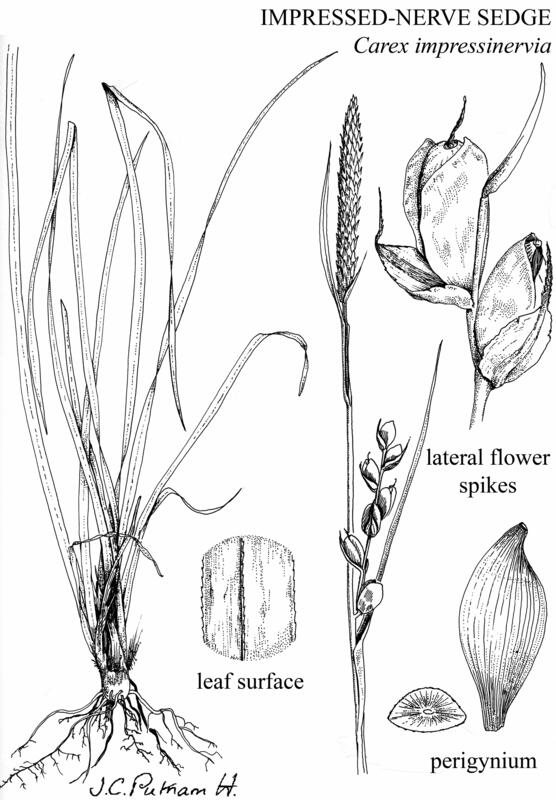
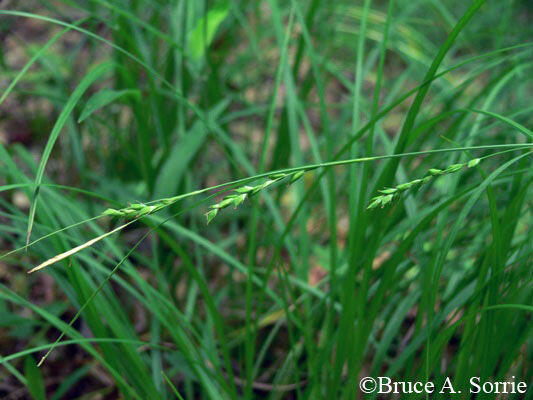
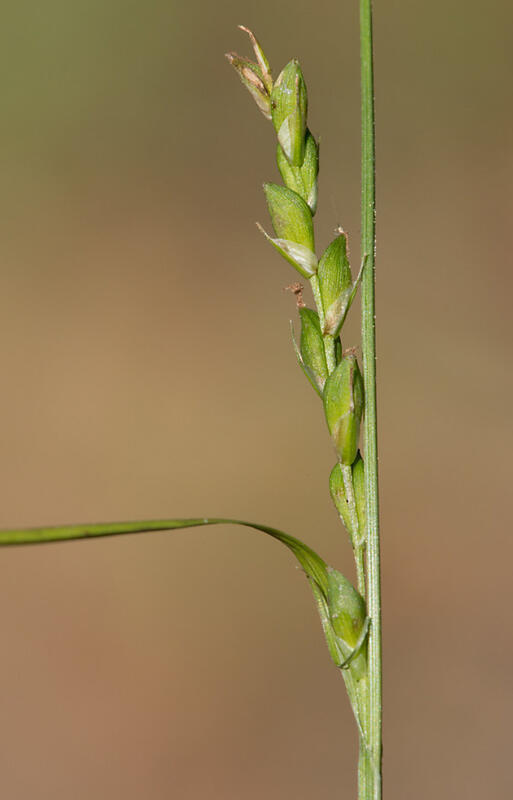
Perennial, grass-like herb forming dense clumps connected by underground stems (rhizomes). Flowering stems are 10 - 34 inches (25 - 85 cm) tall. Leaf blades are up to 0.2 inch (2.6 - 4 mm) wide, smooth except for the hairy midvein; the lower part of the leaf is a hairless, pale green or tan sheath encircling the base of the stem; old, fibrous leaf bases persist at the base of the plant. The topmost flower spike is 0.75 - 1.5 inch (1.9 - 4 cm) long, solitary at the top of the flowering stem, containing male flowers only. Lateral flower spikes are 0.4 - 1.7 inches (1.1 - 4.3 cm) long, with both female and male flowers, 2 - 4 spikes per stem, held below the male-flowered spike on the same stem; each spike with 5 - 11 fruits, the overlapping scales oval with whitish margins and pointed tips. The body of the fruit is about 0.1 inch (3.1 - 3.5 mm) long with a short, bent stalk at the base and sharply bent tip; the fruit is tightly enclosed in a 3-sided, heavily veined sac (perigynium) that has a very short or no beak. Magnification of 10x is needed to examine the spikes and fruits.
Few-fruited sedge (Carex oligocarpa) also forms dense clumps in rich forests over mafic and calcareous bedrock; it does not have old leaf bases persisting at the base of the plant, and its leaf sheaths are purple rather than light green; its perigynium has a straight beak about 0.1 inch (0.2 - 0.4 mm) long.
Forty-five species of Carex are rare in Georgia, see: https://georgiabiodiversity.org/portal/element_lists?group=plant
Detailed information about these rare Carex species is provided on this website:
Acid-Loving Sedge (C. acidicola): https://georgiabiodiversity.org/portal/profile?group=plants&es_id=34933
Baltzell's Sedge (C. baltzellii): https://georgiabiodiversity.org/portal/profile?group=plants&es_id=15974
Granite Dome Sedge (C. biltmoreana): https://georgiabiodiversity.org/portal/profile?group=plants&es_id=19146
Lime-fleeing Sedge (C. calcifugens): https://georgiabiodiversity.org/portal/profile?group=plants&es_id=33655
Velvet Sedge (C. dasycarpa): https://georgiabiodiversity.org/portal/profile?group=plants&es_id=15939
Cypress-knee Sedge (C. decomposita): https://georgiabiodiversity.org/portal/profile?group=plants&es_id=21206
Meager Sedge (C. exilis): https://georgiabiodiversity.org/portal/profile?group=plants&es_id=34936
Wretched Sedge (C. misera): https://georgiabiodiversity.org/portal/profile?group=plants&es_id=16740
Radford’s Sedge (C. radfordii): https://georgiabiodiversity.org/portal/profile?group=plants&es_id=15374
Roan Mountain Sedge (C. roanensis): https://georgiabiodiversity.org/portal/profile?group=plants&es_id=21034
Thorne's Sedge (C. thornei): https://georgiabiodiversity.org/portal/profile?group=plants&es_id=34939
Moist hardwood forests on slopes above and in the floodplains of small streams, usually in areas with mafic or slate bedrock. In North Carolina, this species occurs in the lower Piedmont and upper Coastal Plain with Sweet Gum, Spicebush, and Jack-in-the-pulpit.
Impressed-nerve Sedge, like most sedges, are wind-pollinated. Nothing has been published about seed dispersal or other aspects of reproduction for this species.
Many Carex species are very similar and positive identification depends on characteristics of the fruit. Surveys are best conducted during fruiting (spring).
Alabama, Mississippi, South Carolina, North Carolina, and Georgia.
Clearing and logging hardwoods in ravines and adjacent floodplains; damming streams.
All known populations in Georgia occur on conservation land.
Protect hardwood slope forests and floodplain forests from clearing, logging, conversion to pine plantations, and stream impoundment.
Bryson, C.T., R. Kral, and J.R. Manhart. 1987. A new species of Carex (Cyperaceae: section Oligocarpae) from the southeastern United States. Rhodora 89: 357-363. https://www.jstor.org/stable/23313967?seq=1#metadata_info_tab_contents
Bryson, C.T., S.W. Rosso, R.FC. Naczi. 1991. Carex baltzellii (Cyperaceae) new to Mississippi with notes on Carex picta and Carex impressinervia in Mississippi. Sida 14(3):493-499. https://www.jstor.org/stable/41966915?seq=1#metadata_info_tab_contents
Naczi, R.F.C. and C.T. Bryson. 2003. Carex impressinervia species account. Flora of North America, Vol. 23, Magnoliophyta: Commelinidae (in part), Cyperaceae (part 1). Oxford University Press, New York. http://beta.floranorthamerica.org/Carex_impressinervia
Naczi, R.F.C., and C.T. Bryson. 1990. Noteworthy records of Carex (Cyperaceae) from the southeastern United States. Bartonia 56:49-58. https://www.jstor.org/stable/41610000?seq=1#metadata_info_tab_contents
NatureServe. 2020. Carex impressinervia species account. NatureServe Explorer. Arlington, Virginia. https://explorer.natureserve.org/Taxon/ELEMENT_GLOBAL.2.130775/Carex_impressinervia
Weakley, A.S. 2015. Flora of the southern and mid-Atlantic States. University of North Carolina Herbarium, University of North Carolina, Chapel Hill. http://www.herbarium.unc.edu/flora.htm
Linda G. Chafin
L. Chafin, Oct. 2008: original account.
K. Owers, Jan. 2010: updated status and ranks, added pictures.
L. Chafin, Jan 2020: updated original account.