


Loading profile. Please wait . . .
Arnoglossum sulcatum (Fern.) H.E. Robins.
Grooved-stem Indian-plantain




Federal Protection: No US federal protection
State Protection: No Georgia state protection
Global Rank: G3
State Rank: S1
Element Locations Tracked in Biotics: Yes
SWAP 2015 Species of Greatest Conservation Need (SGCN): Yes
SWAP 2025 Species of Greatest Conservation Need (SGCN): Yes
2025 SGCN Priority Tier: High Conservation Concern
Element Occurrences (EOs) in Georgia: 3
Habitat Summary for element in Georgia: Bottomland forests
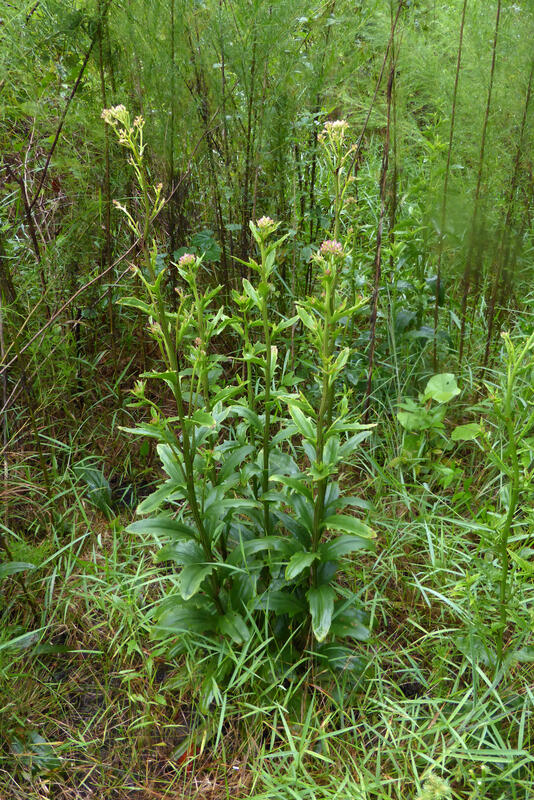
Perennial herb with strongly ribbed, hairless stems 2 - 4.5 feet (70 - 140 cm) tall. The basal leaves have long stalks (4 - 18 inches / 10 - 45 cm) and oval, lance-shaped, or elliptic blades 4.7 - 8 inches (12 - 20 cm) long, tapering to a broadly wedge-shaped base with blade tissue continuing along the stalk and forming wings. Three conspicuous veins arise from the base of the blade, and margins may be entire or have widely spaced teeth. The stem leaves become smaller up the stem and mostly lack stalks, their blades oval or lance-shaped with tapered bases and entire or toothed margins. (In smaller plants, basal and stem leaves may be identical.) The flower cluster is large and much branched, held at the top of the stem, more or less flat-topped, with many small flower heads. Flower heads are about 0.3 inch (8 - 10 mm) high, held erect at the tips of short branches; the involucral bracts are white tinged with rose, pink, yellow, or green, and are winged along the midrib; the 5 disk flowers (mostly hidden by the bracts) are pale yellow, pink, or greenish; there are no ray flowers. Fruits are dry, seed-like, ribbed achenes 4 mm long.
Three other species of Arnoglossum occur in Georgia’s Coastal Plain:
Pale Indian-plantain (Arnoglossum atriplicifolium) has broad, lobed, maple-like basal leaves with five veins originating at the top of the leaf stalk. The lower surfaces of all the leaves are waxy and white. It occurs in dry to moist upland woods and clearings.
Broadleaf Indian-plantain (Arnoglossum ovatum) leaf blades are usually oval with entire margins. Its stems are round in cross-section, not ribbed or grooved, and its involucral bracts are not winged. It occurs in wet savannas over limestone.
Variable-leaf Indian-plantain (Arnoglossum diversifolium) also occurs in swamps and is rare in Georgia, see below.
The blades of Variable-leaf Indian-plantain (Arnoglossum diversifolium) leaves are shaped differently from those of Grooved-stem Indian-plantain and are either heart-shaped or triangular in general outline, and the leaf margins are deeply toothed or lobed. There are usually 5 or more veins spreading from the top of the leaf stalk. Its flower heads have greenish- or pinkish-white bracts and the disk flowers are usually pale lavender. For more information, see: https://www.georgiabiodiversity.org/portal/profile?group=plants&es_id=21263
Peaty swamps and streamhead seepage bogs, wet woodlands, and wet roadside ditches through these habitats.
Grooved-stem Indian-plantain reproduces by seeds and also by producing small plants from the thickened stem base; these offshoots eventually become detached from the parent plant and established as physically separate, though genetically identical, plants. There is no published information on this species’ life history but the closely related Pale Indian-plantain (Arnoglossum atriplicifolium) produces both pollen and nectar and is visited by bees, wasps, and flies. It requires cross-pollination in order to set fertile seed. The small, seed-like fruits are surrounded by a whorl of fine bristles (the pappus) that aids in dispersal by both wind and small animals.
Grooved-stem Indian-plantain is usually a large, showy plant, identifiable throughout the summer and fall by its leaves and stems. The inflorescence is also large and showy, mid-summer through early fall.
Grooved-stem Indian-plantain occurs in southwest Georgia, southern Alabama, and the Florida Panhandle. It is rare throughout its range.
Grooved-stem Indian-plantain is threatened by ditching, draining, and filling of wetlands and by damming of small streams for farm and stock ponds. Hydrological alterations from bridge and road building have also been detrimental. Logging in wetlands and mud-bogging by recreational vehicles also pose a threat.
| Threat 1 | Threat 2 | Threat 3 | |
|---|---|---|---|
| General Threat | Energy production & mining | Transportation & service corridors | Biological resource use |
| Specific Threat | None | None | None |
Arnoglossum sulcatum is ranked S1 by the Georgia Department of Natural Resources, indicating that it is critically imperiled in Georgia. Only one population is known to be extant; it occurs on private land.
Protect riparian wetlands from logging, impoundment, ditching, draining, filling, and cattle. Prevent sedimentation into streams. Exclude recreational vehicles from wetlands.
GADNR. 2019. Element occurrence records for Arnoglossum sulcatum. Georgia Department of Natural Resources, Wildlife Resources Division. Social Circle, Georgia.
Hilty, J. 2019. Species account for Arnoglossum atriplicifolium. Illinois Wildflowers. Accessed 7 July 2019. https://www.illinoiswildflowers.info
Les, D.H. 2017. Aquatic Dicotyledons of North America: Ecology, Life History, and Systematics. CRC Press/ Taylor & Francis, Boca Raton, Florida.
NatureServe. 2019. Species account for Arnoglossum sulcatum. NatureServe Explorer: an online encyclopedia of life, Version 7.1. NatureServe, Arlington, Virginia. Accessed 7 July 2019. http://explorer.natureserve.org/servlet/NatureServe?searchName=Arnoglossum+sulcatum
Flora of North America. 2002. Species account for Arnoglossum sulcatum. Flora of North America North of Mexico, vol. 20. Accessed 7 July 2019. http://www.efloras.org/florataxon.aspx?flora_id=1&taxon_id=250066138
Weakley, A.S. 2015. Flora of the southern and mid-Atlantic States. University of North Carolina Herbarium, University of North Carolina, Chapel Hill.
Linda G. Chafin
16 July 2019