


Loading profile. Please wait . . .
Macrochelys temminckii (Troost, in Harlan, 1835)
Alligator Snapping Turtle




Federal Protection: No US federal protection
State Protection: Threatened
Global Rank: G3
State Rank: S2
Element Locations Tracked in Biotics: Yes
SWAP 2015 Species of Greatest Conservation Need (SGCN): Yes
SWAP 2025 Species of Greatest Conservation Need (SGCN): Yes
2025 SGCN Priority Tier: Moderate Conservation Concern
Element Occurrences (EOs) in Georgia: 35
Habitat Summary for element in Georgia: Streams and rivers; impoundments; river swamps
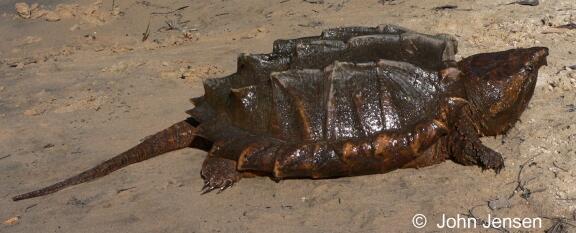
The largest documented western alligator snapping turtle measured 77.5 cm (30.5 in maximum carapace length, but adults usually range 30-50 cm or 12-30 inches carapace length) making this species the second largest freshwater turtle species occurring in North America and arguably the fifth largest in the world. The generic name for the alligator snapping turtles is fitting, since Macrochelys means “large turtle.” As is the case for all chelydrid turtles (snapping turtles), this species has a total of 25 marginal scutes (including the cervical scute) on the perimeter of the carapace (upper shell). Both species of alligator snapping turtles have a row of three (occasionally more) supramarginal scutes situated between marginal scutes and the first three lateral scutes on each side of the carapace (Figure 1.); this trait is unique to Macrochelys. The carapace is large, rough, dark-brown to reddish-brown, and strongly serrated posteriorly. There are three prominent keels running longitudinally along the length of the carapace, one down the center along the vertebral scutes, and a keel down each side of the carapace along the lateral scutes; there are knobs along these keels on each vertebral & lateral scute that are curved anteriorly. The largely reduced plastron (lower shell), possessing similar coloration to the carapace, is characterized by anteriorly off-set abdominal or “preabdominal” scutes (Figure 1.). The skin is typically dark brown in color (lighter below), but in some individuals this may appear to have more of a beige hue. The enormous head, which has earned it the nickname “loggerhead,” is triangular in shape and has an elongated snout. The head is covered in elaborate papillae (small pimple-like fleshy projections) and the eye is ringed with conical tubercles (bumps of skin), all of which produce the effect of expertly camouflaging the turtle’s head with vegetation and woody debris typical of the species’ habitat. The upper jaw is strongly hooked. The relatively long tail has three dorsal rows of tubercles. Hatchlings (3-4.5 cm or 1.25 - 1.75 inches carapace length) that look much like adults, have roughened carapaces, long, slender tails, and dark brown skin (sometimes possessing lighter mottling).
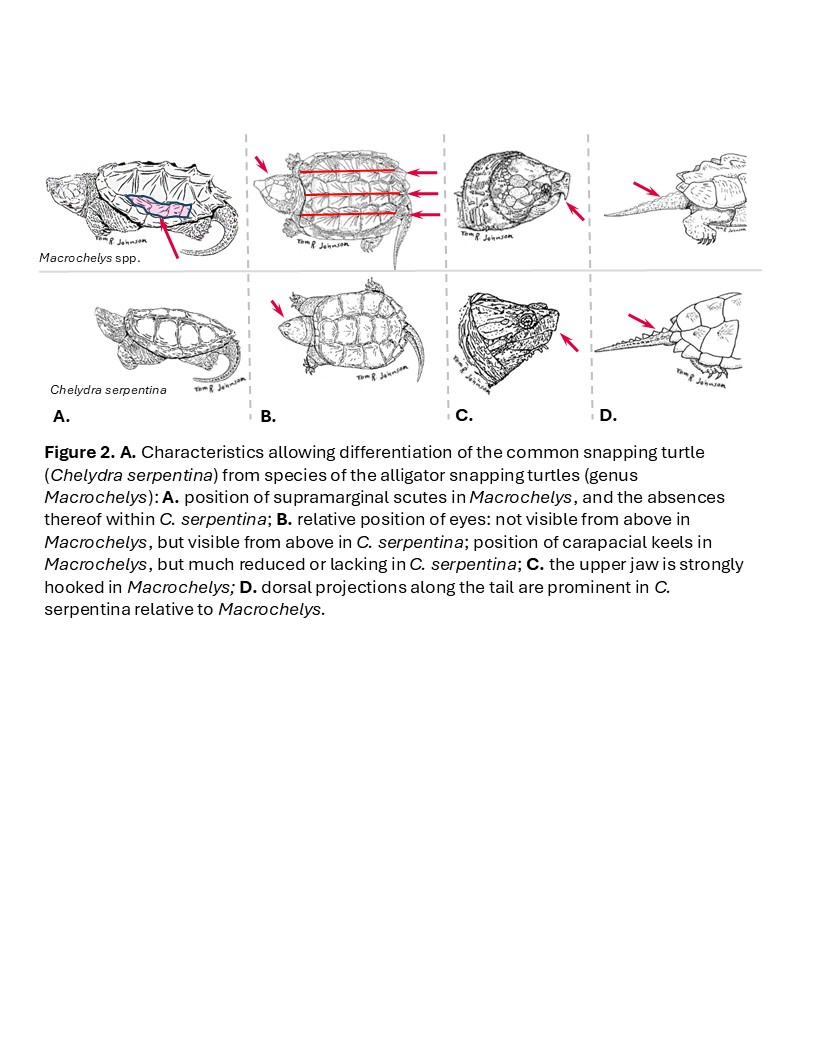
Among Georgia’s native turtle species, only the common snapping turtle (Chelydra serpentina) (within the same family, Chelydridae) could be confused with an alligator snapping turtle (genus Macrochelys); but common snapping turtles can be differentiated by the following: 1) both eyes are clearly visual from above; 2) dorsal projections along the tail are prominent relative to species of Macroclemys; and 3) possesses a carapace a) without supramarginal scutes, b) lacking prominent knobs on the vertebral or lateral scutes, and c) lacking keels at all or at least that extend the entire length of the shell (Figure 2). Further, common snappers are frequently seen on land while alligator snappers almost never leave the water except to nest.
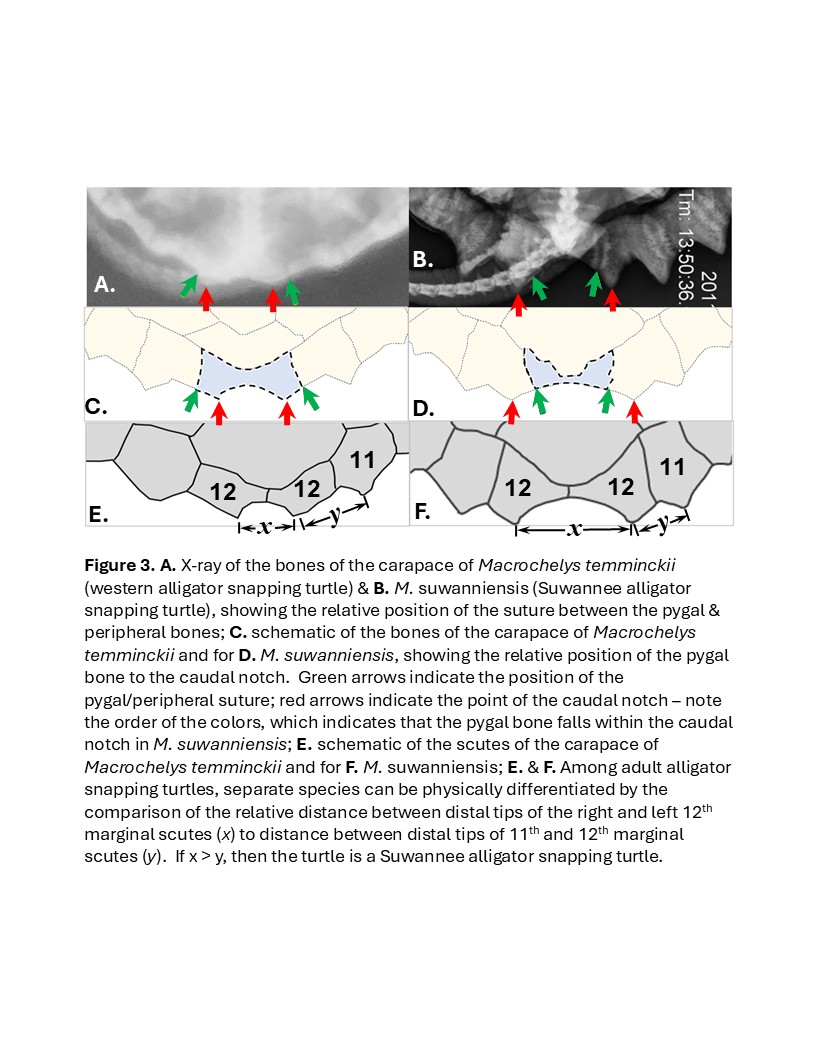
In 2014 the western alligator snapping turtle (Macrochelys temminckii) was taxonomically separated from the Suwannee alligator snapping turtle (M. suwanniensis) based on differences in shell and skull morphology and genetic differentiation. Additionally, alligator snapping turtles occurring within the Choctawhatchee, Apalachicola (including the Chipola, Chattahoochee, and Flint rivers), and Ochlockonee river drainages of Alabama, Florida, and Georgia, characterized by a caudal notch more “U”-shaped as compared to the “V”-shaped caudal notches of all other alligator snapping turtle populations occurring west of the Choctawhatchee River drainage, were initially designated as M. apalachicolae, however while these populations represent a distinct genetic lineage, subsequent scientific consensus has considered genetic differences among western drainages to be insufficient for separate species recognition. All Macrochelys populations occurring within Georgia, outside of the Suwannee River drainage are included within this “central” genetic lineage.
The western alligator snapping turtle (M. temminckii) can be differentiated from the Suwannee alligator snapping turtle (M. suwanniensis) by the respective species’ allopatric (non-overlapping) geographic distribution and through the comparison of shell characteristics, namely the 1) width and general shape of the caudal notch; and 2) the position of the “preabdominal” scute. Within Georgia, the western alligator snapping turtle occupies the lower Chattahoochee, Flint, and Ochlockonee rivers and their tributaries; the Suwannee alligator snapping turtle occupies the Suwannee River watershed. Among adult alligator snapping turtles, species can be physically differentiated by the comparison of the relative distance between distal tips of right and left 12th marginal scutes (x) to distance between distal tips of 11th and 12th marginal scutes (y) (Figure 3. E. & F.). If x < y, then the turtle is a western alligator snapping turtle. Since carapace morphology cannot be used to definitively determine a species identification for hatchling and juvenile alligator snapping turtles, and because the suture between the pygal and peripheral bones are discernible in radiographs (x-rays), if the geographic origin of a turtle is unknown, an x-ray of the posterior carapace may be necessary to determine the relative position of the pygal bone to the supracaudal scutes (scutes immediately adjacent and above the tail) and marginal scute cusps; for M. temminckii the pygal bone is not completely contained within the caudal notch (Figure 3. A., B., C., & D.). Additionally, on the plastron, the “preabdominal” scute is laterally off-set relative to the abdominal scute in M. suwanniensis, but anteriorly off-set to the abdominal scute in M. temminckii (Figure 1.).
Preferred habitats of M. temminckii typically consist of lotic (flowing), deeper waters of large rivers and major tributaries (especially spring-fed portions), but this species are also found in lentic (still water) canals, impounded ponds & lakes (particularly of larger rivers), oxbows, swamps, including turbid and tannin-stained backwaters of swamp forest floodplains. Aquatic microhabitats important for alligator snapping turtles include under-cut banks, limestone ledges, scour holes, large woody debris, essential habitat features serving as both refugia and as substrate necessary for ambushing prey.
Though alligator snapping turtles are omnivores and individuals likely feed on any animal that they can capture, subdue, and shallow, the majority of their diet consists of fish. Macrochelys are particularly adapted to ambush fish; the inside of their months is camouflaged to blend into the surrounding when open underwater and they possess a double-ended moveable worm-shaped appendage attached to the anterior third of the oral cavity, anterior of the glottis – an example of aggressive mimicry, as it has specifically evolved as a lure for fish. Other documented food items include plant fruits and parts (e.g., briar roots, wild grapes, hickory nuts, locust beans, oak acorns, palmetto fruits, persimmons, tupelo fruits), leaches, freshwater clams, mussels, and snails, crayfish, large salamanders, turtles, snakes, small alligators, birds, and small mammals. Some larger prey animals have been known to be taken by alligator snapping turtles as carrion.
Macrochelys are the only turtles in the world with an oral predatory lure (resembling a worm or insect larva), which both adults and juveniles use to lure prey into biting range; this “worm” appendage is white or pale pink (juveniles) or mottled or smoky gray (adults) while at rest, but becomes suffused with red when active, contrasting with the gray-black of the oral cavity.
The only time alligator snapping turtles ever leave the water, is when females dig nests within sandy soil 8-656 feet (2.5-200 m) from the nearest water and less than 10 feet (~3 m) above it, avoiding open sandbars and low forested areas with leaf litter and matted roots. Sexual maturity is reached in approximately 11-13 years. Mating takes place in late winter or early spring and is subsequently followed by an April through June nesting season. Hatching occur 80-115 days after oviposition, depending on ambient temperature. Sex of individual alligator snapping turtles is determined by the temperature at which the egg incubates during embryonic development while in the nest; 11% males at 72.5°F (22.5°C), 69% males at 77°F (25°C), and 71% at 80.6°F (27°C), no males at 86°F (30°C) (i.e., temperature sex determination pattern TSD – 2).
Perhaps as an adaptation to its typically deeper, swift water, the tails of small alligator snapping turtles are reportedly prehensile habitats (i.e., can maintain a position in a current by hooking their tails around fixed objects). As individuals are rarely seen basking, research suggests that alligator snapping turtles thermoregulate by altering their depth in the water column, however Macrochelys turtles cannot remain submerged as long as many other turtles (i.e., must surface after 15-20 minutes in warm water).
Snorkeling or SCUBA diving in clear water may be conducted to visually locate individuals, but deployment of large, heavy-duty hoop traps, particularly in blackwater systems with low visibility, are a more effective survey method. Trapping is ideally conducted March through November, when alligator snapping turtles are most active (individuals no longer forage for prey when the ambient air temperature falls below 18°C (65°F). Baited hoop traps should be set within and upstream of suitable habitat (i.e., adjacent to preferred microhabitats and within discernible to moderately flowing current). Within previous survey efforts, researchers have successfully used single-funnel hoop traps of various sizes, depending on field situations such as different water depths. Hoop traps should be positioned so that a funnel entrance is facing downstream, and so that the longitudinal axis of the hoop trap is approximately parallel to the stream flow with the current flowing through the throat of the trap, and should be baited with cut fish contained within a partially open vessel which is secured inside the back of the trap’s funnel throat and suspended into the approximate center of the trap diameter. At least the upstream and second trap hoops should be secured to the stream substrate (or large woody debris); if suitable rocks, limbs or root systems are unavailable for securing traps, staking may be required to secure the trap. To allow trapped animals, including alligator snapping turtles, to surface and avoid drowning, hoop traps should be positioned and secured so as to allow a portion of the upper part of the trap to be emergent from the water surface. Consideration should be given to the timing and feasibility of placement of traps on stream and river segments that could possibly experience rising flood water conditions, as stormwater flows could overtop set hoop traps, creating a drowning hazard for captured animals. Conversely, setting traps amid reduced stream discharge due to seasonality or drought could create a lack of flow rendering otherwise suitable habitats suboptimal, encouraging turtles to move to more stable habitats, limiting the success of trapping efforts. To maximize trapping results, hoop traps should remain in place for at least 12 to 20 hours, though they may be checked for captures as frequently as every hour or two, but no less frequently than every 24 hours so that captured animals can be removed, and to avoid escapes and drownings (previous research has shown that the majority of alligator snapping turtle individuals are captured within the first 24 hours of a trap set). Use of such turtle traps are only legal in Georgia by issuance of a permit by the Georgia Department of Natural Resources.
The western alligator snapping turtle occurs within Gulf of Mexico drainages from southeastern Georgia west to Texas, and north along the Mississippi River to southeastern Iowa. Within Georgia, M. temminckii occurs within the Chattahoochee River (below the Fall Line), as well as the Ochlockonee and Flint river drainages, including the upper Flint River mainstem and its tributaries flowing through the Piedmont.
Although alligator snapping turtle longevity is at least 80 years (likely much longer) and research has shown adult annual survivorship is 99%, the typical pattern characterizing all turtle species – delayed sexual maturity (11-13 years), low fecundity (clutch size, 15-50, annually) and low nest and yearling survivorship (clutch success is variable, but juvenile survivorship is 32%), make them vulnerable to over harvest or mortality, especially of sexually mature females.
Prior to receiving protection in the state (1992), these giants were trapped heavily for commercial purposes, particularly to supply meat for the turtle soup industry. One individual trapper was responsible for harvesting between 4,000 and 5,000 adult alligator snapping turtles from the Flint River during the period 1971-1983. This individual also reported catching up to 450 kg (1,000 lbs) of this turtle per day in one of the Flint River's tributaries. Removing this many adult turtles, especially of a late maturing species like the alligator snapping turtle, can seriously impact a local population. This was substantiated after a 1988-1989 survey of the conducted by the aforementioned trapper yielded only 62 alligator snappers in 783 trap nights.
Within Georgia, sport trotlines, set hooks, bush hooks, limb lines, and jug lines that are deployed recreationally to fish for catfish are often deployed without labeling, without restriction as to quantity, and are also easily abandoned without recourse. Field observations suggest that both attended, and especially abandoned trotlines, set hooks, bush hooks, limb lines, and jug lines pose a problem for Macrochelys bycatch and mortality through ensnarement and hook ingestion. Recent research has shown that the incidence of bycatch of Macrochelys involving fishhooks to be four times more numerous than the second-most numerous threat, turtle persecution (i.e., wanton killing).
The magnitude of the effects of habitat alteration resulting from the removal of large woody debris (e.g., “deadhead logging”) is largely unknown, but is likely significant.
| Threat 1 | Threat 2 | Threat 3 | |
|---|---|---|---|
| General Threat | Natural system modifications | Climate change & severe weather | Biological resource use |
| Specific Threat | Dams & water management/use | Droughts | Fishing & harvesting aquatic resources |
The state of Georgia prohibited the take (including commercial harvest) of alligator snapping turtles and their eggs by designating Macrochelys as State Threatened under Georgia's Endangered Wildlife Act in 1992, but this did not prohibit the use of freshwater turtle traps for other turtles species during which Macrochelys could be bycatch. However, Georgia’s freshwater turtle regulations (Chapter 391-4-16) enacted in 2012 and revised in 2018 made it illegal to deploy turtle traps within Georgia’s public or private waters without a permit issued by the Georgia DNR (i.e., permitted nuisance wildlife control operator or a commercial fishing permit issued in conjunction with a commercial turtle-farming permit). In 2006, Macrochelys was listed as Appendix III under the Convention on International Trade in Endangered Species of Wild Fauna and Flora (CITES), and as an Appendix II species in 2023. Following the development of a Species Status Assessment, in 2021 the US Fish and Wildlife Service proposed that Macrochelys temminckii be listed as Threatened under the U.S. Endangered Species Act; a final determination of this listing status is forthcoming.
Surveys for M. temminckii have been conducted in all drainages within the Georgia range to assess occupancy, but not all drainages have been surveyed multiple times. Few drainages have been sampled repetitively over time sufficient to facilitate modeling of population status. Occupancy was assessed via a 1997-2001 study [Jensen and Birkhead 2003], which included stretches of the Chattahoochee River, as well as some tributaries. Stretches of the Flint River were sampled in both 1988-1989 [Johnson 1989] and in 2014-2015 [King et al. 2016], allowing comparison of abundance over time. Georgia’s most extensive dataset includes repetitive survey efforts from 1997-2013 on Spring Creek, allowing modeling of demographics. The best available scientific data available for Georgia M. temminckii populations (including estimations of abundance from catch-per-unit-effort [CPUE] survey data as well as population modeling from a long-term data set collected from a natural population) neither indicate precipitous population declines, nor population growth or recovery. Instead, taken as a whole, these available data are indicative of the gradual recovery of populations; the lack of an increase in estimated relative abundance from Georgia data for such a long-lived species that is so slow to reach sexual maturity is hardly surprising since the enactment of conservation measures, such as harvest prohibition, have only been in place in Georgia for a small fraction of the species’ life span.
The long-term survey and monitoring of select Georgia populations (using mark-recapture methods) should be continued (periodically monitored) in order to evaluate demographics and to identify possible future population declines. The impacts of legal fishing methods (e.g., trotlines, bush hooks, limblines, etc.) on turtle bycatch and mortality should be evaluated and means of mitigation of these risks explored. Because underwater snags, logs, and limbs (i.e., large woody debris) provide the habitat for the larval insects that are the foundation of vertebrate food webs within these otherwise nutrient deficient (i.e., blackwater) streams, the need to regulate wood removal (i.e., “deadhead logging”) should be assessed. Impacts to riparian habitats from upland land use should be minimized; forestry best management practices including the implementation of stream management zones within the turtle’s range should be implemented during forestry operations in order to minimize erosion of the uplands and sedimentation input into adjacent stream channels.
Dobie, J. L. 1986. Alligator snapping turtle. Pp. 49-50, In: Mount, R.H., ed. Vertebrate animals of Alabama in need of special attention. Alabama Agricultural Experiment Station, Auburn University, Auburn. 124pp.
Dobie, J. L. 1971. Reproduction and growth in the alligator snapping turtle, Macrochlemys temminckii (Troost). Copeia 1971: 645-658.
Folt, B. and C. Guyer. 2015. Evaluating recent taxonomic changes for alligator snapping turtles (Testudines: Chelydridae). Zootaxa 3947(3): 447-450.
Jensen, J. B. and W. S. Birkhead. 2003. Distribution and status of the alligator snapping turtle (Macrochelys temminckii) in Georgia. Southeastern Naturalist 2(1): 25–34.
Johnson, S. C. 1989. Population status of the alligator snapping turtle (Macroclemys temmincki) in the Flint River. Report to the Georgia Department of Natural Resources. 11pp.
King, R. L., B. P. Hepler, L. L. Smith, and J. B. Jensen. 2016. The status of Macrochelys temminckii (alligator snapping turtle) in the Flint River, GA, 22 years after the close of commercial harvest. Southeastern Naturalist 15(4): 575-585.
Powders, V. N. 1978. Observations of oviposition and natural incubation of eggs of the alligator snapping turtle, Macroclemmys temminckii, in Georgia. Copeia 1978:154-156.
Pritchard, P. C. H. 1989. The alligator snapping turtle: biology and conservation. Milwaukee Public Museum, Milwaukee, Wisconsin. 104 pp.
Thomas, T. M., M. C. Granatosky, J. R. Bourque, K. L. Krysko, P. E. Moler, T. Gamble, E. Suarez, E. Leone, K. M. Enge, K.M. and J. Roman. 2014. Taxonomic assessment of Alligator Snapping Turtles (Chelydridae: Macrochelys), with the description of two new species from the southeastern United States. Zootaxa 3786(2): 141-165.
US Fish & Wildlife Service. 2021. Endangered and Threatened Wildlife and Plants; Threatened Species Status with Section 4(d) Rule for Alligator Snapping Turtle. Federal Register 86(214): 62434-62463.
Thomas M. Floyd and John B. Jensen
J. Jensen, Dec. 2007: original account
K. Owers, Sept. 2009: updated status and ranks, added picture
J. Jensen, Apr. 2018; updated text
T. M. Floyd, Sept 2025: major account revision