

Loading profile. Please wait . . .
Convallaria pseudomajalis Bartram
American Lily-of-the-valley




Federal Protection: No US federal protection
State Protection: Rare
Global Rank: G4?
State Rank: S2
Element Locations Tracked in Biotics: Yes
SWAP 2015 Species of Greatest Conservation Need (SGCN): No
SWAP 2025 Species of Greatest Conservation Need (SGCN): Yes
2025 SGCN Priority Tier: High Conservation Concern
Element Occurrences (EOs) in Georgia: 20
Habitat Summary for element in Georgia: Rocky, montane oak forests
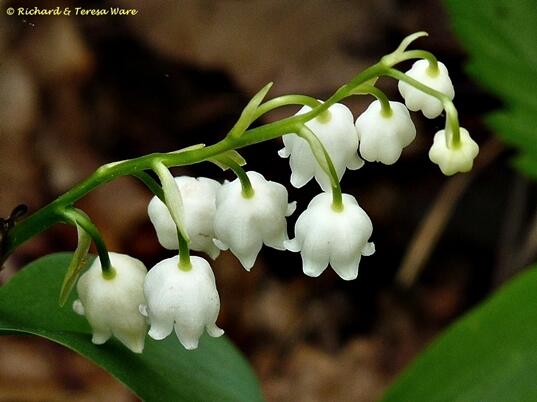
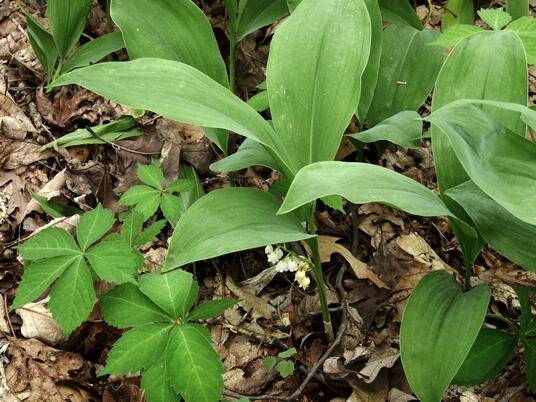
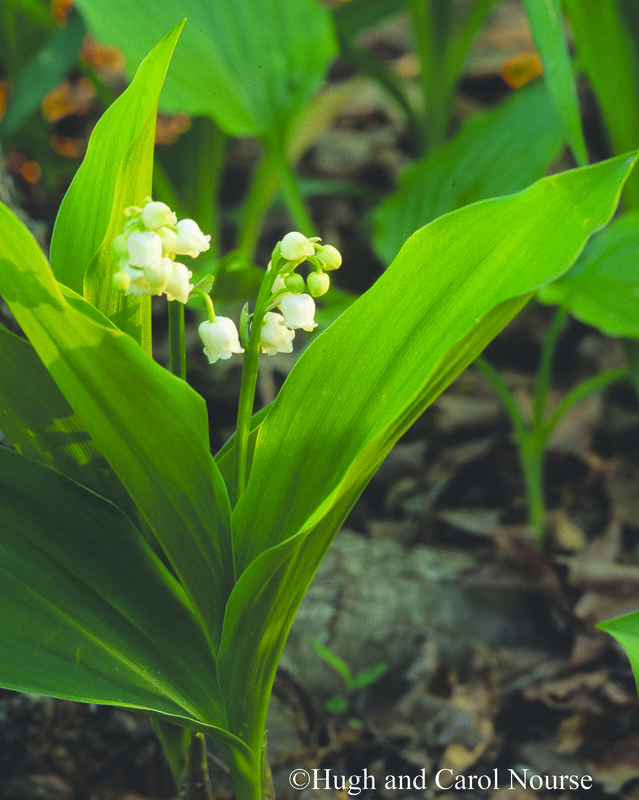
Perennial herb often forming small colonies of widely spaced plants. The leaves are 6 - 14 inches (15 - 35 cm) long and 2 - 5 inches (5 - 13 cm) wide, 2 or 3 per plant, with a pointed tip; the leaf base tapers to the leaf stalk. Flower stalks and clusters are less than ½ the length of the leaves, and arise from the base of the plant. Flower clusters have 5 - 15 white, nodding flowers. Flowers are 0.24 - 0.4 inch (6 - 10 mm) long, bell-shaped with 6 upturned tips, fragrant. Fruits are round, reddish-orange berries about 0.3 inch (7 - 9 mm) wide.
European Lily-of-the-valley (Convallaria majalis) forms colonies of closely spaced plants that may persist at old home sites. Its leaves are 4 - 6 inches (10 - 15 cm) long, and the stalk of the flower cluster is longer than ½ the length of the leaves.
None in Georgia.
Rocky, montane forests near ridgelines, often under White Oak or Northern Red Oak.
American Lily-of-the-valley is a perennial herb that reproduces vegetatively by sprouting from long underground stems (rhizomes) that produce widely spaced plants. It also reproduces sexually, attracting insect pollinators by the sweet fragrance of the flowers and by the nectar-producing glands at the base of the ovary. Lily-of-the-valley plants are toxic due to the presence of at least 38 cardenolide glycoside compounds. European species of Lily-of-the-valley, such as Convallaria majalis, are used as a food plant by the larvae of some butterflies and moths.
Surveys are best conducted during flowering (April–June) and fruiting (June–August).
Georgia, north to Pennsylvania and west to Kentucky.
Logging, clearing, ridgeline housing developments, overbrowsing by deer, digging by feral hogs.
| Threat 1 | Threat 2 | Threat 3 | |
|---|---|---|---|
| General Threat | Biological resource use | Residential & commercial development | None |
| Specific Threat | Logging & wood harvesting | Housing & urban areas | None |
Convallaria pseudomajalis is ranked S2 by the Georgia Department of Natural Resources, indicating that it is imperiled in the state. It is listed as Rare by the State of Georgia. Fourteen populations are known, all in the Chattahoochee National Forest or on state-owned conservation land.
Maintain hardwood canopy cover. Avoid clearcutting and disturbances to the herb layer in high elevation forests and woodlands. Prohibit ridgeline development. Reduce the size of Georgia’s deer herd. Eradicate feral hogs.
Chafin, L.G. 2007. Field guide to the rare plants of Georgia. State Botanical Garden of Georgia and University of Georgia Press, Athens.
GADNR. 2019. Element occurrence records for Convallaria pseudomajalis. Georgia Department of Natural Resources, Wildlife Resources Division, Social Circle, Georgia.
Horn, D., T. Cathcart, T.E. Hemmerly, and D. Duhl. 2005. Wildflowers of Tennessee, the Ohio Valley, and the southern Appalachians. Lone Pine Publishing, Auburn, Washington.
NatureServe. 2019. Convallaria majuscula comprehensive report. NatureServe Explorer. Arlington, Virginia. http://explorer.natureserve.org/servlet/NatureServe?searchName= Convallaria%20pseudomajalis
Radford, A.E., H.E. Ahles, and C.R. Bell. 1968. Manual of the vascular flora of the Carolinas. University of North Carolina Press, Chapel Hill.
Utech, F.H. 2003. Convallaria majalis var. montana species account. Flora of North America, Vol. 26. Oxford University Press, NY. http://www.efloras.org/florataxon.aspx?flora_id=1&taxon_id=242102225
Weakley, A.S. 2015. Flora of the southern and mid-Atlantic States. University of North Carolina Herbarium, University of North Carolina, Chapel Hill. http://www.herbarium.unc.edu/flora.htm
Linda G. Chafin
L. Chafin, Nov. 2007: original account
K. Owers, Jan. 2010: updated status and ranks, added pictures
L. Chafin, Jan 2020: updated original account.