Loading profile. Please wait . . .
Eurybia jonesiae (Lamboy) Nesom
Piedmont Bigleaf Aster




Federal Protection: No US federal protection
State Protection: No Georgia state protection
Global Rank: G3?
State Rank: S2
Element Locations Tracked in Biotics: Yes
SWAP 2015 Species of Greatest Conservation Need (SGCN): Yes
SWAP 2025 Species of Greatest Conservation Need (SGCN): Yes
2025 SGCN Priority Tier: High Conservation Concern
Element Occurrences (EOs) in Georgia: 11
Habitat Summary for element in Georgia: Mixed oak-hickory forests
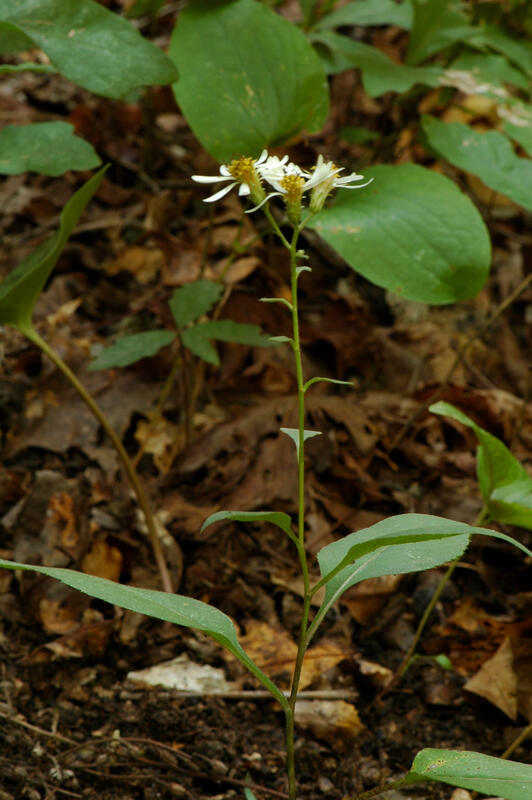
Perennial herb with dark reddish-brown stems 8 - 43 inches (20 - 110 cm) tall, straight or slightly crooked, smooth or often hairy, especially in the upper part. Lower leaves have long, hairy leaf stalks up to 5 inches (12 cm) long, and oval, lance- or heart-shaped blades; the margins are toothed and the surfaces are roughly hairy. The leaf blades are 3 - 7.5 inches long and 2 - 4.3 inches wide (8 - 19 cm long and 5 - 11 cm wide). Upper leaves have short, winged leaf stalks (uppermost leaves have no stalk) and oval, lance- or heart-shaped blades, 0.8 - 2.4 inches long and 0.3 - 1 inch wide (2 - 6 cm long and 0.8 - 3 cm wide). Flower heads are on hairy stalks up to 0.6 inch (0.4 - 1.6 cm) tall, each head with 7 - 15 white, cream, or pale purple ray flowers and 20 - 25 yellow (turning red with age) disk flowers. The base of each head is surrounded by a cylinder-shaped involucre about 0.5 inch (10 - 13 mm mm) high, composed of many greenish, hairy bracts spreading outward into pointed tips. Fruits are small, dry, brown, and seed-like, tipped with orange-brown, 0.2 inch long (6 mm) bristles.
Piedmont Big-leaf Aster (also called Jones’s Aster) resembles many other fall-flowering asters. It is distinguished by its large, hairy, long-stalked basal leaves; 7 - 15 ray flowers (cream or white, turning to violet); and, involucral bracts with pointed, spreading tips. Piedmont Big-leaf Aster most closely resembles Piedmont Aster (Eurybia mirabilis), which occurs only in the Piedmont of North and South Carolina.
Eurybia eryngiifolia (Snakeroot-leaf Aster) occurs in moist pine flatwoods in the Coastal Plain. Its stems are hairy and its leaves are bordered with spines. For more information, see: http://beta.floranorthamerica.org/Eurybia_eryngiifolia
Eurybia avita (Alexander Rock Aster) occurs in and around Piedmont granite outcrops. It has narrow, grass-like leaves. For more information, see: https://www.georgiabiodiversity.org/portal/profile?group=plants&es_id=16985
Eurybia jonesiae occurs in moist oak-hickory forests in the Piedmont of Georgia and eastern Piedmont of Alabama.
Piedmont Big-leaf Aster is a perennial herb that goes dormant in the winter. Little is known about its life history. Related species are pollinated by a variety of bees, flies, and butterflies. Its bristle-tipped fruits are dispersed by the wind and by small animals.
Piedmont Big-leaf Aster’s leaves are distinctive during spring and early summer, but surveys are best conducted in late summer and fall when the plants are in flower.
In Georgia, Piedmont Big-leaf Aster is found in nine counties scattered across the Piedmont. In Alabama, it is found in one Piedmont county adjacent to Georgia.
Piedmont Big-leaf Aster's habitat – oak-hickory forest – has been logged and cleared in several cycles over the last two hundred years.
| Threat 1 | Threat 2 | Threat 3 | |
|---|---|---|---|
| General Threat | Agriculture & aquaculture | Human intrusions & disturbance | Invasive & other problematic species, genes & diseases |
| Specific Threat | None | None | None |
Eurybia jonesiae is ranked S2 by the Georgia Department of Natural Resources, indicating that it is imperiled in the state. Eleven populations have been documented but only one has been observed in the last 20 years; only one population is protected on conservation land.
Protection of high quality upland hardwood sites known to support this species by conservation purchase or easement is needed to prevent further loss to logging, conversion to pine plantations and pastures, and residential and commercial development.
Brouillet, L. 2006. Species account for Eurybia jonesiae. Flora of North America North of Mexico, vol. 20. http://beta.floranorthamerica.org/Eurybia_jonesiae
GADNR. 2020. Element occurrence records for Eurybia jonesiae. Georgia Department of Natural Resources, Wildlife Resources Division. Social Circle, Georgia.
NatureServe. 2020. Species account for Eurybia jonesiae. NatureServe Explorer: an online encyclopedia of life, Version 7.1. NatureServe, Arlington, Virginia. https://explorer.natureserve.org/Taxon/ELEMENT_GLOBAL.2.142368/Eurybia_jonesiae
Semple, J.C. 2014. Eurybia jonesiae, Jones’s Aster. Astereae Lab, University of Waterloo, Waterloo, Ontario. https://uwaterloo.ca/astereae-lab/research/asters/eurybia/eurybia-jonesiae
Weakley, A.S. 2015. Flora of the southern and mid-Atlantic States. University of North Carolina Herbarium, University of North Carolina, Chapel Hill. http://www.herbarium.unc.edu/flora.htm
Linda G. Chafin
Linda G. Chafin, 9 November 2019: original account