


Loading profile. Please wait . . .
Pseudacris brimleyi Brandt and Walker, 1933
Brimley's Chorus Frog




Federal Protection: No US federal protection
State Protection: No Georgia state protection
Global Rank: G5
State Rank: S1
Element Locations Tracked in Biotics: Yes
SWAP 2015 Species of Greatest Conservation Need (SGCN): No
SWAP 2025 Species of Greatest Conservation Need (SGCN): No
2025 SGCN Priority Tier:
Element Occurrences (EOs) in Georgia: 12
Habitat Summary for element in Georgia: Moist forests; swamps; bottomlands
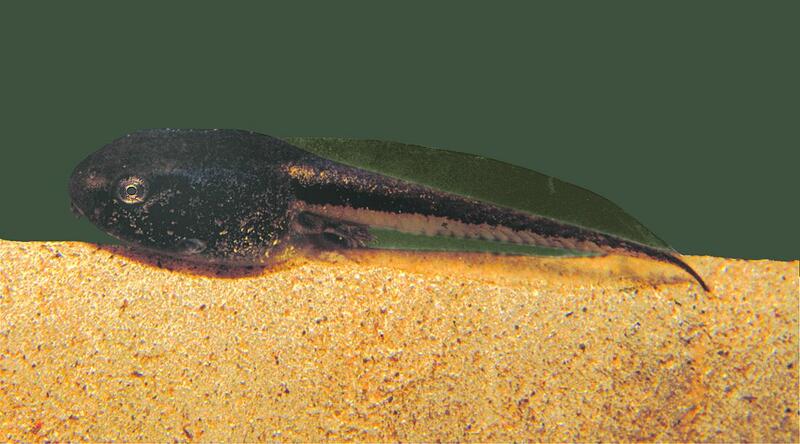
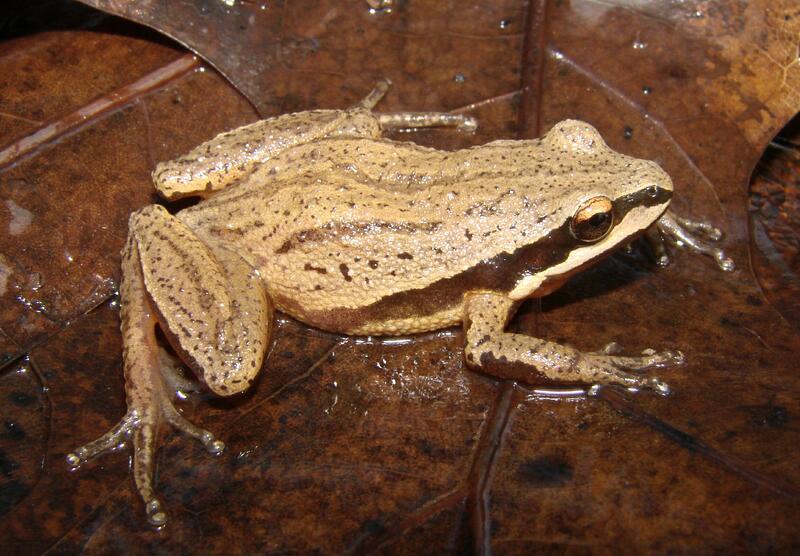
Brimley’s chorus frog is a long legged (i.e., heel of the rear leg reaches forward to the eye), medium-sized chorus frog with total lengths (snout to vent lengths or SVL) measuring 2.4 – 3.5 cm (~1 – 1.4 in). The dorsal (back) pattern consists of three dark stripes, bordered by a dark dorsolateral stripe running from the snout through the eye to the groin on each side of the frog’s body. The two lateral dorsal stripes are often well defined, but the median stripe may be lighter; in other individuals all of the dorsal stripes are faint. The background color, which is variable among individuals, ranges from yellowish to reddish brown to dark brown. How relatively light or dark an individual appears is variable as well – the coloration of an individual’s back which typically exhibits an evident triseriate pattern may fade to a seemingly pattern-less brownish yellow color, though the dorsolateral stripes (running from the snout through the eye, uninterrupted to the groin) always remain dark and prominent. Although the edge of the upper jaw is dark, above that, a light line extends to the shoulder. Unlike some other Pseudacris species, the skin is smooth and there is no inverted triangle, or “T”-shaped spot between the eyes. There are longitudinal rather than transverse markings on the hind legs, including a dark line along the outer edge of the tibia and on the underside of the rear foot. This species has no webbing on the front digits and the rear digits are only minimally webbed; digital disks (toe pads) are only slightly enlarged. The venter (belly) is distinctly yellow, and the chest has a variable amount of small dark spots; smaller but similar spotting is present on the under surfaces of the limbs. The throat (vocal sac) of the male is more darkly pigmented. Newly transformed froglets (8.6 -11 mm or 0.3-0.4 inches SVL) bare the three dorsal stripes and dark dorsolateral stripes of the adult pattern, but the venter is opaque silvery with dark stippling on the chest. Pseudacris brimleyi larvae (tadpoles) measure 2.2-3 cm (0.85-1.2 inches) [stage 36, Gosner standard stages of anuran development], and are darkly pigmented dorsally, throat and belly spotted, and tail musculature is strikingly bicolored (dark above), though fins are clear to only moderately marked (eyes are located dorsolaterally). The mating call is a short rasping trill, kr-r-r-a-k, lasting about 0.25 seconds which is uttered in a series (15-22 pulses) with short intervals in between. This call is somewhat similar to that of Collinses' mountain chorus frog and is much shorter in duration than those of the southern or upland chorus frogs.
In Georgia, the low swampy woodlands dwelling Brimley’s chorus frog, a member of the trilling chorus frogs, is sympatric (overlapping geographic distributions) with five other chorus frog species which it superficially resembles (at least as a recent metamorph) – three trilling chorus frogs: the upland chorus frog (P. feriarum), southern chorus frog (P. nigrita), and little grass frog (P. ocularis), as well as the spring peeper (P. crucifer) and the ornate chorus frog (P. ornata). However, these species can be differentiated based on appearance (especially, dorsal pattern), vocalizations, and/or differences in habitat affinity. Marks on the back of the upland chorus frog (1.9 – 3.5 cm [0.75 – 1 .4 in] SVL) are extremely variable – a persistent middorsal pattern consisting of a series of stripes, partial stripes, or spots. The call of this species is often compared to the sound of successively running one’s finger across the teeth of a hard plastic comb – a regularly repeated, crrreeek, crrreeek….crrreeek. Marks on the back of the southern chorus frog (1.9 – 3.2 cm [0.75 – 1 .25 in] SVL) consist of three rows of rounded dark spots that may coalesce to form longitudinal stripes over background color of olive, gray, brown, or black; there is a dark dorsolateral stripe running from the snout to midway between the forelimb and the groin (but not to the groin as in P. brimleyi). The belly and chest lack any definitive marks. Unlike the P. feriarum, and like P. brimleyi, P. nigrita lacks a dark inverted triangular mark between the eyes. The southern chorus frog’s breeding call consists of a metallic, staccato trill containing five to eight ratchet-like notes (ik-ik-ik-ik-ik-ik-ik-ik) repeated in regular intervals. The background color of the little grass frog (1 – 2 cm [~0.4 – ~0.8 in] SVL) is uniformly gray, greenish, brown, bronze, or reddish with a dark stripe running from the eye to the shoulder (and sometimes to the groin), but unlike P. brimleyi, lacks any dorsal markings. The breeding call of the little grass frog is a faint, insect-like shrill (ts-r-e-ek or s’lick). Marks on the back of the spring peeper (1.9 – 3.2 cm [0.75 – 1 .25 in] SVL) typically form an “X” shape, albeit often imperfectly. This species gets its common name from its distinctive call – a high-pitched, whistling peep, peep…peep repeated at intervals of about a second or sometimes a trilling peep. As its common name suggests, the ornate chorus frog displays a range of attractive dorsal coloration, varying from green, to gray, pinkish, red, or chestnut brown. This species typically has two dorsolateral longitudinal bars running from the neck to the groin, however these may be greatly reduced in some individuals and broken up in others. Pseudacris ornata always has a mask-like narrow, black stripe running from the tip of the snout, through the eye, to the shoulder (but not always to the groin as in P. brimleyi). The breeding call of the ornate chorus frog consists of a series of shrill, bird-like peeps, or is likened to the metallic ring of a hammer hitting a chisel (a note that is repeated 65-80 a minute). Because the spring peeper and upland chorus frog prefer open-canopied wetlands for breeding sites, these species are usually allotopic (occupying different microhabitats) with Brimley’s chorus frog. Unlike many other chorus frog sister taxa, the southern chorus frog tends to avoid floodplains and habitats with wet, mucky soils. Like the ornate chorus frog and the little grass frog, the southern chorus frog selects shallow ephemeral wetlands as breeding sites and inhabits adjacent uplands and wetlands during the non-breeding season making these three species allotopic to Brimley’s chorus frog as well.
Although Brimley’s chorus frogs are not known to migrate seasonally, adults have been found well away from water within mixed pine and hardwood forests, pine forests, secondary dune scrub forest, and cultivated fields. The typical habitat of this species consists of low, heavily wooded, swampy woodlands. Pseudacris brimleyi typically utilizes heavily wooded, shallow (15-20 cm or ~6-8 in) grassy temporary pools located within wet forest and floodplains for breeding. During the non-breeding season Brimley’s chorus frog presumably disperses to fields and swampy woodlands surrounding breeding sites. Adults and juveniles emerge at night to forage terrestrially and seek refugia under leaf litter, downed logs, and other woody debris during the day.
This species likely feeds on small invertebrates, especially insects, spiders, and other arthropods, but research on this topic is currently lacking.
As in most anurans (frogs & toads), fertilization is external, and reproduction is aquatic. The initiation of calling (breeding) by the males depends on temperature (usually begins in February or March) and breeding occurs when ambient air temperature is > 4.5°C (40°F) following rainstorm events; adults spend around four months within the breeding habitats annually. Males complete for prime locations and call from perches on or beneath vegetation, usually partially submerged in water; calling may precede breeding by one to two weeks. Once a female is receptive, amplexus is axillary (male grasps the female with his forelimbs just behind the female’s forelimbs). Females deposit clutches of 260-300 eggs in multiple loose clumps attached to vegetation or woody debris just below the water’s surface; each egg averages ~0.3 inches (7.65 mm) in diameter. Eggs hatch in 4.5-14 days depending on temperature. Newly emerged larvae (tadpoles) measure ~0.25 inch (6 mm) TL in total length; metamorphosis of tadpoles is complete 35-60 days following hatching (but the larval period is typically quite short: 30-35 days) and froglets (young transformed individuals) (~0.35-0.43 inches [9-11 mm] snout to vent length) disperse to surrounding upland microhabitats. Sexual maturity is likely attained by the first spring following metamorphosis. This species appears to remain active throughout the winter except during freezing weather conditions, during which individuals seek shelter underground. Like other chorus frogs, P. brimleyi are sensitive to light in the blue part of the visible spectrum (which apparently functions to aid in orienting individuals toward areas of increasing illumination [sources of water]) and they likely have true color vision.
Though Brimley’s chorus frog individuals are elusive and exceptionally difficult to locate during much of the year, this species regularly elicits advertisement calls throughout the duration of its breeding season (February - April) that extends over several weeks. Aural surveys targeting calling males within appropriate wetland habitats are recommended as the primary method to locate populations of this species. Such aural surveys not only can be used to better define the species’ geographic distributional extent (within Georgia and elsewhere), but can also be utilized to evaluate relative population abundances and species conservation status over time.
Pseudacris brimleyi occurs within low swampy floodplain woodlands of the Atlantic Coastal Plain from eastern Virginia south to the extreme northeastern Coastal Plain of Georgia. A record of this species from northern Georgia is in error, likely being confused with the occurrence of the most closely related frog species, P. collinsorum (Collinses' mountain chorus frog).
Though P. brimleyi may be locally abundant, Brimley’s chorus frog is known to have declined in some portions of its range (a number of historical populations from across the distribution no longer exist) due to urban expansion, particularly in proximity to the coast.
Brimley’s chorus frog has been documented from Ft. Stewart, the Savanah National Wildlife Refuge, and Tuckahoe WMA and likely occurs in appropriate habitat within the bounds of other conservation lands such as Yuchi WMA. Pseudacris brimleyi undoubtedly occurs within bottomland wetlands bordering the Savannah and Ogeechee rivers as well as within bottomlands wetlands of the lesser tributaries to the Savannah River. Though likely secure, the precise status of Georgia populations is unknown; occurrences of the species are currently tracked within the Georgia Department of Natural Resources’ (DNR) conservation database.
This species undoubtedly occurs on other conservation lands and surveys should be conducted throughout the probable distributional extent of this species. Further concerted survey effort for the species throughout its presumed range over several years is suggested to determine the full extent of the species distribution, abundance, and conservation status in Georgia.
Brandt, B. B. and C. F. Walker. 1933. A new species of Pseudacris from the southeastern United States. Occasional Papers of the Museum of Zoology, University of Michigan. 272: 1-7.
Goldberg, S. R. 2024. Notes on Reproduction of Brimley’s Chorus Frogs, Pseudacris brimleyi (Anura: Hylidae), from Virginia. Bulletin of the Chicago Herpetological Society 59(2): 20-22.
Gosner, K. L. and I. H. Black. 1958. Notes on the life history of Brimley's chorus frog. Herpetologica 13(4): 249-254.
Hoffman, R. L. 1983. Pseudacris brimleyi Brandt and Walker, Brimley’s chorus frog. Catalogue of American Amphibians and Reptiles 311.1-311.2.
Luhring, T. M. 2008. “Problem Species” of the Savannah River Site, such as Brimley's chorus frog (Pseudacris brimleyi), demonstrate the hidden biodiversity concept on an intensively studied government reserve. Southeastern Naturalist 7(2): 371-373.
Thomas M. Floyd
T. M. Floyd, June 2025: original account