



Loading profile. Please wait . . .
Eretmochelys imbricata (Linnaeus, 1766)
Hawksbill Sea Turtle




Federal Protection: Listed Endangered
State Protection: Endangered
Global Rank: G3
State Rank: SU
Element Locations Tracked in Biotics: Yes
SWAP 2015 Species of Greatest Conservation Need (SGCN): No
SWAP 2025 Species of Greatest Conservation Need (SGCN): No
2025 SGCN Priority Tier:
Element Occurrences (EOs) in Georgia: 0
Habitat Summary for element in Georgia: Shallow coastal waters with rocky bottoms, coral reefs
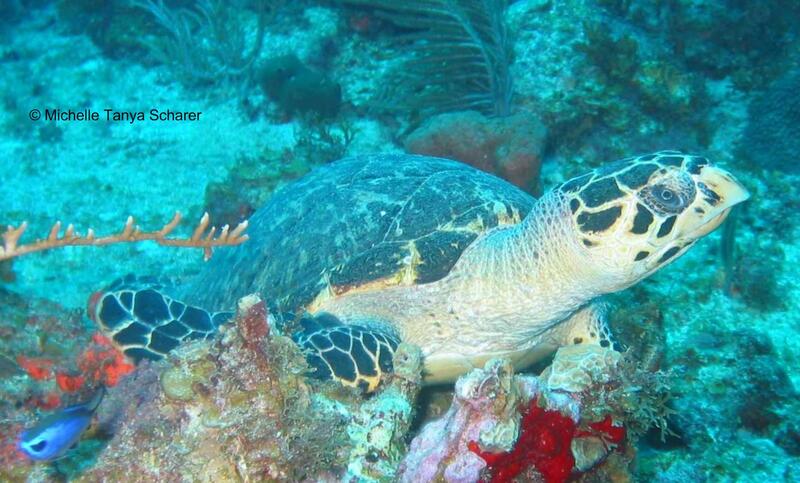
The hawksbill turtle is a small to medium-sized sea turtle with a brown carapace that has a distinctive tortoiseshell pattern for which the species is best known. Hawksbills are usually 76-89 cm (30-35 in) long, weighing 43-75 kg (95-165 lbs.). The carapace of the juvenile is almost heart-shaped, but that of the adult is shaped more like a shield. Scutes of the carapace overlap the next posterior scute, creating a shingled appearance in most age classes. This overlap is more prominent in younger individuals. The posterior edge of the carapace is usually serrated, and the plastron yellow. The head is elongated and tapers to a beak-like mouth, hence the name hawksbill.
Although belonging to a different genus, hawksbill sea turtles are superficially similar in appearance to loggerhead, green, and Kemp’s ridley sea turtles. The anterior-most costal scute on each side of the carapace touches the nuchal scute on loggerhead and Kemp’s ridley sea turtles, but does not on hawksbills. Green sea turtles have just one pair of prefrontal scales on the head, while hawksbill sea turtles have two pairs. However, the presence of a strong keel down the midline of the carapace, along with overlapping carapace scutes, is usually sufficient for distinguishing this species from other marine turtles.
This tropical species prefers shallow, hard-bottomed areas such as coral reefs and rock outcroppings. Juveniles are found in oceanic habitat associated with sargassum mats. Hawksbills may occasionally pass through Georgia waters as transients, but only four stranded hawksbills have been documented since stranding surveys began in 1980. Two hawksbills were found dead on Cumberland and Jekyll islands in 1998, one on Cumberland Island in 2008, and another on St. Simons Island in 2010.
Hawksbill sea turtles are generally omnivorous, feeding primarily on a wide array of invertebrates, particularly sponges.
Hawksbills breed in Central and South America both on the Atlantic and Pacific coasts, occasionally nesting in Florida between April and August. In addition, they nest in other areas of the Pacific and Indian Ocean. These turtles nest solitarily with few concentrated nesting sites. Their nests are often in heavily vegetated areas behind the high water line and dunes. Adult females from the Atlantic population are a minimum of 62.5 cm (25 in) straight carapace length and have been recorded as long as 90.0 cm (35 in). Nesting for an individual takes place on average of once every 2-3 years. There is an average of 130 eggs per nest, and 3-5 nests are deposited each nesting season.
None
Hawksbills can be found in the Atlantic, Pacific, and Indian oceans, primarily in tropical waters.
With a diet specializing in reef sponges, hawksbills may be particularly vulnerable to the slow decline of many of the world's coral reefs. Hawksbills rely on coral reef communities for food resources and habitat. Historically, commercial exploitation for the translucent scutes of the carapace, known as tortoiseshell, was the primary cause of the population decline. There is a continuing demand for tortoiseshell products and some Caribbean countries still allow a limited harvest. The illegal harvest of hawksbill turtles in considered significant in some areas. Most populations of nesting females are fewer than 500 individuals and are considered endangered.
Hawksbill sea turtles do not nest in Georgia and thus are not associated with any conservation lands in the state.
Unlike most sea turtle species which have specific regions or even specific beaches routinely used for nesting, hawksbill sea turtles nest in scattered locations throughout the tropics. This makes the use of standard sea turtle management protocols difficult to implement and population trend assessment difficult. Efforts to protect coral reef habitat and reduce commercial exploitation are necessary for the recovery of hawksbill populations.
Lutz, P.L., J.A. Musick, and J. Wyneken (editors). 2003. The Biology of Sea Turtles, Volume II. CRC Press. Boca Raton, Florida. 455 pages.
Lutz, P.L. and J.A. Musick (editors). 1997. The Biology of Sea Turtles. CRC Press. Boca Raton, Florida. 432 pages.
Ernst, C. H., J. E. Lovich, and R. W. Barbour. 1994. Turtles of the United States and Canada. Smithsonian Institution Press, Washington D.C. 578 pp.
Magnuson, J. J., K. A. Bjorndal, W. D. DuPaul, G. L. Graham, F. W. Owens, C. H. Peterson, P.C. H. Pritchard, J. I. Richardson, G. E. Saul, and C. W. West. 1990. Decline of the sea turtles: causes and prevention. National Acad. Press, Washington, D.C. 259 pp.
Mason, P. A. and K. M. Andrews. 2008. Kemp’s Ridley Sea Turtle Lepidochelys kempii. Pp. 453-455 in Jensen, J. B., C. D. Camp, J. W. Gibbons, and M. J. Elliott (eds.). Amphibians and Reptiles of Georgia. University of Georgia Press, Athens, GA. 575 pp.
National Marine Fisheries Service and U.S. Fish and Wildlife Service. 1993. Recovery Plan for Hawksbill Turtles in the U.S. Caribbean Sea, Atlantic Ocean, and Gulf of Mexico. National Marine Fisheries Service, St. Petersburg, FL.
Website of interest: http://www.seaturtle.org/nestdb/index.shtml?view=3
John B. Jensen, Mark Dodd, and Bradford Winn
28-Feb-11