

Loading profile. Please wait . . .
Clinopodium ashei (Weatherby) Small
Ohoopee Wild Basil




Federal Protection: No US federal protection
State Protection: Threatened
Global Rank: G3
State Rank: S2
Element Locations Tracked in Biotics: Yes
SWAP 2015 Species of Greatest Conservation Need (SGCN): Yes
SWAP 2025 Species of Greatest Conservation Need (SGCN): Yes
2025 SGCN Priority Tier: High Conservation Concern
Element Occurrences (EOs) in Georgia: 13
Habitat Summary for element in Georgia: Dune systems along the Ohoopee River
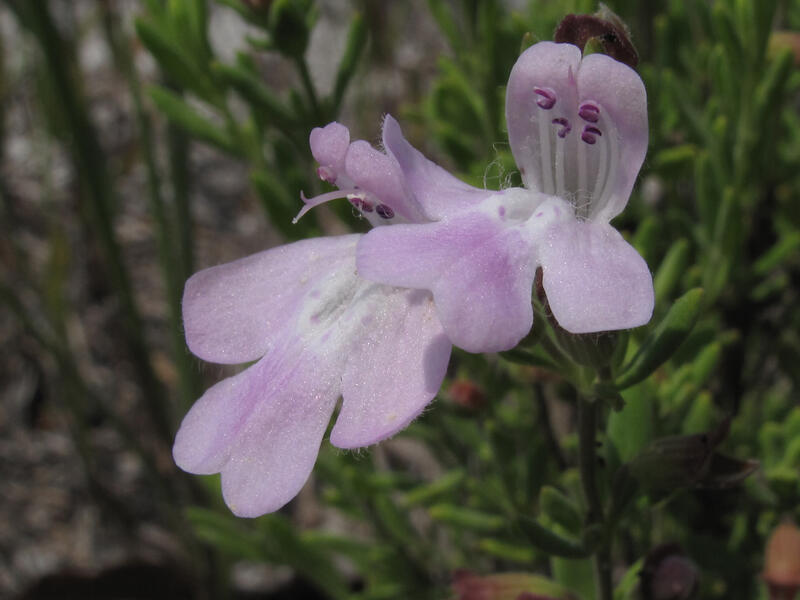
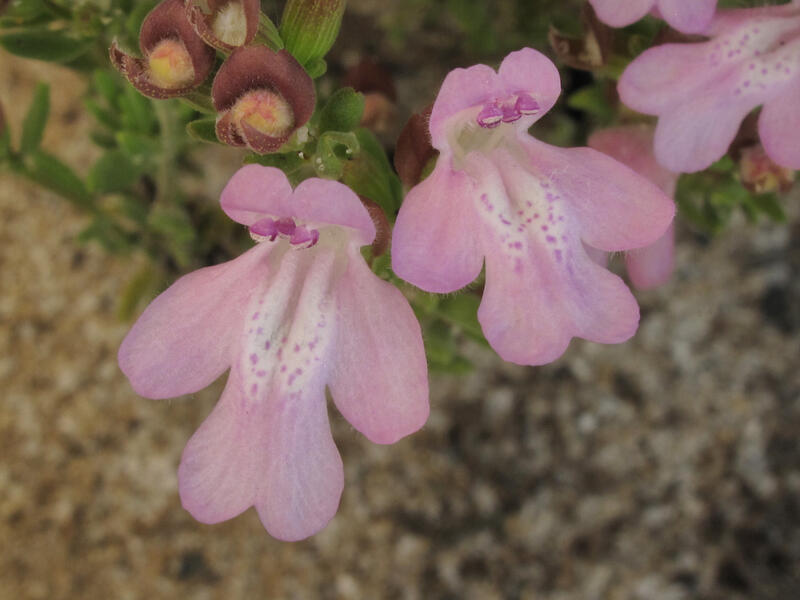
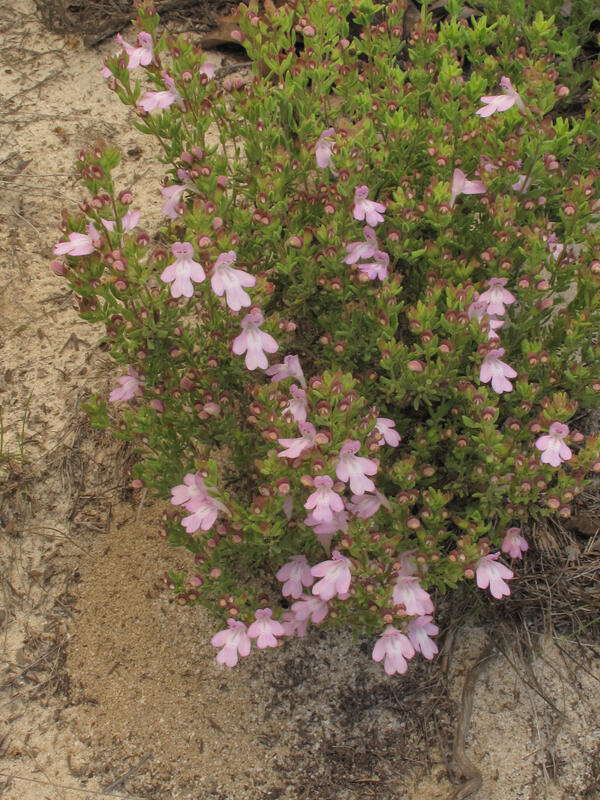
Compact, evergreen shrub less than 20 inches (50 cm) tall with peeling, gray bark and many stiff, erect, slightly 4-angled branches. Leaves are 0.25 - 0.5 inch (0.5 - 1 cm) long, in opposite clusters, gray-green, covered with fine hairs and tiny glistening glands; the leaf margins are tightly inrolled. The flower is 0.4 inch (1 cm) long, tubular with a nearly erect upper lip and a spreading, 3-lobed lower lip; pale pink to lavender-blue with purple dots on the lower lip. All parts of the plant smell strongly of basil.
Scarlet Wild Basil (Calamintha coccinea) is a taller shrub (20 - 30 inches, 50 - 76 cm tall) with a straggly growth form, nearly hairless leaves, and tubular, red or yellow, flowers. It also grows in the Ohoopee Dunes.
Radford’s Mint (Dicerandra radfordiana) occurs on ancient sand dunes along the lower Altamaha River near the coast. For more information, see: https://georgiabiodiversity.org/portal/profile?group=plants&es_id=19033
Florida Pennyroyal (Piloblephis rigida) occurs in sandy pine flatwoods, sandhills, and oak/saw palmetto scrubs on the Trail Ridge and barrier islands. For more information, see: https://www.georgiabiodiversity.org/portal/profile?group=plants&es_id=16630
Scrublands on sand dunes along and near the Ohoopee River, with Scarlet Wild Basil, Woody Goldenrod, and Sandhill Rosemary (https://georgiabiodiversity.org/natels/profile?es_id=20708).
Ohoopee Wild Basil (aka Ashe’s Savory) is a small, evergreen shrub, flowering throughout the growing season. Flowers of Calamintha are pollinated by bees, their lower lips providing a sturdy landing platform for this large insect. It often grows in otherwise unvegetated patches of sand, and releases allelopathic compounds that prevent germination of other species’ seeds, thus reducing competition in their vicinity.
Surveys are best conducted during flowering (spring–fall) although the growth form and leaves are recognizable year-round.
Southeastern portions of Georgia's Coastal Plain and central peninsular Florida.
Fire suppression. Conversion of habitat to pine plantations, developments, and agriculture.
| Threat 1 | Threat 2 | Threat 3 | |
|---|---|---|---|
| General Threat | Natural system modifications | Energy production & mining | Agriculture & aquaculture |
| Specific Threat | None | None | None |
Calaminthia ashei is ranked S2 by the Georgia Department of Natural Resources, indicating that it is imperiled in the state. It is listed as Threatened by the State of Georgia. Twelve populations are known, about half on conservation lands.
Apply prescribed fire in scrub every 5 - 10 years. Calamintha ashei is killed by fire but re-seeds abundantly afterwards. Protect scrub and sandhill habitats from development and conversion to pine plantations and agriculture.
Calabrese, L.B. and E.S. Menges. 2007. Do allelopathic properties of Calamintha ashei affect other Florida scrub plants? A comparison of intact vs. degraded scrub. Florida Scientist 70(3): 189-201. https://www.jstor.org/stable/24321385?seq=1#metadata_info_tab_contents
Carrington, M.E. 1999. Post-fire seedling establishment in Florida sand pine scrub. Journal of Vegetation Science 10(3): 403-412. https://onlinelibrary.wiley.com/doi/abs/10.2307/3237069
Chafin, L.G. 2007. Field guide to the rare plants of Georgia. State Botanical Garden of Georgia and University of Georgia Press, Athens.
Florida Wildflowers. 2020. Flower Friday: Ashe’s calamint, Calamintha ashei species profile. Florida Wildflower Foundation. https://flawildflowers.org/flower-friday-calamintha-ashei/
GADNR. 2019. Element occurrence records for Calamintha ashei. Georgia Department of Natural Resources, Wildlife Resources Division, Social Circle, Georgia.
NatureServe. 2019. Clinopodium ashei comprehensive report. NatureServe Explorer. Arlington, Virginia. http://explorer.natureserve.org/servlet/NatureServe?searchName=Calamintha%20ashei
Kral, R. 1983. A report on some rare, threatened, or endangered forest-related vascular plants of the South. Technical Publication R8-TP2. United States Forest Service, Atlanta.
Patrick, T.S., J.R. Allison, and G.A. Krakow. 1995. Protected plants of Georgia. Georgia Department of Natural Resources, Natural Heritage Program, Social Circle.
Shinners, L.H. 1962. Calamintha (Labiatae) in the southern United States. Sida 1(2): 69-75, 92-93. https://www.jstor.org/stable/41966195?seq=1#metadata_info_tab_contents
Tanrisever, N., N.H. Fischer, G.B. Williamson. 1988. Menthofurans from Calamintha ashei: effects on Schizachyrium scoparium and Lactuca sativa. Phytochemistry. 27, 8: 2523-2526. https://www.sciencedirect.com/science/article/pii/0031942288870213
Weakley, A.S. 2015. Flora of the southern and mid-Atlantic States. University of North Carolina Herbarium, University of North Carolina, Chapel Hill. http://www.herbarium.unc.edu/flora.htm
Weidenhamer, J., M.A. Menelaou, F.A. Macias, N.H. Fischer, D.R. Richardson and G.B. Williamson. 1994. Allelopathic potential of menthofuran monoterpenes from Calamintha ashei. Journal of Chemical Ecology, 20(12): 3345-3359. https://link.springer.com/article/10.1007/BF02033731
Linda G. Chafin
L. Chafin, Dec. 2007: original account.
K. Owers, Jan 2010: updated status and ranks, added pictures.
L. Chafin, Jan 2020: updated original account.