

Loading profile. Please wait . . .
Sorex albibarbis (Cope, 1862)
Eastern Water Shrew




Federal Protection: No US federal protection
State Protection: No Georgia state protection
Global Rank: G5
State Rank: SU
Element Locations Tracked in Biotics: Yes
SWAP 2015 Species of Greatest Conservation Need (SGCN): Yes
SWAP 2025 Species of Greatest Conservation Need (SGCN): Yes
2025 SGCN Priority Tier: Data Deficient
Element Occurrences (EOs) in Georgia: 1
Habitat Summary for element in Georgia: Mountainous, along small cold streams with thick overhanging riparian growth
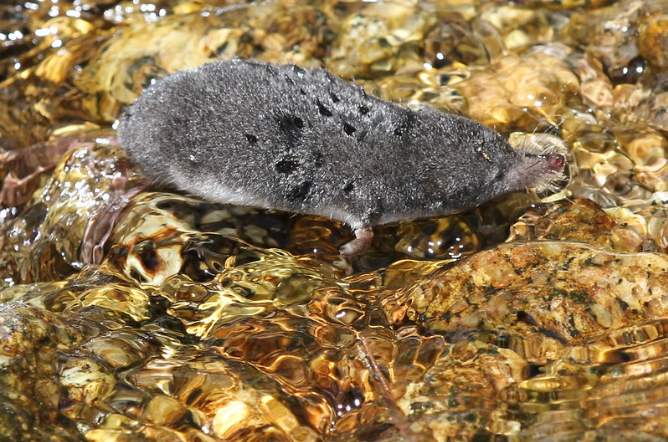
This species has a head and body length of 67-96 mm (3 ¼ in), tail length of 60-75 mm (2 ¾ in), hind foot length between 18-20 mm (¾ in), and weighs between 9-18 g ( ½ oz). The American water shrew is a relatively large shrew with dark coloration and has a long bicolored tail. Dorsal color is variable but often blackish, sometimes with white flecking, and silvery white or buffy brown on the ventral side. The tip of the tail is tufted with hair. This species has large feet, and the toes on the hind feet are partially webbed and fringed on sides with white hair.
The American water shrew is larger and longer-tailed than most shrews in its range. The marsh shrew (S. hendirii) is similar in body size but lacks fringes on feet and nearly always has a uniform tail. The American water shrew is a relatively advanced swimmer for a shrew and appears silvery in water due to air trapped in the fur, creating buoyancy. Hairs on feet also trap air, enabling it to run across water surfaces.
American water shrews prefer areas with high humidity, surrounded by heavy vegetation, logs, and rocks. They are commonly found in northern forests, along edges of streams, lakes, ponds, marshes, or bogs.
This species is predominantly insectivorous. They can dive to the bottom of streams to forage for aquatic insect larvae, especially caddisflies, crane flies, mayflies, and stoneflies. American water shrews may also feed on land, enjoying earthworms, snails, and fungi. This species feeds by holding food by its fore feet and thrusting the head upward.
American water shrews are solitary animals, active throughout the day and night, resting every 30 minutes of activity for approximately 1 hour. Females breed after their first winter (February- July) and may have 2-3 litters per year in the spring or summer. Average number of offspring per litter is 5. Nests are usually built from dried vegetations under logs or in tunnels for protection. This species is known for being aggressive and fighting is common among males. Males and females may also fight. Although these fights have not been proven to be of a territorial nature, they can be intense and head and tail injuries can occur. More research is needed to understand the full extent of this aggressive behaviour. American water shrews are short lived. Longevity record is 18 months in the wild.
Trapping water shrews is not highly recommended due to their high metabolism making them vulnerable to starvation and shock when in the trap. With that being said, the bait tube method has been the most successful trapping method due to their noninvasive nature. The bait tube also allows the shrew to eat while in the trap, minimizing risk of starvation.
American water shrews are found throughout much of Canada, Alaska, and northern mountain regions of the United States. This species is thought to be widespread, uncommon to fairly common in some areas.
The biggest threat to American water shrews is habitat fragmentation and habitat degradation from logging, agriculture, and road construction. These land use practices are negatively impacting riparian habitats favored by this species by creating stream pollution, acidification, and increased sedimentation.
This species is considered Critically Imperiled in Georgia.
Streamside management zones with effective Best Management Practices are critical around riparian areas where American water shrews occur. For more information on Best Management Practices for Georgia Agriculture, follow this link provided by the Georgia Soil and Water Conservation Commission: https://gaswcc.georgia.gov/best-management-practices-georgia-agriculture. Management impacts to water quality should be minimized or avoided in habitat associated with the water shrew. Additional surveys to adequately document this species’s presence are needed in the southern Appalachians.
Beneski, J., D. Stinson. 1987. Sorex palustris. Mammalian Species, 296: 1-6.
Calder, W. 1969. Temperature relations and underwater endurance of the smallest homeothermic diver, the water shrew. Comp. Biochem. Physiol, 30A: 1075-1082.
Carmen, M. 2001. "Sorex palustris" (On-line), Animal Diversity Web. Accessed March 27, 2020 at https://animaldiversity.org/accounts/Sorex_palustris/
Conaway, C. 1952. Life history of the water shrew (Sorex palustris). Amer. Midland Nat, 48: 2018-248.
Ford, W. M., and J. L. Rodrique. 2001. Soricid abundance, impartial overstory removal harvests, and riparian areas in an industrial forest landscape of the central Appalachians. Forest Ecology and Management, 152:159–168.
“How To Do A Water Shrew Survey.” Sussex Wildlife Trust, assets.sussexwildlifetrust.org.uk/how-to-do-a-water-shrew-survey.pdf.
Whitaker, L., W. Hamilton. 1998. Mammals of the Eastern United States. New York: Cornell University Press.
Sarah Krueger
S. Krueger, March 2020