

Loading profile. Please wait . . .
Croomia pauciflora (Nutt.) Torr.
Croomia




Federal Protection: No US federal protection
State Protection: Threatened
Global Rank: G3
State Rank: S2
Element Locations Tracked in Biotics: Yes
SWAP 2015 Species of Greatest Conservation Need (SGCN): Yes
SWAP 2025 Species of Greatest Conservation Need (SGCN): Yes
2025 SGCN Priority Tier: High Conservation Concern
Element Occurrences (EOs) in Georgia: 20
Habitat Summary for element in Georgia: Mesic hardwood forests, usually with Fagus and Tilia
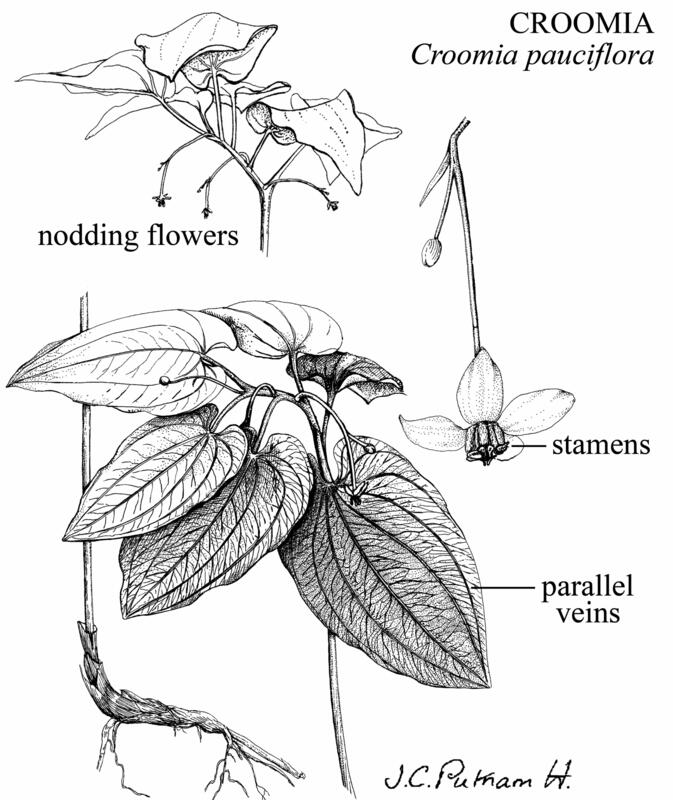
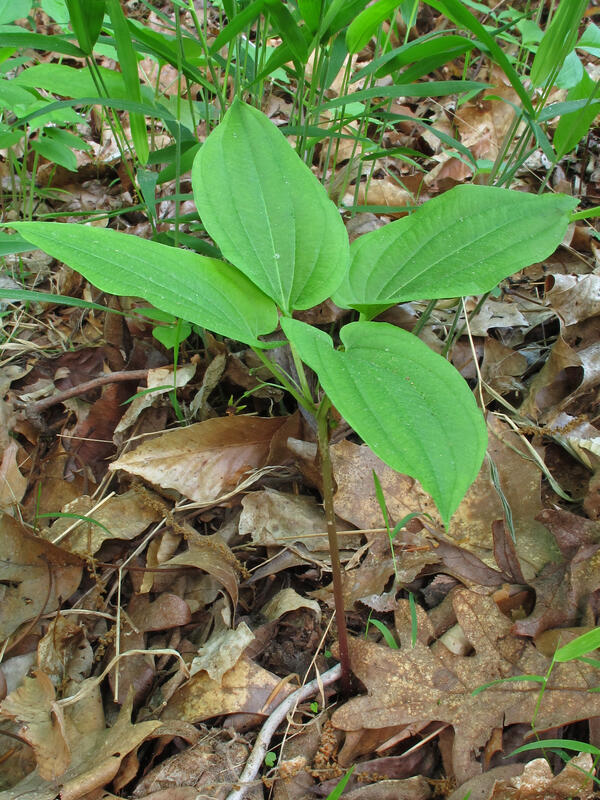
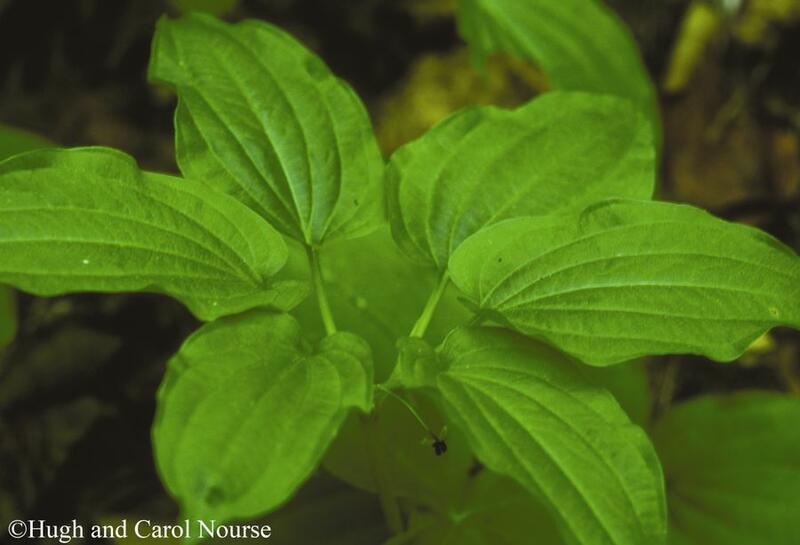
Perennial herb with an erect, somewhat fleshy stem about 6 inches (15 cm) tall (occasionally up to 11 inches / 28 cm), usually occurring in patches of several plants connected by underground stems (rhizomes). The leaves are up to 3 inches (8 cm) long, heart-shaped with parallel veins curving from the leaf base to the leaf tip; 4 - 7 leaves are clustered at the top of the stem; they are alternate but appear whorled or spiraled when viewed from above. The flowers are less than 0.4 inch (1 cm) wide, nodding below the leaves on stalks 0.4 - 1 inch (1 - 3 cm) long, with 4 green tepals and 4 maroon stamens with orange anthers. Fruits are oval, fleshy, green capsules, about 0.4 inch (1 cm) long; the seeds have elaiosomes.
Several other plant species in different plant families have similar leaves. Upright Carrion-flower (Smilax ecirrata) has erect but wiry stems and its leaves have conspicuous cross-veins. Wild Yam (Dioscorea spp.) is a climbing herbaceous vine with whorled or opposite leaves. Climbing Carrion-flower (Smilax herbacea) is an herbaceous vine with tendrils. Sarsaparilla-vine (Smilax pumila) is a ground vine with hairy leaves.
Croomia pauciflora is the only member of the Stemonaceae family in North America; its closest relatives occur in east Asia.
Rich, moist, deciduous forests in ravines and on river bluffs, often over limestone or marl.
Croomia is a perennial herb that dies back to the ground in late summer and produces new growth in the early spring. It reproduces both sexually and vegetatively, sending up shoots from a network of rhizomes; however, vegetative spread is slow, with rhizomes branching only every few years. Croomia also produces fruits and seeds, but nothing has been published about its pollinators. Its seeds have elaiosomes, fatty appendages that entice ants to remove the seeds to their nests, where the fatty part is fed to larvae and the seed itself is discarded in the ants' nutrient-rich waste pile.
Surveys are best conducted during flowering (late March–April) and fruiting (June–July), however, plants may be identified by their leaves until late summer.
Georgia, Alabama, the Florida Panhandle, and historically, Louisiana. It is rare throughout its range.
Logging and conversion of habitat to pine plantations. Canopy removal. Soil disturbance. Browsing by deer. Fire. Trampling by cattle and digging by feral hogs. Invasion by exotic pest plants, especially Japanese Honeysuckle.
| Threat 1 | Threat 2 | Threat 3 | |
|---|---|---|---|
| General Threat | Residential & commercial development | Climate change & severe weather | None |
| Specific Threat | None | None | None |
Croomia pauciflora is ranked S2 by the Georgia Department of Natural Resources, indicating that is imperiled in the state. It is listed as Threatened by the State of Georgia. About 18 populations have been documented in Georgia but only 3 of these occur on conservation lands and only 3 populations have been documented in the last 20 years.
Avoid logging on slopes and in ravines. Reduce the size of Georgia’s deer herd. Control exotic pest species especially Japanese Honeysuckle and feral hogs. Prevent prescribed fire in uplands from burning into ravines and onto moist slopes. Prevent grazing and cattle trampling in hardwood forests.
Chafin, L.G. 2007. Field guide to the rare plants of Georgia. State Botanical Garden of Georgia and University of Georgia Press, Athens.
Chafin, L.G. 2000. Field guide to the rare plants of Florida. Florida Natural Areas Inventory, Tallahassee.
Whetstone, R.D. 2000. Croomia pauciflora species account. Flora of North America, Vol. 22. Oxford University Press, New York. http://beta.floranorthamerica.org/Croomia_pauciflora
GADNR. 2020. Element occurrence records for Croomia pauciflora. Georgia Department of Natural Resources, Wildlife Resources Division, Social Circle, Georgia.
Harper, R.M. 1942. Croomia, a member of the Appalachian flora. Castanea 7: 109-113. https://www.jstor.org/stable/4031344
Kral, R. 1983. A report on some rare, threatened, or endangered forest-related vascular plants of the South. Technical Publication R8-TP2. United States Forest Service, Atlanta.
NatureServe. 2019. Croomia pauciflora comprehensive report. NatureServe Explorer. Arlington, Virginia. http://explorer.natureserve.org/servlet/NatureServe?searchName= Croomia%20pauciflora
Patrick, T.S., J.R. Allison, and G.A. Krakow. 1995. Protected plants of Georgia. Georgia Department of Natural Resources, Natural Heritage Program, Social Circle.
Rogers, G.K. 1982. The Stemonaceae in the southeastern United States. Journal of the Arnold Arboretum 63: 327-336. https://www.jstor.org/stable/43821643
Tomlinson, P.B. and E.S. Ayensu. 1968. Morphology and anatomy of Croomia pauciflora. Journal of the Arnold Arboretum 49: 260-275. https://www.jstor.org/stable/43781627
Weakley, A.S. 2015. Flora of the southern and mid-Atlantic States. University of North Carolina Herbarium, University of North Carolina, Chapel Hill. http://www.herbarium.unc.edu/flora.htm
Whetstone, R.D. 1984. Notes on Croomia pauciflora (Stemonaceae). Rhodora 86: 131-137. https://www.jstor.org/stable/23314301
Linda G. Chafin
L. Chafin, Sept. 2007: original account
K. Owers, Jan. 2010: updated status and ranks, added pictures
L. Chafin, Feb 2020: updated original account.