

Loading profile. Please wait . . .
Nestronia umbellula Raf.
Indian Olive




Federal Protection: No US federal protection
State Protection: Rare
Global Rank: G4
State Rank: S3
Element Locations Tracked in Biotics: Yes
SWAP 2015 Species of Greatest Conservation Need (SGCN): Yes
SWAP 2025 Species of Greatest Conservation Need (SGCN): No
2025 SGCN Priority Tier:
Element Occurrences (EOs) in Georgia: 56
Habitat Summary for element in Georgia: Mixed with dwarf shrubby heaths in oak-hickory-pine woods; often in transition areas between flatwoods and uplands
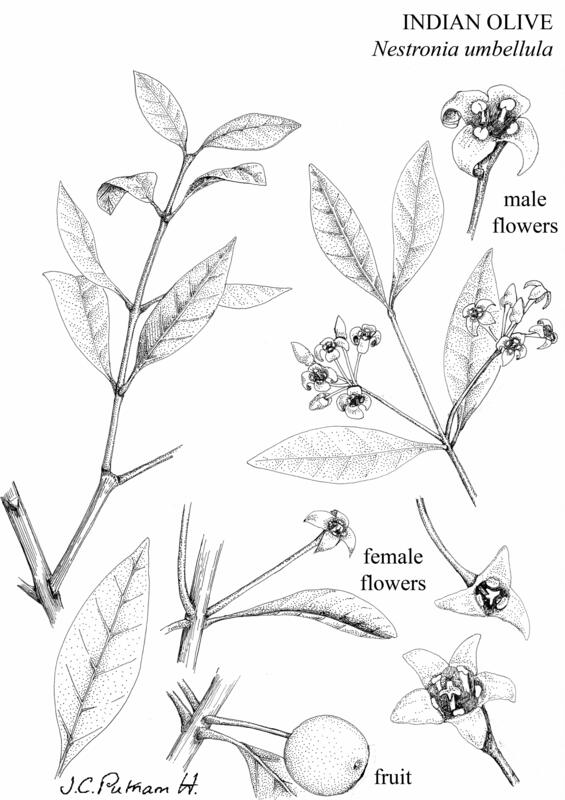
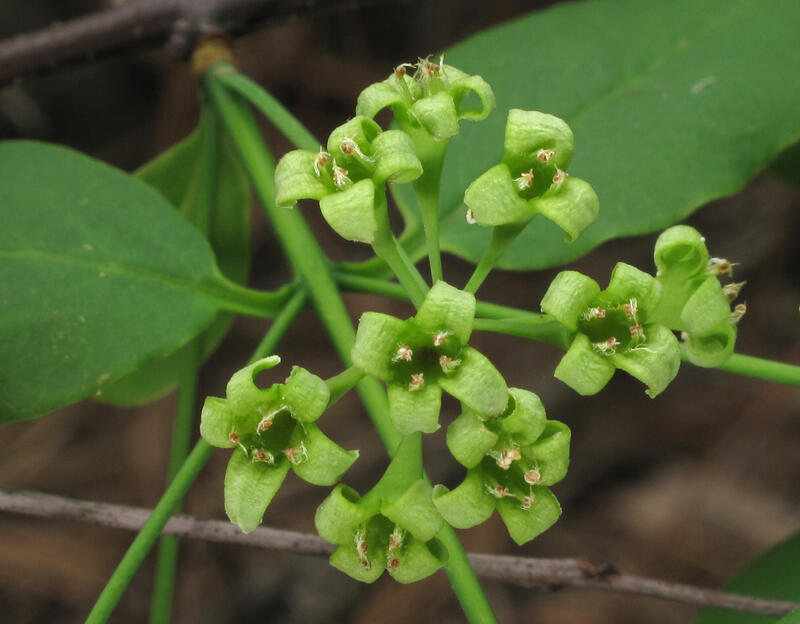
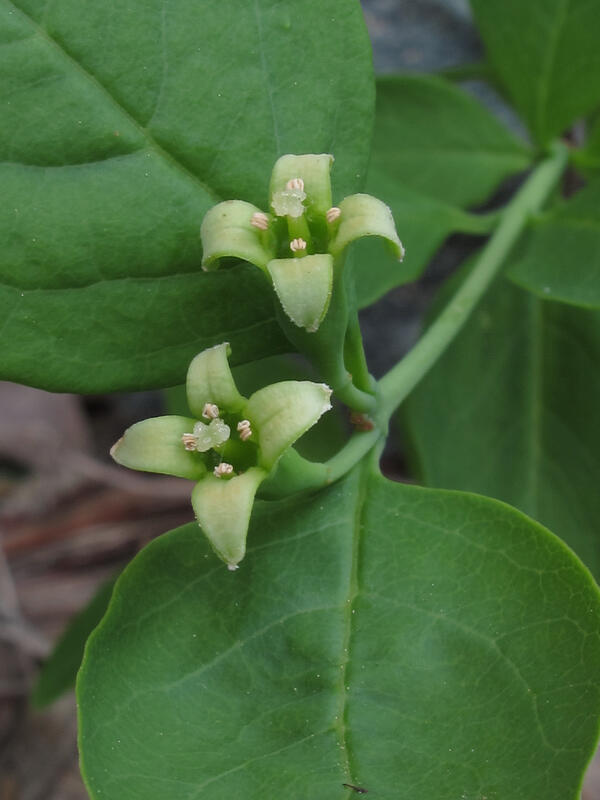
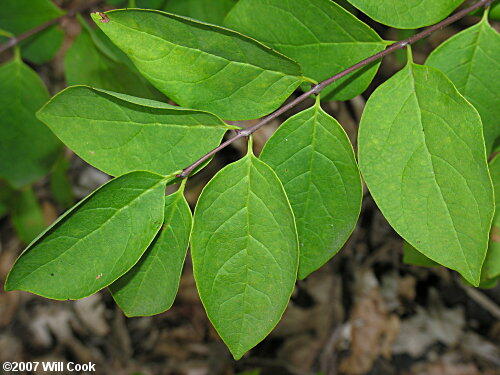
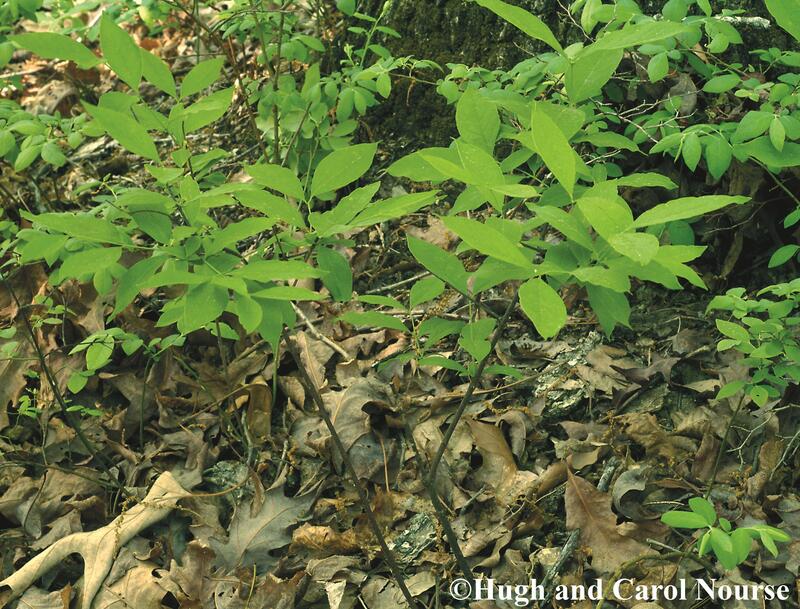
Semi-parasitic shrub with stems 2 - 4 feet (60 - 130 cm) tall, spreading by underground stems (rhizomes) to form small colonies of stems. Stems and branches are smooth and dark purplish-brown; the winter buds are dark brown, pointing outward, often at right angles to the stem. Leaves are 1 - 2.4 inches (3 - 6 cm) long, opposite, deciduous, oval to lance-shaped, upper surface dark yellow-green, lower surface pale green; leaves are deciduous and fall early in autumn. Female-flowered plants and male-flowered plants are in separate colonies; both types of flower are pale yellow-green, with 4 - 5 petal-like sepals and no petals; female flowers are solitary, male flowers are held in clusters of 3 - 11 flowers. Fruit is 0.6 inch (1.4 cm) wide, oval to round, fleshy, and greenish-yellow.
Blueberry (Vaccinium spp.) and Huckleberry (Gaylussacia spp.) often form low, shrubby colonies, but their leaves are alternate and their stems are green. Sweet-shrub (Calycanthus floridus) has opposite leaves, but it is a taller shrub and both leaves and twigs have a spicy smell.
Nestronia umbellula is the only species in the genus Nestronia.
Dry to moist, open, upland woods with mixed hardwood-pine canopy.
Indian Olive is dioecious – female and male flowers occur on separate plants. Because of habitat destruction and fragmentation, female-flowered plants and male-flowered plants are often in widely separated colonies, and sexual reproduction rarely occurs; reproduction is largely vegetative through spread of rhizomes. The flowers are visited by bees, flies, and beetles that are attracted to the nectar produced by a cushion-like nectary in the center of both female and male flowers and to the pollen presented by male flowers. However, fertilization rarely occurs and fruits are seldom seen. Indian Olive forms colonies of plants that may be several decades old although individual stems probably live less than 7 years. Indian Olive is a hemi-parasite; although it photosynthesizes, it extracts some nutrients from the roots of host plants, including oaks, pines, blackberries, and others.
Surveys are best conducted during flowering (late April–May) and fruiting (July).
Georgia, Alabama, Mississippi, South Carolina, North Carolina, Tennessee, Kentucky, and Virginia.
Logging, clearing, conversion of habitat to pine plantations and developments.
Nestronia umbellula is ranked S3 by the Georgia Department of Natural Resources, indicating that it is rare in Georgia. It is listed as Rare by the State of Georgia. Plants have been documented at more than 50 sites in Georgia since 1931, about half on conservation or military lands; only 16 have been confirmed since 2000. Many of these populations are small and have either female-flowered plants only or male-flowered plants only. Same-sex populations that are separated from populations of the other sex have little to no chance to reproduce except vegetatively, and fruits are rarely observed.
Avoid logging and mechanical clearing. Use fire or hand-clearing to create sunny openings in woodlands.
Chafin, L.G. 2007. Field guide to the rare plants of Georgia. State Botanical Garden of Georgia and University of Georgia Press, Athens.
Foote, L.E. and S.B. Jones, Jr. 1989. Native shrubs and woody vines of the southeast. Timber Press, Portland, Oregon.
GADNR. 2020. Element occurrence records for Nestronia umbellula. Georgia Department of Natural Resources, Wildlife Resources Division, Social Circle, Georgia.
Kral, R. 1983. A report on some rare, threatened, or endangered forest-related vascular plants of the South. Technical Publication R8-TP2. United States Forest Service, Atlanta.
Libby, G.W. and C.T. Bloom. 1998. Nestronia umbellula Rafinesque (Santalaceae) from the Highland Rim of Kentucky. Castanea 63: 161-164. https://www.jstor.org/stable/pdf/4034071.pdf?refreqid=excelsior%3A432cc8e1b820ef5a2aeba45f40da9bac
NatureServe. 2019. Nestronia umbellula comprehensive report. NatureServe Explorer. Arlington, Virginia. http://explorer.natureserve.org/servlet/NatureServe?searchName= Nestronia+umbellula
Nickrent, D.L., V. Malécot, R. Vidal-Russell, and J.P. Der. 2010. A revised classification of Santalales. Taxon 59: 538-558. https://onlinelibrary.wiley.com/doi/abs/10.1002/tax.592019
Nickrent, D.L. Nestronia umbellula species account. Flora of North America, vol. 12. Oxford University Press, New York. http://www.efloras.org/florataxon.aspx?flora_id=1&taxon_id=220009214
Patrick, T.S., J.R. Allison, and G.A. Krakow. 1995. Protected plants of Georgia. Georgia Department of Natural Resources, Wildlife Resources Division, Social Circle.
Radford, A.E., H.E. Ahles, and C.R. Bell. 1968. Manual of the vascular flora of the Carolinas. University of North Carolina Press, Chapel Hill.
Sowers, F.C. 1980. Why conjurer’s nut? A look at reproductive biology in Nestronia umbellula Rafinesque, a rare plant. M.S. Thesis, University of North Carolina, Charlotte.
Weakley, A.S. 2015. Flora of the southern and mid-Atlantic States. University of North Carolina Herbarium, University of North Carolina, Chapel Hill. http://www.herbarium.unc.edu/flora.htm
Wentworth, C. 2013. Plant of the Week: Indian Olive (Nestronia umbellula Raf.) U.S. Forest Service. https://www.fs.fed.us/wildflowers/plant-of-the-week/nestronia_umbellula.shtml
Linda G. Chafin
L. Chafin, Jul 2008: original account
K. Owers, Feb 2010: added pictures
L. Chafin, Mar 2020: updated original account.