


Loading profile. Please wait . . .
Melanoplus foxi Hebard, 1923
Fox's Short-wing grasshopper




Federal Protection: No US federal protection
State Protection: No Georgia state protection
Global Rank: GU
State Rank: S1
Element Locations Tracked in Biotics: Yes
SWAP 2015 Species of Greatest Conservation Need (SGCN): No
SWAP 2025 Species of Greatest Conservation Need (SGCN): Yes
2025 SGCN Priority Tier: Highest Conservation Concern
Element Occurrences (EOs) in Georgia: 4
Habitat Summary for element in Georgia: Sandhills and mixed forests with scrubby undergrowth
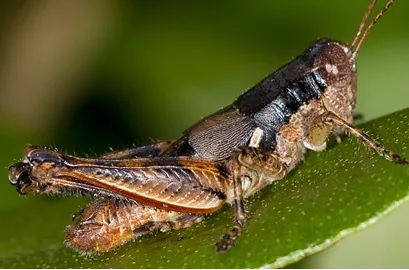
A small grasshopper (10-27 mm in length). Brownish in color with black stripe extending laterally from behind the eye down the thorax. Hind tibia are blueish-gray. The male cerci are slender in distal two-thirds, and slightly enlarged and angulate ventro-distad. This species has short wings and is incapable of flight, but is a very strong jumper.
Similar to some other species of the Melanoplus puer species group (Sensu Lato) in southern Georgia, but can be distiguished from them by the shape of the male cerci and internal genitalia.
Scrubby undergrowth among longleaf pine woodlands and savannas.
Probably a generalist herbivore.
Like all Orthopterans, the Melanoplus foxi undergoes an incomplete metamorphosis. Adults can be found throught the summer months.
Walk through suitable habitat to flush Melanoplus from resting. Catch specimens with a net to confirm ID.
Melanoplus foxi is endemic to the North American Coastal Plain of Georgia.
Timber cutting of the savannas where these grasshoppers are found is their most immediate threat. Also, absence of periodic fires needed to maintain the habitat are likely a contributing factor to declines.
| Threat 1 | Threat 2 | Threat 3 | |
|---|---|---|---|
| General Threat | Residential & commercial development | Natural system modifications | Agriculture & aquaculture |
| Specific Threat | None | None | None |
Melanoplus foxi is endemic to the North American Coastal Plain of Georgia. There are currently a few exant populatations known, some of which are on public land.
Protect savannas where this species is known to occur from development and timber harvests. Reintroduce fire to retain an open canopy, where possible.
Hubble, T.H. 1932. A revision of the Puer Group of the North American genus Melanoplus with remarks on the taxonomic value of the concealed male genitalia in the Cyrtacanthacrininae. (Orthoptera: Acrididae) Miscellaneous Publications of the University of Michigan Museum of Zoology No. 23. 64 pp.
Woller, D.A. and J.G. Hill 2015. Melanoplus foxi Hebard, 1923 (Orthoptera: Acrididae: Melanoplinae): recently rediscovered after almost 60 years using historical field notes. Transactions of the American Entomological Society 141: 545-574.
JoVonn G. Hill and Brady S. Dunaway
12/5/2019