

Loading profile. Please wait . . .
Marshallia trinervia (Walt.) Trel.
Broadleaf Barbara's-buttons




Federal Protection: No US federal protection
State Protection: No Georgia state protection
Global Rank: G3
State Rank: S1S2
Element Locations Tracked in Biotics: Yes
SWAP 2015 Species of Greatest Conservation Need (SGCN): Yes
SWAP 2025 Species of Greatest Conservation Need (SGCN): Yes
2025 SGCN Priority Tier: High Conservation Concern
Element Occurrences (EOs) in Georgia: 2
Habitat Summary for element in Georgia: Streamsides in open, bouldery gravel bars and washed, sandy banks
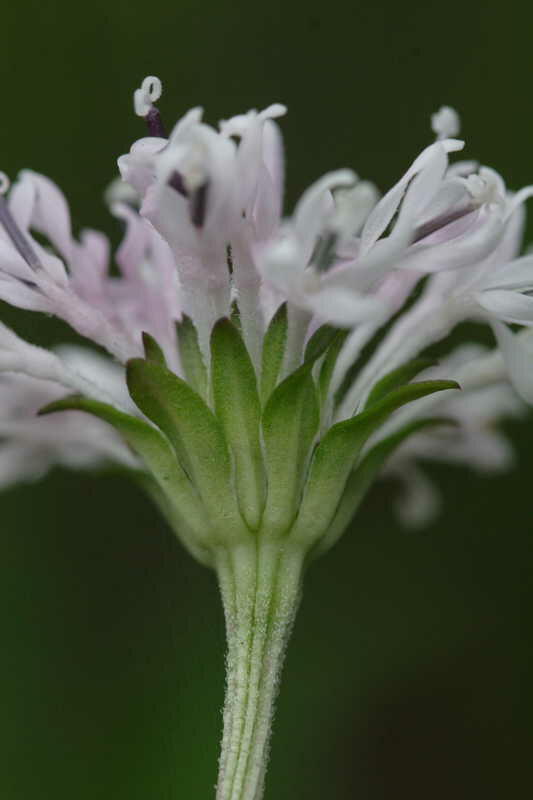
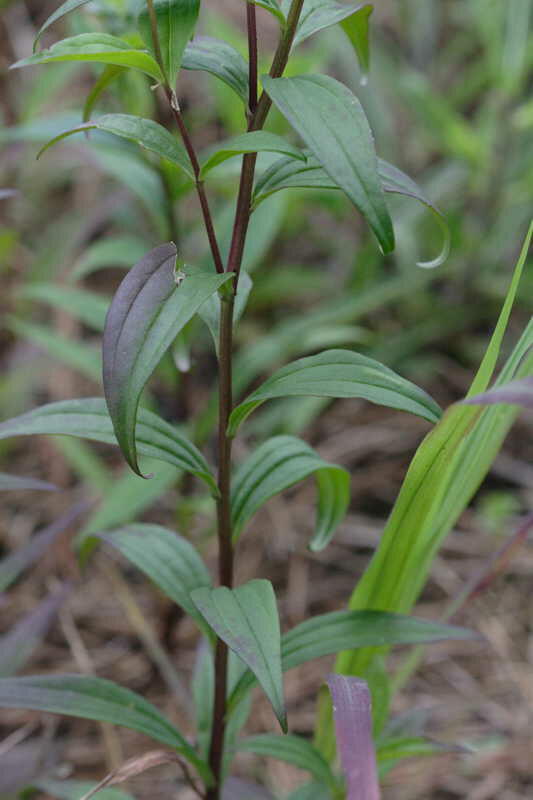
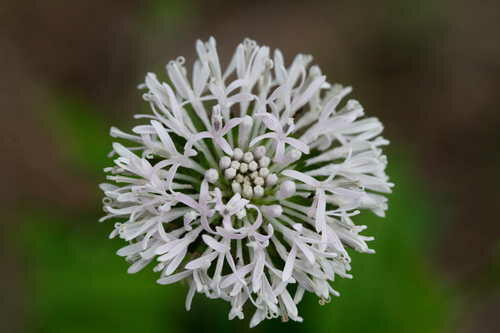
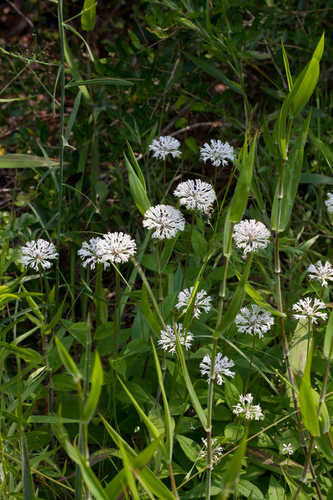
Perennial herb with erect, hairless stems 16 - 32 inches (40 - 80 cm) tall with 10 - 25 internodes. Leaves are 1.5 - 4 inches long and 0.4 - 1 inch wide (4 - 10 cm and 1.1 - 3 cm wide), more or less the same size throughout, alternate, oval to lance-shaped, strongly 3-nerved, thin-textured, hairless, and without stalks. Flower heads are 1 - 5 on each plant, 0.7 - 1.3 inches (2 - 3.3 cm) across, on stalks up to 6 inches (15 cm) tall or more. The heads have no ray flowers and consist of many, pale pink to white, conspicuously 5-lobed, disk flowers with long tubes. Each head is surrounded at the base by 2 whorls of green, pointed phyllaries about 0.3 inch (8 - 12 mm) long. Fruits are dry, seed-like, 5-angled, with 10 ribs, often hairy, and tipped with 5 - 6 pointed scales.
There are five other species of Marshallia in Georgia; all have very similar flower heads. Marshallia trinervia is distinguished by having most of its leaves on the stems, rather than clustered at the base of the stem in a rosette. M. trinervia leaves are oval, while most other species of Marshallia have narrower, linear leaves.
Coosa Barbara's Buttons (Marshallia mohrii, Georgia and U.S. Threatened) occurs in Coosa River Valley prairies and associated roadsides and rights-of-way in northwest Georgia. For more information, see: https://www.georgiabiodiversity.org/portal/profile?group=plants&es_id=20983
Pineland Barbara’s Buttons (Marshallia ramosa, Georgia Rare) occurs in the Fall Line region in open forests over ultramafic rock and in the Coastal Plain on Altamaha Grit outcrops. For more information, see: https://www.georgiabiodiversity.org/portal/profile?group=plants&es_id=19910
Marshallia trinervia occurs in moist hardwood forests along streams, often in rocky sites.
Marshallia trinervia is a perennial herb that reproduces sexually by seed and also vegetatively, forming colonies by the spread of short rhizomes. Its flowers are pollinated by beetles, butterflies, and other small insects, and must be cross-pollinated in order to set viable fruit. To avoid self-pollination, the disk flowers on a given plant produce pollen before that plant's stigmas become receptive. The seeds are probably dispersed by means of the pointed scales at the tip of the fruit which attach to fur and feathers.
Although the broad leaves evenly distributed along the stem are distinctive among Marshallia species, they resemble many other forest herbs’ leaves. Surveys are best conducted during flowering, in July, when plants are most conspicuous and most easily identified.
Georgia, west to Louisiana and north to Tennessee and North Carolina. It is rare throughout its range.
Marshallia trinervia is threatened by development, logging, road-building and road maintenance, and other types of clearing in streamside zones. It is also threatened by overbrowsing by deer and by digging by wild hogs.
| Threat 1 | Threat 2 | Threat 3 | |
|---|---|---|---|
| General Threat | Human intrusions & disturbance | Natural system modifications | Invasive & other problematic species, genes & diseases |
| Specific Threat | None | None | None |
Marshallia trinervia is ranked S1S2 by the Georgia Department of Natural Resources, indicating that it is either imperiled or critically imperiled in the state. There are only two documented populations, and only one of these occurs on conservation land.
Protect forested streamsides from logging and other clearing and conversion to pastures, developments, or other uses. Avoid road and bridge construction near known populations.
Channell, R.B. 1957. A revisional study of the genus Marshallia (Compositae). Contributions of the Gray Herbarium 181:41-132. https://www.jstor.org/stable/41764637?seq=1
Cronquist, A. 1980. Vascular flora of the southeastern United States, Vol. 1, Asteraceae. University of North Carolina Press, Chapel Hill.
GADNR. 2020. Element occurrence records for Marshallia trinervia. Georgia Department of Natural Resources, Wildlife Resources Division, Social Circle, Georgia.
NatureServe. 2020. Species account for Marshallia trinervia. NatureServe Explorer. NatureServe, Arlington, Virginia. https://explorer.natureserve.org/Taxon/ELEMENT_GLOBAL.2.131415/Marshallia_trinervia
Watson, L.E. 2006. Marshallia trinervia. Flora of North America. Vol. 21, Magnoliophyta: Asteridae, Part 8: Asteraceae, Part 3. Oxford University Press, New York. http://www.efloras.org/florataxon.aspx?flora_id=1&taxon_id=250067164
Watson, L.E. and J.R. Estes. 1990. A biosystematic and phenetic analysis of morphological variation in Marshallia (Asteraceae). Systematic Botany 15: 403-414. https://www.jstor.org/stable/2419354?seq=1#metadata_info_tab_contents
Weakley, A.S. 2015. Flora of the southern and mid-Atlantic States. University of North Carolina Herbarium, University of North Carolina, Chapel Hill. http://www.herbarium.unc.edu/flora.htm
Linda G. Chafin
Linda G. Chafin, 15 November 2019: original account