Loading profile. Please wait . . .
Silene catesbyi Walter
Fringed Campion




Federal Protection: Listed Endangered
State Protection: Endangered
Global Rank: G2
State Rank: S2
Element Locations Tracked in Biotics: Yes
SWAP 2015 Species of Greatest Conservation Need (SGCN): Yes
SWAP 2025 Species of Greatest Conservation Need (SGCN): Yes
2025 SGCN Priority Tier: Highest Conservation Concern
Element Occurrences (EOs) in Georgia: 30
Habitat Summary for element in Georgia: Mesic deciduous forests
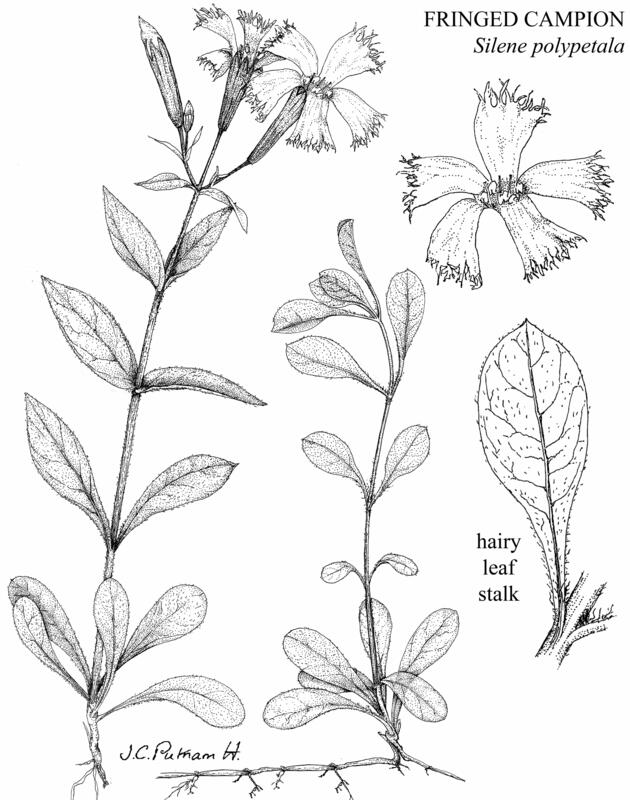
Silene polypetala (synonym Silene catesbaei) is a perennial herb, rooting at nodes and tips of runners and forming mats. Stems are erect, 4 - 16 inches (10 - 40 cm) tall, with long, soft hairs; rising from evergreen rosettes that form at the tips of runners. Leaves are 0.8 - 3.5 inches (2 - 9 cm) long and 0.4 - 1 inch (1 - 2.5 cm) wide, widest above the middle, opposite; the upper surface has raised veins and is smooth except for short hairs on the margins and long hairs on the leaf stalks. Flowers are 1 - 2 inches (3 - 5 cm) wide, pink with 5 deeply fringed petals. Fruits are oval capsules about 0.4 inch (1 cm) long, with a toothed opening at the tip.
Many wildflowers have rosettes of leaves connected by creeping stems; vegetatively, Fringed Campion is distinguished by the small mats of rosettes and the paired, hairy leafstalks. In flower, Fringed Campion is unmistakable.
There are five rare species of Silene in Georgia:
Carolina Catchfly (Silene caroliniana) occurs on granite outcrops and in sandhills near the Ogeechee and Savannah Rivers. For more information, see: http://beta.floranorthamerica.org/Silene_caroliniana
Ovate Catchfly (Silene ovata) occurs in rich, deciduous forests over limestone or amphibolite in the Coastal Plain and in Fall Line ravines. In the mountains, it occurs in high-elevation, rocky, oak forests, usually over mafic rocks. For more information, see: https://www.georgiabiodiversity.org/portal/profile?group=plants&es_id=17459
Fringed Campion (Silene polypetala, synonym Silene catesbaei) occurs in moist deciduous forests in the upper Coastal Plain and southwest Georgia. For more information, see: https://www.georgiabiodiversity.org/portal/profile?group=plants&es_id=18409
Royal Catchfly (Silene regia) occurs in limestone cedar glades, rocky openings in woodlands over basic soils, Coosa Valley prairies, and rights-of-way through these habitats in northwest Georgia. For more information, see: https://www.georgiabiodiversity.org/portal/profile?group=plants&es_id=16033
Roundleaf Catchfly (Silene rotundifolia) occurs on moist sandstone ledges and cliffs in northwest Georgia. For more information, see: http://beta.floranorthamerica.org/Silene_rotundifolia
Mature hardwood forests with low-acid soils on moist, mid- to lower slopes and small stream terraces.
Fringed Campion reproduces sexually by seed as well as vegetatively by the growth of ground-hugging, horizontal stems (stolons) that form leaf rosettes at their tips; the stolons eventually decay and the rosettes become established as separate, though genetically identical, plants. The showy flowers are probably visited by a variety of insects, such as bees and butterflies, which probe the flowers for nectar and potentially carry pollen to nearby plants. The flowers have evolved a method to reduce the chances of self-pollination: the stamens on a given flower mature before that flower’s pistils become receptive to pollen. Even so, vegetative reproduction is extremely important to this species. It is likely that most patches of plants consist of a single genetic stock.
Surveys are best conducted during flowering (mid-March–May); although rosettes are evergreen, non-flowering plants are difficult to find and identify.
Georgia (Flint, Ocmulgee, and Chattahoochee River drainages) and Florida (Apalachicola River drainage in the Florida Panhandle).
Logging and clearing of mature hardwood slopes. Erosion from upslope developments. Invasion by exotic pest plants. Overbrowsing by deer. Rooting by feral hogs.
| Threat 1 | Threat 2 | Threat 3 | |
|---|---|---|---|
| General Threat | Biological resource use | Invasive & other problematic species, genes & diseases | Residential & commercial development |
| Specific Threat | None | None | None |
Silene polypetala is ranked S2 by the Georgia Department of Natural Resources, indicating that the species is imperiled in Georgia. It is listed as Endangered by the State of Georgia and the U.S. Fish and Wildlife Service. Thirty-five populations have been documented in Georgia, 16 confirmed since 2000, but only a few sites are protected.
Avoid logging and other clearing on slopes and maintain intact hardwood canopy. Protect slopes from erosion from upslope developments. Avoid fire, raking, and other disturbance to soil and leaf litter. Eradicate exotic pest plants especially Japanese Honeysuckle, Autumn Olive, Thorny Olive, Chinese Privet, and Nandina. Reduce the size of Georgia’s deer herd. Eradicate feral hogs.
Burleigh, J.G. and T.P. Holtsford. 2003. Molecular systematics of the eastern North American Silene (Caryophyllaceae): evidence from nuclear ITS and chloroplast TRNL intron sequences. Rhodora 105 (921): 76-90. https://www.jstor.org/stable/23313589
Chafin, L.G. 2007. Field guide to the rare plants of Georgia. State Botanical Garden of Georgia and University of Georgia Press, Athens.
Coile, N.C. 1992. Pinks, pinked, and pink! Botany Circular No. 26. Florida Department of Agriculture and Consumer Services, Division of Plant Industry, Gainesville. https://ufdc.ufl.edu/UF00002309/00001
GADNR. 2020. Element occurrence records for Silene polypetala. Georgia Department of Natural Resources, Wildlife Resources Division, Social Circle, Georgia.
Kral, R. 1983. A report on some rare, threatened, or endangered forest-related vascular plants of the South. Technical Publication R8-TP2. United States Forest Service, Atlanta.
Morton, J.K. 2005. Silene polypetala species account. Flora of North America, Vol. 5. Oxford University Press, New York. http://beta.floranorthamerica.org/Silene_polypetala
NatureServe. 2020. Silene polpetala species account. NatureServe Explorer. NatureServe, Arlington, Virginia. https://explorer.natureserve.org/Taxon/ELEMENT_GLOBAL.2.131455/Silene_polypetala
Patrick, T.S., J.R. Allison, and G.A. Krakow. 1995. Protected plants of Georgia. Georgia Department of Natural Resources, Natural Heritage Program, Social Circle.
USFWS. 2020. Fringed Campion (Silene polypetala) species profile and related documents. U.S. Fish and Wildlife Service. https://ecos.fws.gov/ecp0/profile/speciesProfile?sId=3738
Ward, D.B. 2006. Silene catesbaei, rather than Silene polypetala, the correct name of the endangered Fringed Catchfly. Castanea 71(4): 324-329. https://www.jstor.org/stable/4034223
Weakley, A.S. 2015. Flora of the southern and mid-Atlantic States. University of North Carolina Herbarium, University of North Carolina, Chapel Hill. http://www.herbarium.unc.edu/flora.htm
Linda G. Chafin
L. Chafin, Aug. 2008: original account.
K. Owers, Feb. 2010: added pictures.
L. Chafin, May 2020: updated original account.
G. Krakow, Dec. 2022: Updated federal and state status to Endangered under "Georgia Conservation Status" section.