

Loading profile. Please wait . . .
Sageretia minutiflora (Michx.) C. Mohr
Small-flowered Buckthorn




Federal Protection: No US federal protection
State Protection: Threatened
Global Rank: G3G4
State Rank: S2
Element Locations Tracked in Biotics: Yes
SWAP 2015 Species of Greatest Conservation Need (SGCN): Yes
SWAP 2025 Species of Greatest Conservation Need (SGCN): Yes
2025 SGCN Priority Tier: High Conservation Concern
Element Occurrences (EOs) in Georgia: 16
Habitat Summary for element in Georgia: Calcareous bluff forests; maritime forests over shell mounds
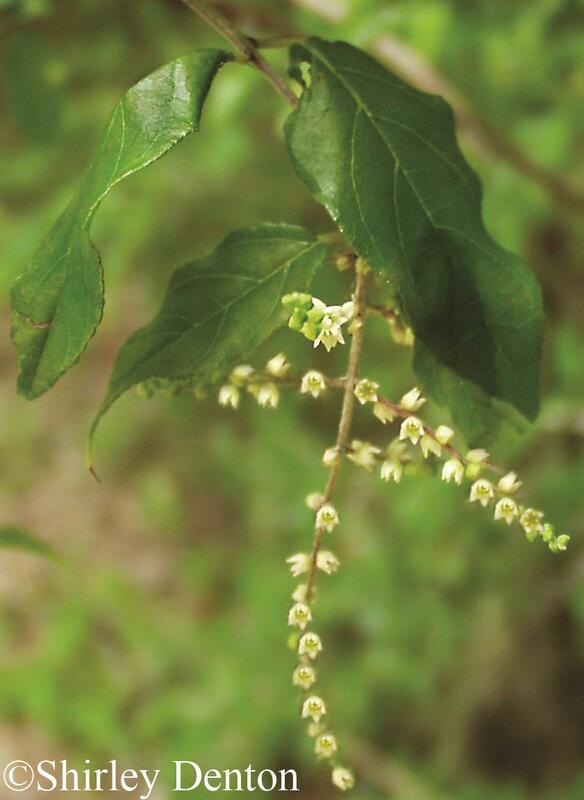
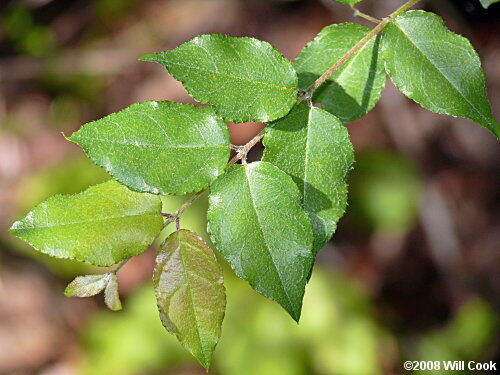
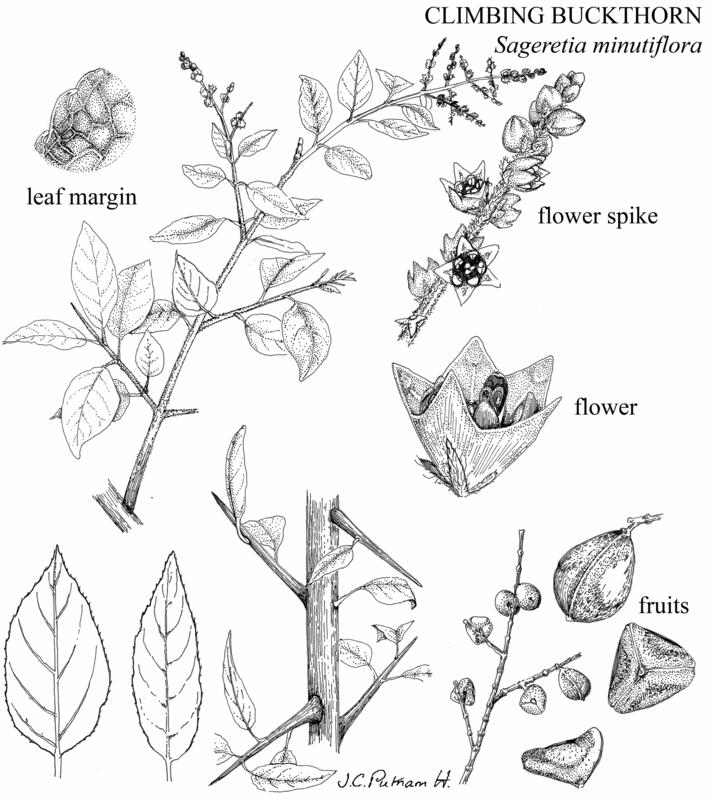
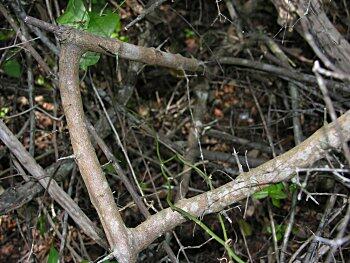
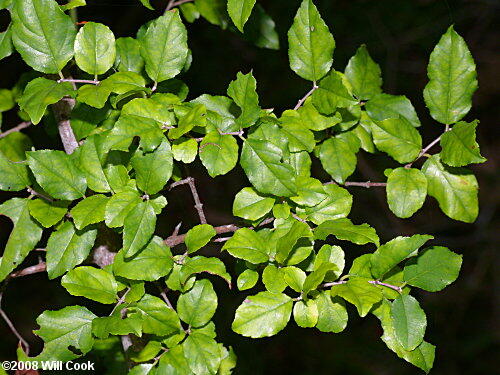
Shrub up to 26 feet (8 meters) tall or taller, straggly with sprawling and climbing stems up to 1 inch (3 cm) in diameter, covered with long hairs and bearing short, thorn-tipped branchlets. Leaves are 0.2 - 2.4 inches (0.5 - 6 cm) long and up to 0.8 inch (2 cm) wide, opposite or subopposite, oval or elliptic, dark green, glossy, somewhat leathery, hairless when mature, with finely toothed margins; deciduous in late winter. Flowers are in leafy spikes up to 1.6 inches (4 cm) long arising near the ends of branches; each flower is tiny with 5 white petals that are shorter than the sepals and strongly and sweetly fragrant. The fruit is rounded and berry-like, up to 0.3 inch (5 - 8 mm) long, changing from green, to orange, to purplish-black, and splitting into 3 leathery nutlets by the end of winter.
Climbing Buckthorn is distinguished from similar shrubs by its climbing habit, opposite leaves, and thorn-tipped branches. Yaupon (Ilex vomitoria) is an evergreen shrub that often occurs with Climbing Buckthorn; it lacks thorns and its leaves are smaller and alternate. Also compare with Florida Wild Privet (Forestiera segregata), https://www.georgiabiodiversity.a2hosted.com/portal/profile?group=plants&es_id=21613on this website.
None in Georgia.
Limestone bluffs near the coast, forested shell mounds on barrier islands, and dry evergreen maritime hammocks along stream banks and coastal marshes.
There is little information reported about the life history of Climbing Buckthorn. Its fragrant, white flowers are pollinated by insects, and its fruits are eaten by birds that disperse the seeds.
Surveys are best conducted during flowering (August–September) and fruiting (September–November). Plants may also be identified by the straggly stems that climb on and into other plants, and by their opposite, leathery leaves and thorn-tipped branchlets.
Georgia, Florida, Alabama, Mississippi, South Carolina, and North Carolina
Clearing and conversion of coastal shell mounds and maritime forests to residential and commercial developments.
| Threat 1 | Threat 2 | Threat 3 | |
|---|---|---|---|
| General Threat | Transportation & service corridors | Biological resource use | Human intrusions & disturbance |
| Specific Threat | None | None | None |
Sageretia minutiflora is ranked S2 by the Georgia Department of Natural Resources, indicating that it is imperiled in the state. It is listed as Threatened by the State of Georgia. Sixteen populations are known, 8 on public or private conservation lands and one military base.
Protect maritime hammocks, shell mounds, and other coastal habitats from development and clearcutting.
Chafin, L.G. 2007. Field guide to the rare plants of Georgia. State Botanical Garden of Georgia and University of Georgia Press, Athens.
Cook, W. 2008. Small-flowered Buckthorn (Sageretia minutiflora). Carolina Nature: Trees, Shrubs, and Woody Vines of North Carolina. https://www.carolinanature.com/trees/sami.html
Foote, L.E. and S.B. Jones, Jr. 1989. Native shrubs and woody vines of the southeast. Timber Press, Portland, Oregon.
GADNR. 2020. Element occurrence records for Sageretia minutiflora. Georgia Department of Natural Resources, Wildlife Resources Division, Social Circle, Georgia.
Godfrey, R.K. 1988. Trees, shrubs, and woody vines of northern Florida and adjacent Georgia and Alabama. University of Georgia Press, Athens.
Kral, R. 1983. A report on some rare, threatened, or endangered forest-related vascular plants of the South. Technical Publication R8-TP2. United States Forest Service, Atlanta.
NatureServe. 2020. Species account for Sageretia minutiflora. NatureServe Explorer. NatureServe, Arlington, Virginia. https://explorer.natureserve.org/Taxon/ELEMENT_GLOBAL.2.148948/Sageretia_minutiflora
Nesom, G.L. 2016. Sageretia minutiflora species account. Flora of North America, vol. 12. http://beta.floranorthamerica.org/Sageretia_minutiflora
Patrick, T.S., J.R. Allison, and G.A. Krakow. 1995. Protected plants of Georgia. Georgia Department of Natural Resources, Natural Heritage Program, Social Circle.
Weakley, A.S. 2015. Flora of the southern and mid-Atlantic States. University of North Carolina Herbarium, University of North Carolina, Chapel Hill. http://www.herbarium.unc.edu/flora.htm
Linda G. Chafin
L.Chafin, Aug. 2008: original account
D.Weiler, Jan. 2010: added pictures
L. Chafin, May 2020: updated original account.