

Loading profile. Please wait . . .
Hydrastis canadensis L.
Goldenseal




Federal Protection: No US federal protection
State Protection: Endangered
Global Rank: G3G4
State Rank: S2
Element Locations Tracked in Biotics: Yes
SWAP 2015 Species of Greatest Conservation Need (SGCN): Yes
SWAP 2025 Species of Greatest Conservation Need (SGCN): Yes
2025 SGCN Priority Tier: High Conservation Concern
Element Occurrences (EOs) in Georgia: 19
Habitat Summary for element in Georgia: Rich woods in circumneutral soil
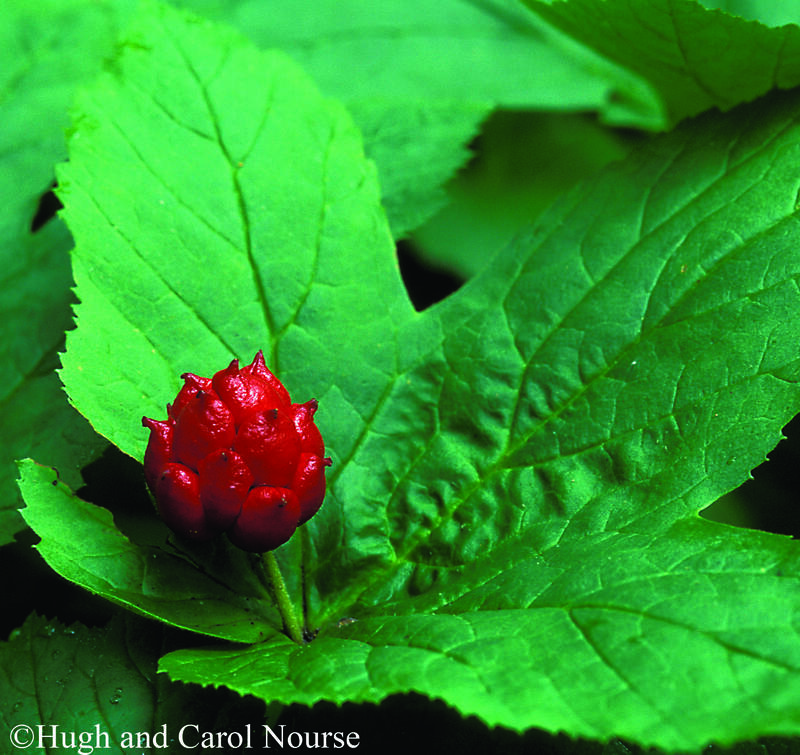
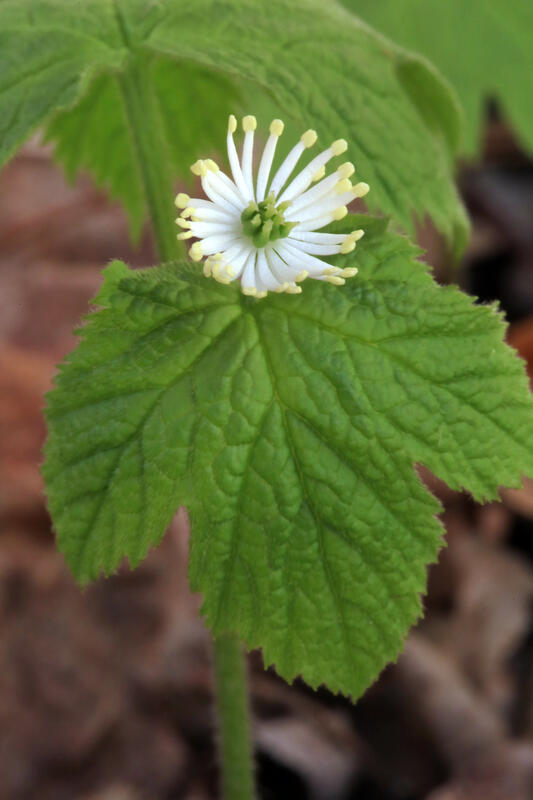
Perennial herb, 6 - 20 inches (15 - 50 cm) tall, forming colonies from a stout, yellow, underground stem. Aboveground stems are erect, hairy, unbranched, often golden-yellow at the base and bearing 1 or 2 leaves at the top. Leaves are up to 4 inches (3 - 10 cm) wide during flowering in early spring, expanding to 10 inches (25 cm) wide when mature during fruiting, with 3 - 7 pointed, toothed lobes and hairy, wrinkled surfaces. Flowers are up to 0.7 inch (1.8 cm) across, solitary on hairy stalks up to 1.5 inches (3.8 cm) long that arise at the base of one of the leaves; the flowers have no petals and small, inconspicuous sepals but many showy, white stamens tipped with green or yellow anthers. The fruit is a raspberry-like aggregate of tiny red berries 0.6 inch (1.5 cm) wide.
Tassel-rue (Trautvetteria caroliniensis) has deeply lobed leaves and flowers similar to Goldenseal, but its stems and leaves are smooth and hairless, and the flowers are in branched clusters. It flowers June – August.
None in Georgia. Hydrastis canadensis is the only species in this genus in North America; there is another species in Japan.
Moist, deciduous hardwood forests with neutral or basic soils over bedrock that is high in calcium or magnesium. Goldenseal thrives best under a patchily open canopy.
Goldenseal is a perennial herb that reproduces sexually by seed and vegetatively by spread of its rhizomes, which produce buds that develop into stems the following year. Vegetative spread results in the formation of large colonies of genetically identical plants. Goldenseal flowers are pollinated by bees and syrphid flies. Its bright red, prominently displayed fruits are attractive to animals, primarily birds, who eat the fruit then disperse the seeds. The rhizomes of Goldenseal contain several highly active alkaloids and have been used to treat a variety of ailments; digging by medicinal plant collectors seriously threatens the survival of this species.
Surveys are best conducted during flowering (late March–late April) and fruiting (May–June). The leaf and stem disappear soon after fruits are dispersed.
Georgia, Alabama, Mississippi, north to Vermont and Ontario, west to Kansas and Oklahoma. Goldenseal is rare throughout most of its range due to loss of habitat and collecting for medicinal uses.
Conversion of habitat to pine plantations and developments; logging and other mechanical clearing; limerock mining; invasion by exotic pest plants; harvesting by medicinal plant diggers.
| Threat 1 | Threat 2 | Threat 3 | |
|---|---|---|---|
| General Threat | Climate change & severe weather | Residential & commercial development | Agriculture & aquaculture |
| Specific Threat | None | None | None |
Hydrastis canadensis is ranked S1 by the Georgia Department of Natural Resources, indicating that it is critically imperiled in the state. Nineteen populations have been documented in Georgia, but only eight have been confirmed since 2000. About half occur on national forest or state park lands; all are vulnerable to plant poaching.
Avoid logging, clearing, and other mechanical disturbances in hardwood forests. Eradicate exotic pest plants. Prosecute plant poachers.
Albrecht, M.A. and B.C. McCarthy. 2006. Comparative analysis of goldenseal (Hydrastis canadensis) population re-growth following human harvest: implications for conservation. The American Midland Naturalist 156(2): 229–236. https://www.researchgate.net/publication/232674194_Comparative_ Analysis_of_Goldenseal_Hydrastis_canadensis_L_Population_Re-growth_Following_Human_ Harvest_Implications_for_Conservation
Chafin, L.G. 2007. Field guide to the rare plants of Georgia. State Botanical Garden of Georgia and University of Georgia Press, Athens.
Clark, J. 2004. Wildflowers of Pigeon Mountain, Lookout Mountain, Cloudland Canyon State Park, and Chickamauga National Military Park in northwest Georgia. Waldenhouse Publishers, Walden, Tennessee.
Ford, B.A. 1997. Hydrastis canadensis species account.Flora of North America, Vol. 3. Oxford University Press, New York. http://www.efloras.org/florataxon.aspx?flora_id=1&taxon_id=220006616
GADNR. 2020. Element occurrence records for Hydrastis canadensis. Georgia Department of Natural Resources, Wildlife Resources Division, Social Circle, Georgia.
NatureServe. 2019. Hydrastis canadensis comprehensive report. NatureServe Explorer. Arlington, Virginia. http://explorer.natureserve.org/servlet/NatureServe?searchName=Hydrastis+canadensis
Patrick, T.S., J.R. Allison, and G.A. Krakow. 1995. Protected plants of Georgia. Georgia Department of Natural Resources, Natural Heritage Program, Social Circle.
Radford, A.E., H.E. Ahles, and C.R. Bell. 1968. Manual of the vascular flora of the Carolinas. University of North Carolina Press, Chapel Hill.
Robbins, C.S. 2000. Comparative analysis of management regimes and medicinal plant trade monitoring mechanisms for American Ginseng and Goldenseal. Conservation Biology (14)5: 1422-1434. https://conbio.onlinelibrary.wiley.com/doi/full/10.1046/j.1523-1739.2000.99100.x
Sanders, B. 2004. William Bartram's botanical discoveries in Georgia. Tipularia, Journal of the Georgia Botanical Society 19: 8-17.
Sanders, S. and J.B. McGraw. 2005. Harvest recovery of Goldenseal, Hydrastis canadensis L. American Midland Naturalist 153(1): 87-94.
Sanders, S. and J. B. McGraw. 2002. Goldenseal (Hydrastis canadensis L.) distribution, abundance, and population dynamics in an Indiana Nature Preserve. Natural Areas Journal 22(2):129-134. https://www.researchgate.net/publication/289398635_Distribution_abundance_and_population _dynamics_of_goldenseal_Hydrastis_canadensis_L_in_an_Indiana_Nature_Preserve_USA
Sharp, P. C. 2003. Hydrastis canadensisL. (Goldenseal) conservation and research plan for New England. New England Wild Flower Society, Framingham, Massachusetts. http://www.newenglandwild.org/docs/pdf/Hydrastiscanadensis.PDF
Sinclair A., Catling P. M., and Dumouchel, L. 2000. Notes on the pollination and dispersal of Goldenseal, Hydrastis canadensis L., in southwestern Ontario. Canadian Field Naturalist 114(3):499-501. https://www.researchgate.net/publication/290362930_Notes_on_the_pollination_ and_dispersal_of_Goldenseal_Hydrastis_canadensis_L_in_southwestern_Ontario
Weakley, A.S. 2015. Flora of the southern and mid-Atlantic States. University of North Carolina Herbarium, University of North Carolina, Chapel Hill. http://www.herbarium.unc.edu/flora.htm
Linda G. Chafin
L. Chafin, Mar. 2007: original account
K. Owers, Feb. 2010: added pictures
L. Chafin, Feb 2020: updated original account.