

Loading profile. Please wait . . .
Platanthera conspicua (Nash) P.M. Brown
Large White Fringed Orchid




Federal Protection: No US federal protection
State Protection: No Georgia state protection
Global Rank: G5T4
State Rank: S1
Element Locations Tracked in Biotics: Yes
SWAP 2015 Species of Greatest Conservation Need (SGCN): Yes
SWAP 2025 Species of Greatest Conservation Need (SGCN): Yes
2025 SGCN Priority Tier: High Conservation Concern
Element Occurrences (EOs) in Georgia: 6
Habitat Summary for element in Georgia: Bogs, seeps, roadsides, wet savannas
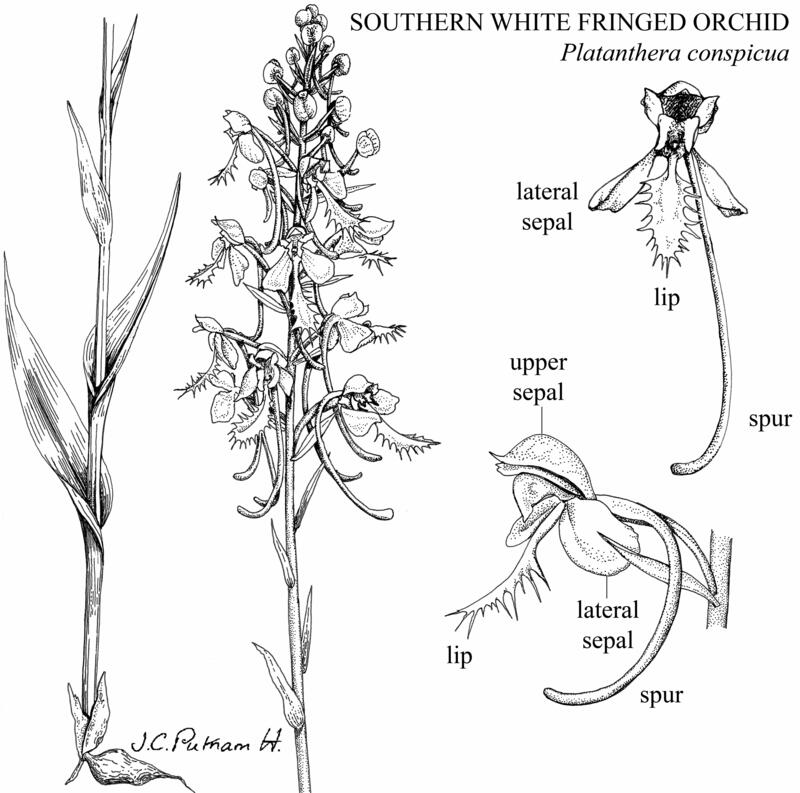
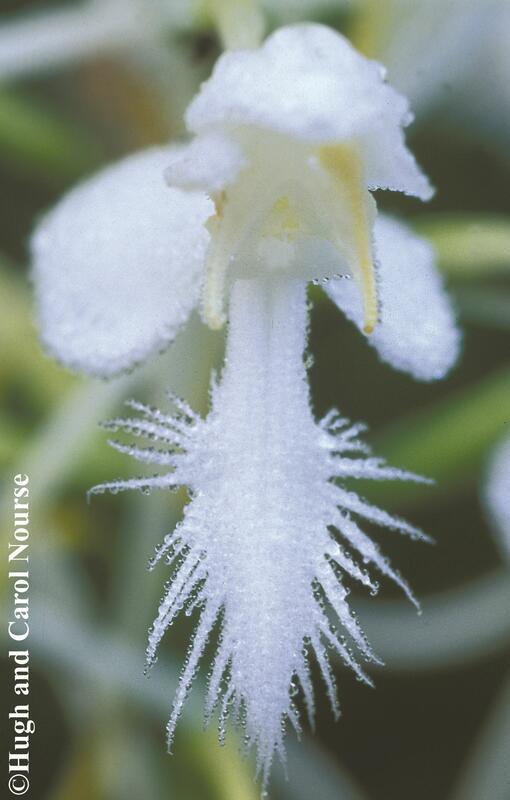
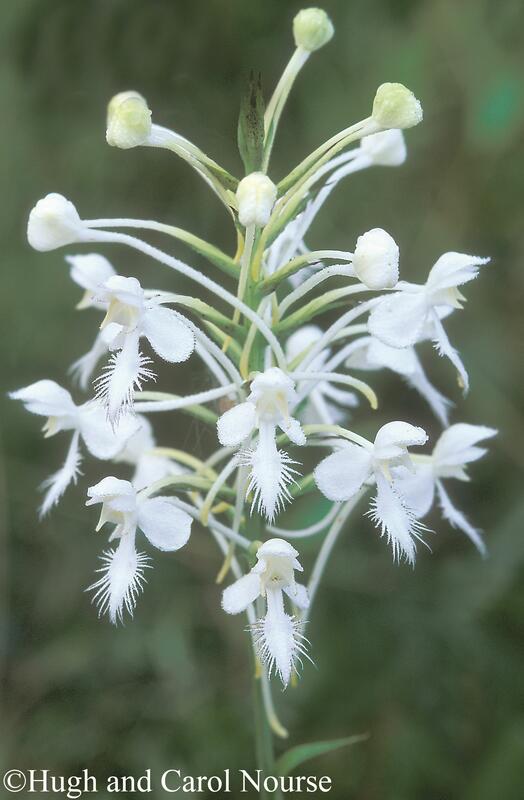
Perennial herb with an erect stem 1 - 3.6 feet (35 - 110 cm) tall. The leaves are 2 - 14 inches (5 - 35 cm) long and 2 inches (5 cm) wide, reduced in size near the top of the stem, alternate. The flowers are pure white and held in a large cluster at the top of the stem. The lateral sepals are rounded at the tip and held backward along the side of the flower; one upright sepal overlaps with 2 narrow petals to form a hood over the center of the flower. The lip petal is up to 1 inch (0.9 - 2.6 cm) long, spoon-shaped with a deeply fringed margin. The spur, a backward extension of the lip petal, is 1 - 2 inches (3 - 5 cm) long and curves down behind the flower. The fruit is a slender capsule, 0.7 - 1.2 inch (1.8 - 3.1 cm) long, containing many tiny seeds.
Small White Fringed Orchid (Platanthera blephariglottis, Georgia Special Concern) occurs in wet seeps in Georgia’s Coastal Plain and closely resembles Large White Fringed Orchid. Until recently Large White Fringed Orchid was considered a variety of Small White Fringed Orchid (Platanthera blephariglottis var. conspicua). For more information, see: https://www.georgiabiodiversity.a2hosted.com/portal/profile?group=plants&es_id=17377
Snowy Orchid (Platanthera nivea, synonym: Gymnadeniopsis nivea, Georgia Special Concern) occurs in wet savannas and pitcherplant bogs in the Coastal Plain. For more information, see: https://www.georgiabiodiversity.a2hosted.com/portal/profile?group=plants&es_id=17443
Monkeyface Orchid (Platanthera integrilabia, US and Georgia Threatened) occurs in Red Maple-Black Gum swamps and peaty seeps and along streambanks in north Georgia. For more information, see: https://www.georgiabiodiversity.a2hosted.com/portal/profile?group=plants&es_id=19469on this website.
There are 10 rare species of Platanthera in Georgia. For information on each of these, see: https://www.georgiabiodiversity.org/portal/element_lists?group=plant
Pitcherplant bogs, wet savannas, seepages, openings in Atlantic white cedar swamps, and wet roadsides through these habitats.
Large White Fringed Orchid is a perennial herb that reproduces sexually. Its flowers are adapted for pollination by long-tongued insects, such as butterflies, moths, and certain bees, who probe the long spurs for nectar. Typically, white flowers are pollinated by night-flying moths and brightly colored flowers by day-flying butterflies, but the Small White Fringed Orchid (Platanthera blephariglottis), a close relative of Large White Fringed Orchid, is pollinated by both butterflies and moths. In the process of probing the spur for nectar, sticky packets of pollen adhere to the front of the insects’ heads and are brushed off onto the stigmas of flowers that are subsequently visited. Flowers must be cross-pollinated for fruit to set. Each fruit contains thousands of dust-like seeds which contain no stored food reserves (endosperm). Seeds must land on a patch of soil containing a specific fungus that provides nutrients for germination and subsequent plant growth.
Surveys are best conducted during flowering (August–September).
Georgia, Florida, Alabama, Mississippi, Louisiana, Texas, South Carolina, and North Carolina.
Conversion of habitat to pine plantations and pastures. Fire suppression. Ditching, draining, and logging of wetlands. Plant poaching. Digging by feral hogs.
| Threat 1 | Threat 2 | Threat 3 | |
|---|---|---|---|
| General Threat | Energy production & mining | Transportation & service corridors | Biological resource use |
| Specific Threat | None | None | None |
Platanthera conspicua is ranked S1 by the Georgia Department of Natural Resources, indicating that it is critically imperiled in Georgia. Four populations have been documented in Georgia, only one protected on a conservation area.
Protect savannas, bogs, and seepage slopes from conversion to pine plantations and pastures. Apply prescribed fire to savannas, bogs, and seepage slopes every 2 - 3 years. Avoid ditching, draining, logging, or other soil-compacting activities in wetlands. Prosecute plant poachers. Eradicate feral hogs.
Argue, C.L. 2012. The pollination biology of North American orchids: Volume 1, North of Florida and Mexico, Part II: subfamily Orchidoideae (part one), Chapter 8, Platanthera. Springer Science + Business Media, LLC. https://link.springer.com/content/pdf/10.1007%2F978-1-4614-0592-4.pdf
Brown, P.M. and S.N. Folsom. 2004. Wild orchids of the southeastern United States, north of peninsular Florida. University Press of Florida, Gainesville.
Brown, P.M. 2002. Revalidation of Platanthera conspicua, the southern white-fringed orchis. North American Native Orchid Journal 8: 3 - 14.
Chafin, L.G. 2007. Field guide to the rare plants of Georgia. State Botanical Garden of Georgia and University of Georgia Press, Athens.
Cole, F.R. and D.H. Firmage. 1984. The floral ecology of Platanthera blephariglottis. American Journal of Botany 71(5): 700-710. https://bsapubs.onlinelibrary.wiley.com/doi/abs/10.1002/j.1537-2197.1984.tb14177.x
Drake, J. 2013. Fringed orchids of the southeastern United States: a guide to the genus Platanthera. Breath o’ Spring, Inc. P.O. Box 2957, Suwanee, Georgia 30024.
Luer, C.A. 1972. The native orchids of Florida. New York Botanical Garden, New York
Luer, C.A. 1975. The native orchids of the United States and Canada, excluding Florida. New York Botanical Garden, New York.
McKeever, S. 2001. Some native orchids of the southeastern United States. Tipularia 16: 22-31.
NatureServe. 2019. Platanthera conspicua comprehensive report. NatureServe Explorer. Arlington, Virginia. http://explorer.natureserve.org/servlet/NatureServe?searchName=Platanthera+conspicua
Nelson, G. 2006. Atlantic Coastal Plain wildflowers. Globe Pequot Press, Guilford, Connecticut.
Sheviak, C.J. 2003. Platanthera blephariglottis var. conspicua species account. Flora of North America, Vol. 26. Oxford University Press, New York. http://www.efloras.org/florataxon.aspx?flora_id=1&taxon_id=242102281http://www.efloras.org/florataxon.aspx?flora_id=1&taxon_id=242101828
Smith, G.R. and G.E. Snow. 1976. Pollination ecology of Platanthera (Habenaria) ciliaris and P. blephariglottis (Orchidaceae). Botanical Gazette 137(2): 133-140. https://www.journals.uchicago.edu/doi/pdfplus/10.1086/336852
Weakley, A.S. 2015. Flora of the southern and mid-Atlantic States. University of North Carolina Herbarium, University of North Carolina, Chapel Hill. http://www.herbarium.unc.edu/flora.htm
Linda G. Chafin
L. Chafin, Jul. 2008: original account
K. Owers, Feb. 2010: added pictures
Z. Abouhamdan, Apr. 2016: updated link
L. Chafin, Mar. 2020: updated original account