

Loading profile. Please wait . . .
Pteroglossaspis ecristata (Fern.) Rolfe
Giant Orchid




Federal Protection: No US federal protection
State Protection: Threatened
Global Rank: G4
State Rank: S2
Element Locations Tracked in Biotics: Yes
SWAP 2015 Species of Greatest Conservation Need (SGCN): Yes
SWAP 2025 Species of Greatest Conservation Need (SGCN): Yes
2025 SGCN Priority Tier: Highest Conservation Concern
Element Occurrences (EOs) in Georgia: 27
Habitat Summary for element in Georgia: Grassy saw palmetto barrens; longleaf pine grasslands, sometimes with Schwalbea americana
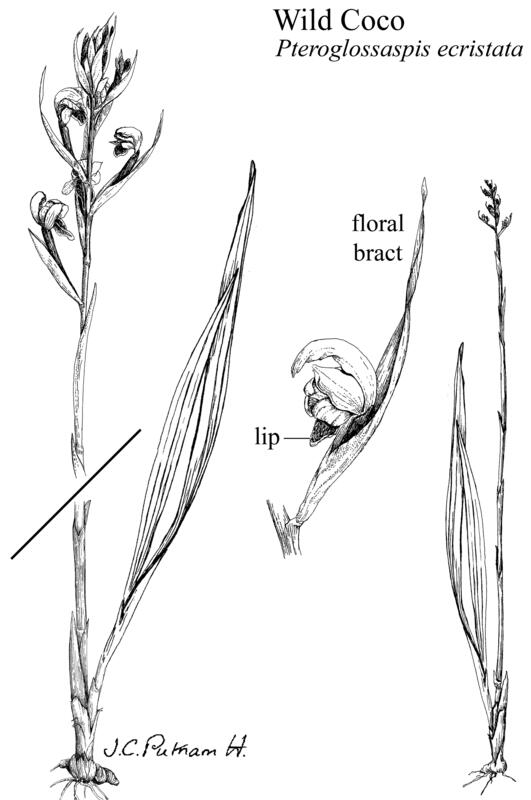
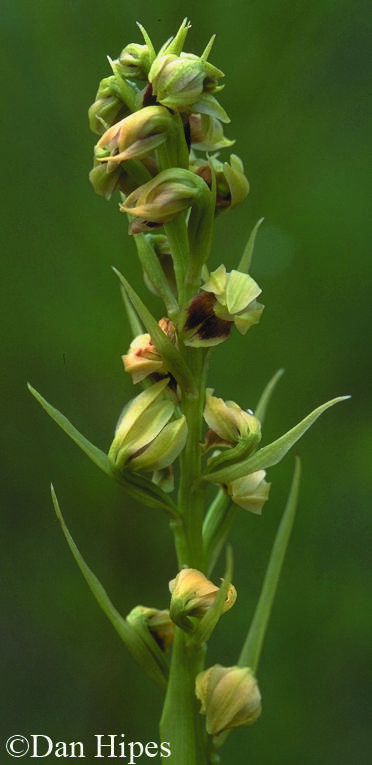
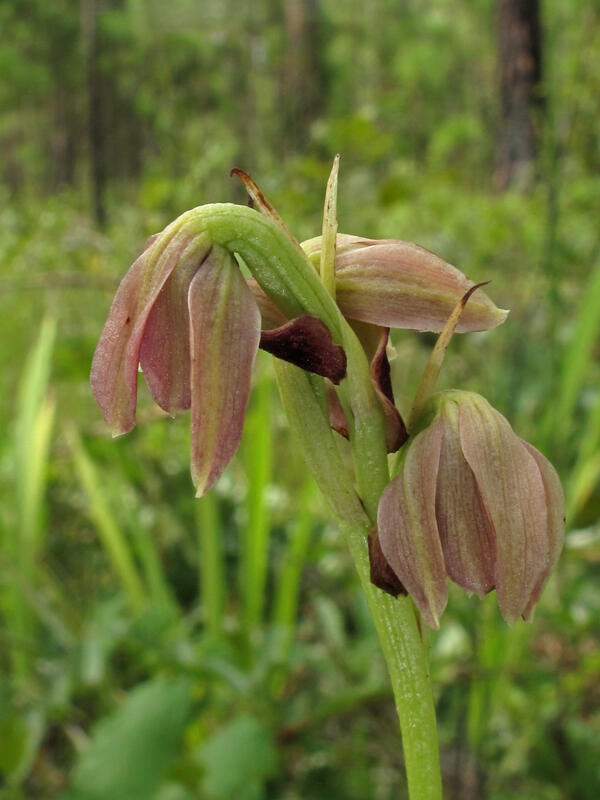
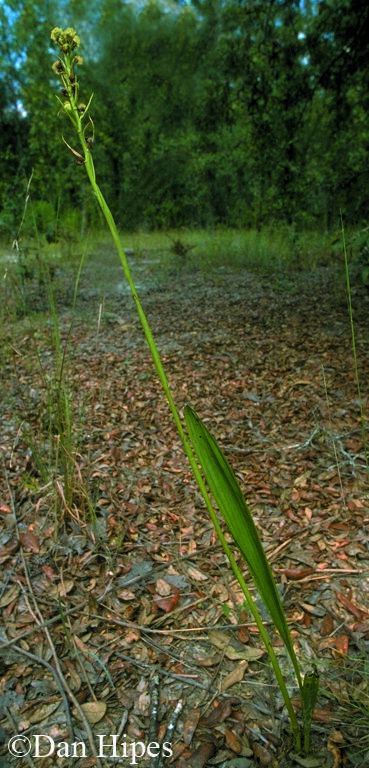
Perennial herb up to 5.5 feet (170 cm) tall, with 2 - 4 basal leaves 6 - 28 inches (15 - 70 cm) long and up to 1.4 inches (1 - 3.5 cm) wide, erect, pleated, with 3 - 5 conspicuous veins. The flower stalk is 5.5 feet (30 - 170 cm) tall, leafless except for a few small bracts, with a cluster of 5 - 30 flowers at the top. Flowers are up to 0.8 inch (1 cm) long, twisted inward to the stalk, with a stiff floral bract 2.4 inches (6 cm) long behind each flower. Sepals and lateral petals are yellowish-green to pinkish and folded forward over the lip; the lip is 3-lobed, with a prominent central lobe that is dark maroon with green margins but lacking a crest. The fruit is an erect, rounded capsule up to 0.8 inch (2 cm) long.
In flower, Wild Coco resembles no other species. However, its leaves are similar to those of other orchids such as grass pinks (Calopogon spp.) but are stiffer and occur in two's or three’s instead of singly. The leaves also resemble those of the seedlings of Saw Palmetto but are softer and lack the woody, saw-toothed leaf stalk of Saw Palmettos.
Pteroglossaspis ecristata is the only species in that genus in North America. More than thirty other orchid species are rare in Georgia.
Longleaf Pine sandhills and flatwoods, oak scrub, prairies, and disturbed clearings in these habitats.
Wild Coco is a perennial herb that reproduces sexually by seed. It blooms every few years, usually in response to fire. Often many flowers will bloom at once and remain open for about a week; they are probably pollinated by bees. Little else is known about the reproductive biology of this species; closely related species in the genus Eulophia are known to be both self- and cross-fertile.
Surveys are best conducted during flowering (July–September) and fruiting (September–November).
Coastal Plain of Georgia, Florida, Alabama, Mississippi, Louisiana, South Carolina, and North Carolina; Cuba.
Destruction of habitat by conversion to pine plantations, pasture, fields, and residential and commercial development; fire suppression. Invasion by the exotic pest plant Cogon Grass.
| Threat 1 | Threat 2 | Threat 3 | |
|---|---|---|---|
| General Threat | Transportation & service corridors | Biological resource use | Human intrusions & disturbance |
| Specific Threat | None | None | None |
Pteroglossaspis ecristata is ranked S2 by the Georgia Department of Natural Resources, indicating that it is imperiled in Georgia. It is listed as Threatened by the State of Georgia. Sixteen populations have been documented in Georgia since the 1940s, about half on public or conservation lands, but only four have been confirmed since 2000.
Use prescribed fire to create sunny openings in sandhills and flatwoods and reduce competition from woody species. Avoid logging, bedding, and plowing fire lanes in sandhills and flatwoods. Eradicate Cogon Grass.
Brown, P.M. and S.N. Folsom. 2004. Wild orchids of the southeastern United States, north of peninsular Florida. University Press of Florida, Gainesville.
Chafin, L.G. 2007. Field guide to the rare plants of Georgia. State Botanical Garden of Georgia and University of Georgia Press, Athens.
Luer, C.A. 1972. The native orchids of Florida. New York Botanical Garden, New York
NatureServe. 2019. Pteroglossaspis ecristata comprehensive report. NatureServe Explorer. Arlington, Virginia. http://explorer.natureserve.org/servlet/NatureServe?searchName=Pteroglossaspis+ecristata
Romero-González, G.A. 2003. Pteroglossaspis ecristata species account. Flora of North America, Vol. 26. Oxford University Press, New York. http://www.efloras.org/florataxon.aspx?flora_id=1&taxon_id=242101875
Schotz, A.R. 2006. Pteroglossaspis ecristata – wild coco, giant orchid. Rare Plants of Louisiana Fact Sheet, Louisiana Department of Wildlife and Fisheries. http://dev.wlf.louisiana.gov/sites/default/files/pdf/fact_sheet_plant/32092-Pteroglossaspis%20ecristata/pteroglossaspis_ecristata.pdf
Schotz, A.R. 2003. Threatened and endangered species: giant orchid. Alabama’s Treasured Forests, Winter: 28-29. http://www.forestry.alabama.gov/Pages/Informational/Treasured_Forests/Magazine/2003_Winter.pdf
Weakley, A.S. 2015. Flora of the southern and mid-Atlantic States. University of North Carolina Herbarium, University of North Carolina, Chapel Hill. http://www.herbarium.unc.edu/flora.htm
Linda G. Chafin
L. Chafin, Jul. 2008: original account
K. Owers, Feb. 2010: added pictures
L. Chafin, Mar. 2020: updated original account