

Loading profile. Please wait . . .
Calystegia catesbeiana ssp. catesbeiana
Catesby's Bindweed




Federal Protection: No US federal protection
State Protection: No Georgia state protection
Global Rank: G4T4
State Rank: S1?
Element Locations Tracked in Biotics: Yes
SWAP 2015 Species of Greatest Conservation Need (SGCN): No
SWAP 2025 Species of Greatest Conservation Need (SGCN): Yes
2025 SGCN Priority Tier: High Conservation Concern
Element Occurrences (EOs) in Georgia: 8
Habitat Summary for element in Georgia: Longleaf pine-wiregrass savannas
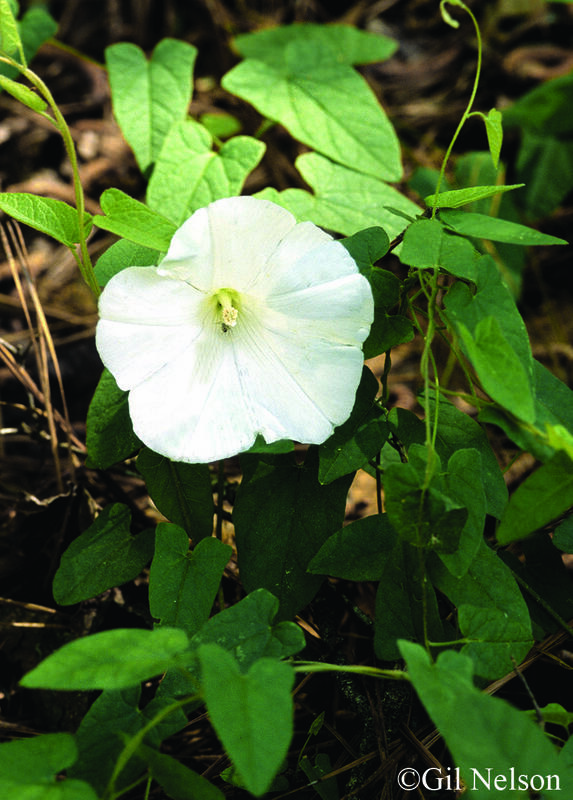
Perennial herb with hairy, vining stems up to 2 feet (60 cm) long, rarely branched, usually twining at the tips but not strongly climbing. The leaves are up to 2 inches (5 cm) long, alternate, arrowhead-shaped, smooth or hairy. The flower stalks are hairy, and arise singly in the axils of the 2 lowest leaves and the stem. The flowers are 1.5 - 2 inches (4 - 5 cm) wide, white, 5-lobed, funnel-shaped, with 5 small, green sepals hidden by 2 much larger, oval leafy bracts, about 0.8 inch (2 cm) long. The fruit is a rounded capsule, about 0.4 inches (1 cm) wide, enclosed by the leafy bracts.
Low Bindweed (Calystegia spithamaea) has erect, finely hairy stems. Its leaves may be smooth or sometimes densely hairy on the lower surface, and the upper leaves overtop the tip of the stem. Its flowers are white or pink.
Hedge Bindweed (Calystegia sepium) is a twining vine with hairless stems and leaves and white to pinkish-purple flowers.
Silky Bindweed (Convolvulus sericatus) occurs in hardwood forests in the northeast Georgia mountains. Its slender stems are densely white-hairy and up to 6 feet long, and its densely hairy leaves may be up to 4 inches (10 cm) long and whitish in color. Its flowers are up to 2.4 inches (6 cm) wide with leafy bracts up to 1 inch (2.5 cm) long.
Frequently burned Longleaf Pine-Wiregrass woodlands in Georgia's Coastal Plain.
Catesby’s Bindweed is a perennial herb, dying back to the ground in winter and producing new growth in early spring. It flowers in mid- to late spring (if its habitat is burned in the spring, plants will re-sprout and flower later in the summer). Typically, only one flower will be open per plant on a given day; it opens early in the morning and withers around noon. The showy flowers of bindweeds attract a variety of insects, especially long-tongued bees such as the large bee, Diadasia sp., considered a specialist pollinator of bindweeds. The size and white color of the flowers suggests that moths visit the flowers in the early morning. Emmelina monodactyla (Morning Glory Plume Moth) and Pink-spotted Hawkmoth (Agrius cingulata) use this and other bindweeds as a larval host plant. Its seeds are probably eaten by numerous animals including ground-dwelling birds such as bobwhite quail. The foliage is toxic and avoided by mammals.
Surveys are best conducted during flowering, April–June (possibly later, depending on timing of recent fire), although plants may be distinguished from look-alikes by leaf and stem traits throughout the growing season.
Georgia and Florida Panhandle.
Fire suppression, logging, clearing, and conversion of habitat to pine plantations, agriculture, and development.
| Threat 1 | Threat 2 | Threat 3 | |
|---|---|---|---|
| General Threat | Natural system modifications | Agriculture & aquaculture | None |
| Specific Threat | Fire & fire suppression | Wood & pulp plantations | None |
Convolvulus catesbyanus is ranked S1? by the Georgia Department of Natural Resources, indicating that it is probably critically imperiled in the state, but that more information is needed to make a definitive ranking. Only one population has been documented in Georgia in the last 120 years; it occurs on conservation land in southwest Georgia.
Apply prescribed fire to Longleaf Pine woodlands every 2 - 3 years, primarily in the growing season. Protect Longleaf Pine woodlands from clearing, logging, bedding, silvicultural site preparation, and development.
Austin, D.F. 2004. Convolvulaceae (morning glory family). In, N. Smith, S.A. Mori, A. Henderson, D.W. Stevenson, S.V. Heald, Flowering Plants of the Neotropics. Princeton University Press, Princeton, New Jersey.
Austin, D. F. 1997. Convolvulaceae (morning glory family). Conservation and Science Department, Arizona-Sonora Desert Museum, Tucson, Arizona.
Austin, D.F. 1992. Studies of the Florida Convolvulaceae - V - Calystegia. Florida Scientist 55(1): 58-60. https://www.jstor.org/stable/24320479?seq=1#metadata_info_tab_contents
Chafin, L.G. 2007. Field guide to the rare plants of Georgia. State Botanical Garden of Georgia and University of Georgia Press, Athens.
GADNR. 2019. Element occurrence records for Calystegia catesbeiana ssp. catesbeiana. Georgia Department of Natural Resources, Wildlife Resources Division, Social Circle, Georgia.
NatureServe. 2020. Calystegia catesbeiana ssp. catesbeiana comprehensive report. NatureServe Explorer. Arlington, Virginia. https://explorer.natureserve.org/Taxon/ELEMENT_GLOBAL.2.129708/Calystegia_catesbeiana
Nelson, G. 2005. East Gulf Coastal Plain wildflowers. Globe Pequot Press, Guilford, Connecticut.
Ushimaru, A. and K. Kikuzawa. 1999. Variation of breeding system, floral rewards, and reproductive success in clonal Calystegia species (Convolvulaceae). American Journal of Botany 86(3): 436-446. https://bsapubs.onlinelibrary.wiley.com/doi/full/10.2307/2656764
Weakley, A.S. 2015. Flora of the southern and mid-Atlantic States. University of North Carolina Herbarium, University of North Carolina, Chapel Hill. http://www.herbarium.unc.edu/flora.htm
Weakley, A.S., and Southeastern Flora Team. 2024. Flora of the southeastern United States Web App. University of North Carolina Herbarium, North Carolina Botanical Garden, Chapel Hill, U.S.A. https://fsus.ncbg.unc.edu/main.php?pg=show-taxon-detail.php&lsid=urn:lsid:ncbg.unc.edu:taxon:{8424CA82-8947-4C82-B226-71A28ED4173D} Accessed Sep 13, 2024.
Wunderlin, R.P and B.F. Hansen. 2003. Guide to the vascular plants of Florida, 2nd edition. University Press of Florida, Gainesville.
Linda G. Chafin
L. Chafin, Nov. 2007: original account.
K. Owers, Jan. 2010: updated status and ranks, added pictures.
Z. Abouhamdan, April 2016: removed broken link.
L. Chafin, Jan. 2020: updated original account.
H. Umstead, Sept. 2024: updated scientific name.


