


Loading profile. Please wait . . .
Malaclemys terrapin (Schoepff, 1793)
Diamond-backed Terrapin




Federal Protection: No US federal protection
State Protection: Unusal
Global Rank: G4
State Rank: S4
Element Locations Tracked in Biotics: Yes
SWAP 2015 Species of Greatest Conservation Need (SGCN): Yes
SWAP 2025 Species of Greatest Conservation Need (SGCN): Yes
2025 SGCN Priority Tier: Moderate Conservation Concern
Element Occurrences (EOs) in Georgia: 1
Habitat Summary for element in Georgia: Entire coast, estuarine and marine edge; All saltmarsh, beaches
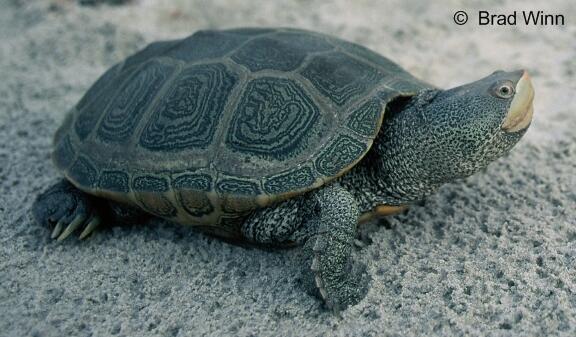
The diamondback terrapin is a medium sized turtle characterized by concentric age rings or grooves on the scutes of the carapace, especially in younger individuals. Terrapins reach a maximum carapace size of 23.8 cm (9⅜ inches). Adult female terrapins dwarf the much smaller males. Adult females have wider heads and shorter tails than males and can be twice the size of adult males in carapace length: females, 15 - 23 cm (6 - 9 inches) long, and males, 10 - 14 cm (4 - 5½ inches) long. The carapace color is variable and may be gray, bluish-gray, brown, or even black. The concentric scale grooves are often ringed with darker pigment. The marginals on the posterior edge of the carapace may be slightly upturned. The plastron is hingeless and often has dark blotches or markings. The skin is gray or light green to black, and is marked with dark flecks or blotches. The jaws are light colored and the upper jaw often has a dark marking resembling a mustache.
Seven subspecies of diamondback terrapin have been described in the southeastern The diamondback terrapin ranges from , to northern and is characterized by the lack of knobs on the median keel of the carapace. Other than sea turtles whose limbs are flipper-like, no other turtle species are likely to be encountered in their estuarine habitat.
Diamondback terrapins inhabit brackish and saltwater estuarine habitats including bays, rivers, sounds, tidal creeks, and coastal marine habitats. Little is known about the habitat use of juvenile terrapins although it is thought they spend much of their early life hiding under mats of decaying marsh grass. Adult terrapins are known to have very high site fidelity, often spending their entire adult life in the reaches of a single tidal creek.
Diamondback terrapins are known to primarily eat a variety of estuarine invertebrates including snails, bivalves, and small crabs, but certain plants and algae are also consumed. Periwinkle snails and fiddler crabs are particularly important food items in . Diamondback terrapins, with their large head and powerful jaws, are well adapted to eating marine snails and bivalves. Terrapins also scavenge on fish and other dead marine organisms.
Courtship and mating occur in April and May in open water at the confluence of tidal creeks. Females emerge from the water in late spring and summer and lay 5 - 12 eggs in sandy, upland areas adjacent to salt marshes. Terrapins are commonly found nesting on sandy beaches, dunes, hammocks, bluffs, and road or causeway embankments, and even in household gardens adjacent to salt marsh. Females may lay several clutches each year. The incubation period is variable but ranges from 61 - 68 days. Hatchlings emerge from the nest in summer and early fall. As temperatures cool in fall, hatchlings may emerge from the egg and overwinter in the ground emerging after heavy winter rains or the following spring. During colder winter months, terrapins may hibernate buried in mud on the creek bottom or in creek banks near the high tide line. In , most terrapins become inactive by November, and begin to appear again in late Marsh and April. Female terrapins are sexually mature at approximately 5 years of age while males mature somewhat faster at 3 years of age.
None
Diamondback terrapins have a wide distribution and may be found on the Atlantic and Gulf coasts from Cape Cod to .
Diamondback terrapins were commercially harvested for soups and stews during the early 1900s. The Cloister on Sea Island was particularly renowned for its terrapin soup. Terrapin populations were substantially reduced during this period and some local populations were completely eliminated. As the popularity of terrapin soup waned, terrapin populations recovered in some areas. Recent threats to terrapin populations include incidental capture and drowning in commercial and recreational blue crab traps, habitat loss from the effects of coastal development, contamination of coastal waters, and highway mortality. Crab traps can eliminate local populations of terrapins. Diamondback terrapins enter crab traps to scavenge on crab bait and drown. Adult males are more commonly found dead in crab traps because the small opening size often excludes the larger adult female terrapins from entering the trap. Over 90 dead terrapins have been found in a single crab trap in Georgia. Coastal development affects Georgia’s terrapin population through loss of habitat and road mortality. Coastal development may result in the construction of bulkheads along tidal creeks and bluffs, blocking access to upland nesting habitat. Recent data collected on the Jekyll Island causeway suggests that over 150 adult females are killed on that road annually as they cross the asphalt in search of preferred nesting sites. Because causeways create preferable marsh-side nesting conditions, it is not known whether or not this level of annual mortality is sustainable or negatively impacting the viability of Georgia’s terrapin population.
| Threat 1 | Threat 2 | Threat 3 | |
|---|---|---|---|
| General Threat | Biological resource use | Transportation & service corridors | Residential & commercial development |
| Specific Threat | Fishing & harvesting aquatic resources | Roads & railroads | None |
Diamondback terrapin populations sustained significant losses due to harvesting for soups and stews in the early part of the 20th century, but recovered to some extent in many areas. Today, the greatest threat comes from development and highway mortality. Diamondback terrapins also drown in crab traps, especially “ghost traps” that have been abandoned or left in the water unattended for many days.
A recent statewide survey of the ’s diamondback terrapin population conducted by the of found terrapins to be relatively abundant in coastal . However, terrapin abundance appeared to be lower than predicted in some areas, suggesting that threats such as crab trap mortality and coastal development may be influencing the terrapin population in localized areas. Research conducted by the Georgia Marine Extension Service explored the effectiveness of alternative openings for crab traps to reduce terrapin capture without reducing crab catch. One opening was found to be effective in reducing terrapin captures without reducing crab catch rates. Long-term monitoring of abundance and the use of terrapin excluders by commercial and recreational crabbers may be necessary to ensure a healthy diamondback terrapin population in .
Ernst, C. H., J. E. Lovich, and R. W. Barbour. 1994. Turtles of the United States and Canada. Smithsonian Institution Press, Washington D.C.
Spivey, P.B. 2008. Diamondback terrapin (Malaclemys terrapin). In J.B. Jensen, C. D. Camp, W. Gibbons, and M. J. Elliott (eds.), Amphibians and Reptiles of Georgia. The University of Georgia Press, Athens.
Mark Dodd
M. Dodd, April 2009: original account
K. Owers, Sept. 2009: updated status and ranks, added picture