Loading profile. Please wait . . .
Verbesina walteri Shinners
Carolina Crownbeard




Federal Protection: No US federal protection
State Protection: No Georgia state protection
Global Rank: G4
State Rank: S1?
Element Locations Tracked in Biotics: Yes
SWAP 2015 Species of Greatest Conservation Need (SGCN): Yes
SWAP 2025 Species of Greatest Conservation Need (SGCN): Yes
2025 SGCN Priority Tier: High Conservation Concern
Element Occurrences (EOs) in Georgia: 3
Habitat Summary for element in Georgia: Moist calcareous bluffs; Savannah River floodplains
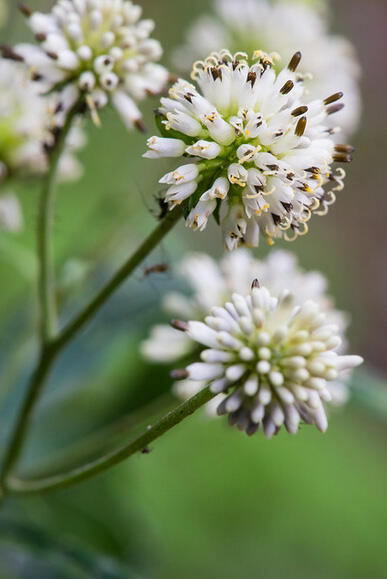
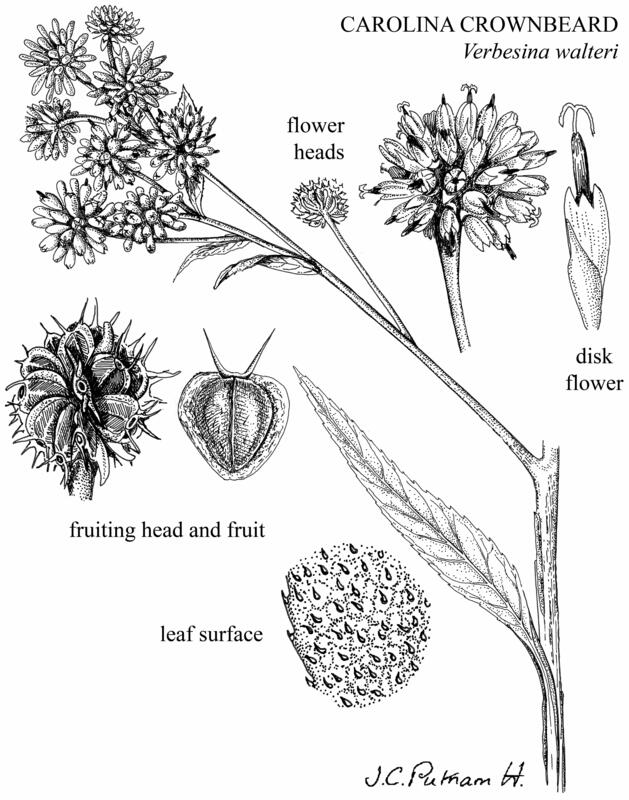
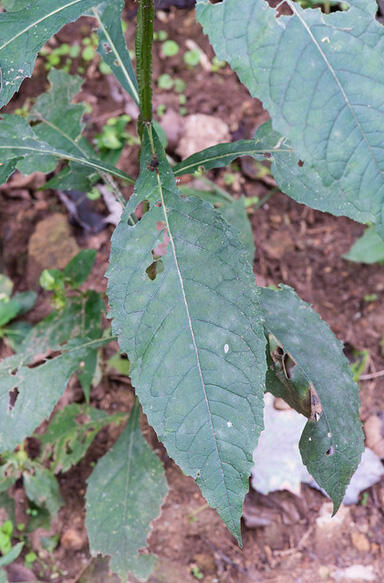
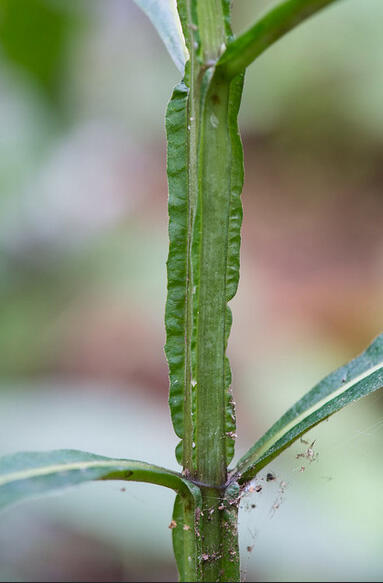
Perennial herb with smooth, winged, erect stems 3 -13 feet (1 - 4 meters) tall. Its leaves are 4 - 8 inches (10 - 20 cm) long and 0.8 - 2.8 inches (2 - 7 cm) wide, alternate, rough-hairy, lance-shaped, with pointed tips, tapering bases, and toothed edges, and a conspicuous pale midvein; leaf tissue forms narrow wings on the leaf stalk and continues down the stem as wings. The flower cluster is large and open, with 10 - 100 flower heads. The flower heads are rounded with 12 - 15 narrow, down-curved involucral bracts and 40 - 60+ white, tubular disk flowers; there are no ray flowers. Fruits are about 0.1 inch (3 - 4.5 mm) long, oval, seed-like, hairy, brown to black with pale brown wings and 2 short, bristle-like awns.
Carolina Crownbeard is the only Verbesina species with a globose head bearing only white disk flowers. Vegetatively, it most closely resembles Common Wingstem (V. alternifolia) but this species has yellow disk flowers and 2 - 10 yellow ray flowers per head. Virginia Wingstem (V. virginica) has white flowers but its heads have both ray and disk flowers.
Hairy Wingstem (Verbesina helianthoides, Special Concern) occurs in mixed pine-hardwood forests in Bibb and Jones Counties. It has hairy, winged stems up to 4 feet (1.2 meters) tall and alternate, toothed, lance-shaped leaves with very hairy lower surfaces. The flower heads have 16 - 21 green, erect involucral bracts in 2 or 3 series, 8 - 13 yellow ray flowers, and 40 - 80 yellow disk flowers.
Diverse-leaf Crownbeard (Verbesina heterophylla) occurs in dry flatwoods and sandhills in southeast Georgia. For more information, see: https://www.georgiabiodiversity.org/portal/profile?group=plants&es_id=33651
Moist slopes of hardwood bluffs along the Savannah River in calcium-rich soils.
Carolina Crownbeard is a perennial herb that reproduces sexually by seed; little else has been published about its life history. As with other Verbesina species, its large, showy flower heads probably attract a variety of pollinators, including bees and butterflies. Other species of Verbesina provide food for caterpillars of the Gold Moth, Silvery Checkerspot, and Bordered Patch butterflies. The fruits, with 2 pointed bristles, would easily stick to fur and feathers and are probably dispersed by animals.
Plants are most conspicuous during flowering (late August–early October), but the leaves and winged stems are distinctive throughout the growing season.
Georgia, South Carolina, North Carolina, Mississippi, Louisiana, Arkansas, and Oklahoma. It is rare throughout most of its range.
Logging, clearing, and conversion of habitat to commerical and residential developments and pine plantations. Canopy closure. Competition from exotic pest plants. Rooting by feral hogs.
| Threat 1 | Threat 2 | Threat 3 | |
|---|---|---|---|
| General Threat | Natural system modifications | Invasive & other problematic species, genes & diseases | Pollution |
| Specific Threat | None | None | None |
Verbesina walteri is ranked S1? by the Georgia Department of Natural Resources, indicating that the species may be critically imperiled in Georgia but that additional surveys are needed to make a definitive ranking. Three populations have been documented in Georgia, two since 2000; only one occurs on conservation land.
Protect river bluffs and slopes from clearcutting, clearing, logging, development, and other disturbances. Eradicate feral hogs and exotic pest plants.
Adams, L., S. Buchmann, A.D. Howell, and J. Tsang. 2010. A study of insect pollinators associated with DOD TER-S flowering plants, including identification of habitat types where they co-occur by military installation in the southeastern United States. https://www.researchgate.net/publication/235054592
Chafin, L.G. 2007. Field guide to the rare plants of Georgia. State Botanical Garden of Georgia and University of Georgia Press, Athens.
Cronquist, A. 1980. Vascular flora of the southeastern United States, Vol. 1, Asteraceae. University of North Carolina Press, Chapel Hill.
NatureServe. 2020. Verbesina walteri species account. NatureServe Explorer. Arlington, Virginia. https://explorer.natureserve.org/Taxon/ELEMENT_GLOBAL.2.154919/Verbesina_walteri
Radford, A.E., H.E. Ahles, and C.R. Bell. 1968. Manual of the vascular flora of the Carolinas. University of North Carolina Press, Chapel Hill.
Strother, J.L. 2006. Verbesina walteri species account. Flora of North America, Vol. 21. Oxford University Press, New York. http://beta.floranorthamerica.org/Verbesina_walteri
Weakley, A.S. 2015. Flora of the southern and mid-Atlantic States. University of North Carolina Herbarium, University of North Carolina, Chapel Hill. http://www.herbarium.unc.edu/flora.htm
Linda G. Chafin
L.Chafin, Jan. 2009: original account.
D.Weiler, Jan. 2010: added pictures.
L. Chafin, June 2020: updated original account.