Loading profile. Please wait . . .
Thalictrum cooleyi Ahles
Cooley's Meadowrue




Federal Protection: Listed Endangered
State Protection: Endangered
Global Rank: G1
State Rank: S1
Element Locations Tracked in Biotics: Yes
SWAP 2015 Species of Greatest Conservation Need (SGCN): Yes
SWAP 2025 Species of Greatest Conservation Need (SGCN): Yes
2025 SGCN Priority Tier: Highest Conservation Concern
Element Occurrences (EOs) in Georgia: 8
Habitat Summary for element in Georgia: Pond margins and wet savannas
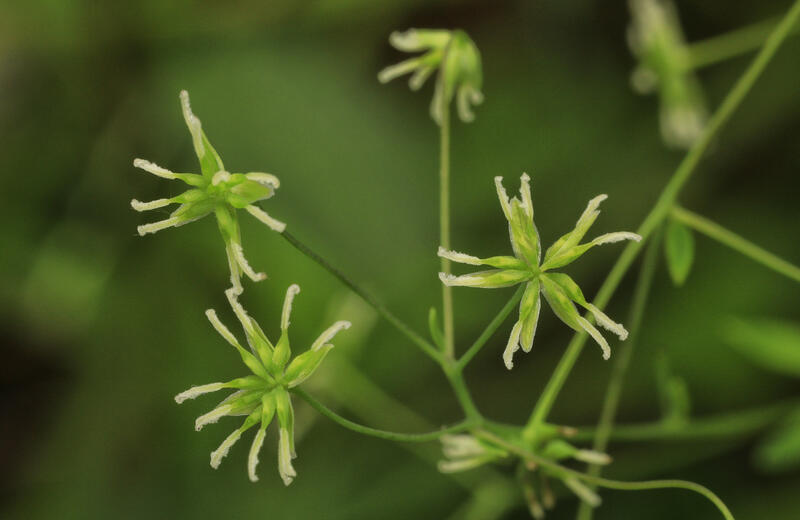
Perennial herb with smooth, erect or leaning stems usually not more than 3 feet (1 meter) tall (some plants are up to 6.5 feet [200 cm] tall); shade-grown plants may have sprawling stems. Leaves are alternate and compound, divided into many stalked leaflets. The leaflets are 0.5 - 2.7 inches (1.2 - 6.8 cm) long and up to 0.5 inch (1.2 cm) wide, 3 - 10 times longer than wide, thin-textured or leathery, oval or elliptic and often 2- or 3-lobed, with slightly inrolled margins. The lower surfaces of leaflets are whitish and hairless or with just a few short-stalked, knob-tipped hairs. Female and male flowers are produced on separate plants in loose, open clusters. Female flowers have 4 or 5 green sepals, no petals, and many small, spindle-shaped ovaries tipped with white styles. Male flowers have 4 or 5 yellow sepals, no petals, and long, dangling stamens with white to pinkish-purple filaments and yellow anthers. Fruits are about 0.2 inch (4.5 - 6 mm) long, oval, ribbed, and hairless.
Early Meadow-rue (Thalictrum dioicum) is also dioecious; it occurs primarily in north Georgia and flowers earlier than T. cooleyi, in April to early May. Its leaflets are not as narrow as T. cooleyi, and are 1 - 5 times longer than wide.
Tall Meadowrue (Thalictrum pubescens) is not dioecious although the flowers on a given plant may be either unisexual or bisexual. The staminal filaments are usually white, rarely lavender. The ovaries and achenes have minute or no stalks. The leaf stalks and leaflet stalks are usually hairy. The leaflets are unlobed or 3- to 5-lobed, and may be leathery or thin-textured. Tall Meadowrue occurs throughut Georgia in bogs, marshes, and swamps; it flowers mid-June–early August.
Skunk Meadowrue (Thalictrum revolutum) is also dioecious and flowers in late spring to mid-summer. Its leaflets are either unlobed or have a large middle lobe and 2 smaller side lobes. The stems and leaves smell like skunk musk when crushed. Its male flowers have white staminal filaments with yellow or brown anthers. It flowers May–August. It occurs throughout Georgia in moist to dry forests, woodlands, and barrens, over mafic or ultramafic bedrock.
There are four rare species of Thalictrum in Georgia:
Thalictrum cooleyi (Cooley's Meadowrue) occurs in pond margins and wet savannas in southeast Georgia. For more information, see: https://georgiabiodiversity.org/portal/profile?group=plants&es_id=18704
Thalictrum coriaceum (Leatherleaf Meadowrue) occurs in sunny openings in rich, moist, rocky woods at high elevation. For more information, see: https://www.georgiabiodiversity.org/portal/profile?group=plants&es_id=18753
Thalictrum dasycarpum (Purple Meadowrue) occurs in wet prairies in the Coosa River valley. For more information, see: http://beta.floranorthamerica.org/Thalictrum_dasycarpum
Thalictrum debile (Trailing Meadowrue) occurs in moist hardwood forests over limestone in northwest Georgia. For more information, see: https://georgiabiodiversity.org/portal/profile?group=plants&es_id=16784
Wet savannas and flatwoods over circumneutral soils, wet borders of low woodlands, also roadsides and powerline rights-of-way through these habitats. Canopy closure prevents flowering but the presence of shrubs seems to provide a favorable microclimate.
Cooley’s Meadowrue is a perennial herb that reproduces sexually by seed and sometimes vegetatively by the spread of rhizomes. Female and male flowers are usually borne on separate plants (a few plants may have perfect flowers with both female and male parts). The flowers are wind-pollinated; insects occasionally visit male flowers to collect pollen but do not visit female flowers. Few seeds are produced and seedlings are rarely seen in the field, probably because the number of female plants is low. Many Cooley’s Meadowrue populations have 3 times as many male plants as female and some have no female plants at all. However, recent research results suggest that, even when the number of male plants is high, seed set is limited by low pollen availability or quality. Some populations are reproducing entirely by the spread of short rhizomes.
Surveys are best conducted during flowering (mid-May–September, possibly earlier when winter-burned); the leaflets are distinctive throughout the growing season.
Georgia, Florida, and North Carolina.
Conversion of habitat to pine plantations or agriculture. Fire suppression and encroachment by woody species. Invasion by exotic pest plants such as Japanese Honeysuckle. Small population size leading to inbreeding, genetic drift, and reduced gene flow. Recent research has found that seeds germinate best after an extended cold period; higher temperatures related to climate change may further limit sexual reproduction in this species.
| Threat 1 | Threat 2 | Threat 3 | |
|---|---|---|---|
| General Threat | Natural system modifications | Transportation & service corridors | Other options |
| Specific Threat | None | None | None |
Thalictrum cooleyi is ranked S1 by the Georgia Department of Natural Resources, indicating that the species is critically imperiled in Georgia. It is listed as Endangered by the State of Georgia and the U.S. Fish and Wildlife Service. Eight populations have been documented in Georgia; only one is protected on conservation land. Georgia's populations differ from North Carolina and Florida plants in several ways and may represent a new species, endemic to Georgia.
Increase population size through ex situ seed propagation and plant reintroduction. Burn every 2 - 3 years to control woody plant encroachment. Monitor sites for invasive pest plants and eradicate when needed. Prevent human disturbances to soil and hydrology. Protect sites from conversion to pine plantations, pastures, and residential and commercial developments. Address climate change.
Ahles, H.E. 1959. Thalictrum cooleyi sp. nov. Brittonia 11: 68-70. https://www.jstor.org/stable/2805173?seq=1#metadata_info_tab_contents
Chafin, L.G. 2007. Field guide to the rare plants of Georgia. State Botanical Garden of Georgia and University of Georgia Press, Athens.
Chafin, L.G. 2000. Field guide to the rare plants of Florida. Florida Natural Areas Inventory, Tallahassee.
Dietrick, E.M. 2016. Embryo development, seed bank potential, and germination of the federally endangered herb of pine savannas, Thalictrum cooleyi. Honors thesis, East Carolina University. http://hdl.handle.net/10342/5638
Fortner, A.R. 2015. Insights into the habitat and breeding biology of the federally endangered herbaceous plant, Thalictrum cooleyi Ahles. Master's Thesis, East Carolina University. http://hdl.handle.net/10342/4926
Fortner, A.R., C.L. Jolls, and C. Goodwillie. 2016. Important biological knowledge for management of Cooley's Meadowrue (Thalictrum cooleyi), a federally endangered endemic of pine savannas. Natural Areas Journal 36(3): 288-301. https://bioone.org/journals/Natural-Areas-Journal/volume-36/issue-3/043.036.0309/Important-Biological-Knowledge-for-Management-of-Cooleys-Meadowrue-Thalictrum-cooleyi/10.3375/043.036.0309.short
GADNR. 2020. Element occurrence records for Thalictrum cooleyi. Georgia Department of Natural Resources, Wildlife Resources Division, Social Circle, Georgia.
Keener, C.S. 1976. Studies in the Ranunculaceae of the southeastern United States. II. Thalictrum L. Rhodora 78:457-472. https://www.jstor.org/stable/23311223?seq=1#metadata_info_tab_contents
Kral, R. 1983. A report on some rare, threatened, or endangered forest-related vascular plants of the South. Technical Publication R8-TP2. United States Forest Service, Atlanta.
NatureServe. 2020. Thalictrum cooleyi species account. NatureServe Explorer. Arlington, Virginia. https://explorer.natureserve.org/Taxon/ELEMENT_GLOBAL.2.137457/Thalictrum_cooleyi
Park, M.M. and D. Festerling, Jr. 1997. Flora of North America, Vol. 3. Oxford University Press, New York. http://beta.floranorthamerica.org/Thalictrum_cooleyi
Patrick, T.S., J.R. Allison, and G.A. Krakow. 1995. Protected plants of Georgia. Georgia Department of Natural Resources, Natural Heritage Program, Social Circle.
USFWS. 2018. Cooley’s meadowrue (Thalictrum cooleyi) species profile and related documents. U.S. Fish and Wildlife Service. https://ecos.fws.gov/ecp0/profile/speciesProfile?sId=3281http://endangered.fws.gov.
Weakley, A.S. 2015. Flora of the southern and mid-Atlantic States. University of North Carolina Herbarium, University of North Carolina, Chapel Hill. http://www.herbarium.unc.edu/flora.htm
Linda G. Chafin
L. Chafin, Sept. 2008: original account
K. Owers, Feb. 2010: added pictures
L. Chafin, May 2020: updated original account.