


Loading profile. Please wait . . .
Streptopus lanceolatus var. lanceolatus
Rosy Twisted-stalk




Federal Protection: No US federal protection
State Protection: Threatened
Global Rank: G5T5
State Rank: S1
Element Locations Tracked in Biotics: Yes
SWAP 2015 Species of Greatest Conservation Need (SGCN): Yes
SWAP 2025 Species of Greatest Conservation Need (SGCN): Yes
2025 SGCN Priority Tier: High Conservation Concern
Element Occurrences (EOs) in Georgia: 4
Habitat Summary for element in Georgia: High elevations boulderfields
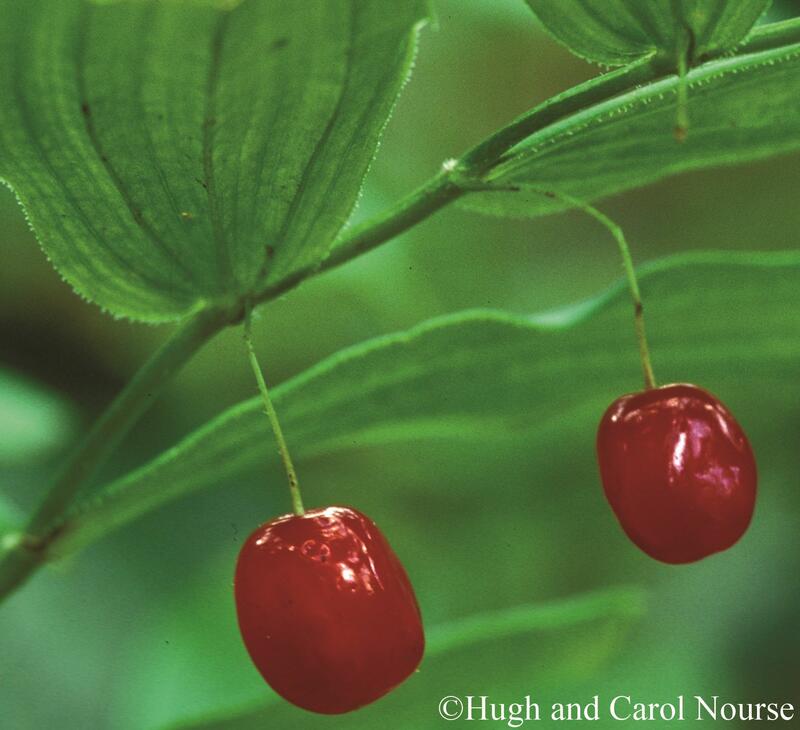
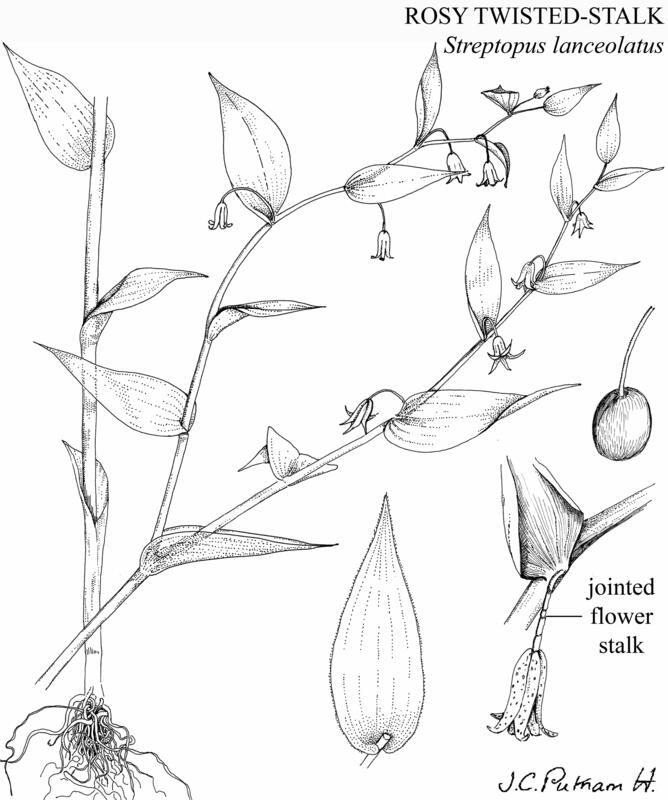
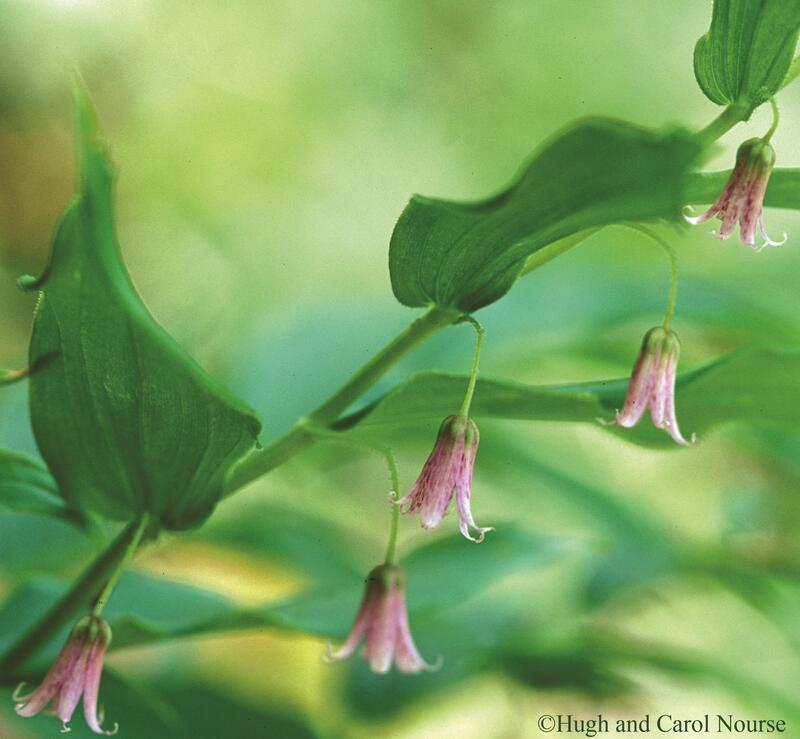
Perennial herb with erect, branched or unbranched, zigzag stems 6 - 30 inches (15 - 80 cm) tall. The leaves are 2 - 4 inches (5 - 10 cm) long and 0.8 - 1.8 inches (2 - 4.5 cm) wide, alternate, oval with pointed tips and rounded bases that clasp the stem; the margins are glandular-hairy. The flowers hang from delicate, jointed flower stalks that arise at the junction of leaf and stem, with 1 or 2 flowers per stalk; the flowers are up to 0.4 inch (1 cm) long, bell-shaped with 6 rosy-pink tepals (3 petals + 3 sepals) streaked or dotted with darker pink. Fruits are less than 0.4 inch (1 cm) long, round or oval, bright red.
Yellow Mandarin (Disporum lanuginosum, synonym Prosartes lanuginosa) has orange fruits and its flowers occur only at the tips of branches.
Solomon’s Seal (Polygonatum biflorum) has one unbranched stem, 2 white or yellow flowers per flower stalk, and black fruits.
Solomon’s Plume (Smilacina racemosa, synonym Maianthemum racemosum) has one unbranched stem with a cluster of white flowers at the tip of the stem.
White Twisted Stalk (Streptopus amplexifolius) occurs in North Carolina and Virginia, where it is rare, and in northern and western North America, but has not been seen in Georgia.
Rich, moist, high-elevation coves and boulderfields in Georgia's Blue Ridge.
Rosy Twisted-stalk is a perennial herb that reproduces sexually by seed and vegetatively by the spread of rhizomes. The flowers are probably pollinated by bees and flies. The bright red fruit is undoubtedly eaten, and its seeds dispersed, by animals.
Surveys are best conducted during flowering (April–mid-May) and fruiting (June–July).
Variety lanceolatus occurs from Georgia north along the Appalachians to Newfoundland and Labrador. Variety longipes occurs in the Midwest, and variety curvipes in the Pacific Northwest.
Logging and clearing in mountain coves and boulderfields. Rooting by feral hogs. Deer browsing. Infestation by the Lily Leaf Beetle [Lilioceris lilii (Scopoli) (Coleoptera: Chrysomelidae)].
| Threat 1 | Threat 2 | Threat 3 | |
|---|---|---|---|
| General Threat | Agriculture & aquaculture | Biological resource use | Invasive & other problematic species, genes & diseases |
| Specific Threat | Wood & pulp plantations | Logging & wood harvesting | None |
Streptopus lanceolatus var. lanceolatus is ranked S1 by the Georgia Department of Natural Resources, indicating that the species is critically imperiled in Georgia. Four populations have been documented in Georgia, all in the Chattahoochee National Forest.
Georgia’s plants are the southernmost populations of this species. Plants occurring at the periphery of a species’ range are thought to be of special conservation importance. Peripheral populations are usually smaller and less genetically diverse within the population, but genetically divergent from centrally located populations. These genetic differences may confer special survival traits that plants in other portions of the species’ range lack, such as the ability to survive changes in the climate or the arrival of a new pathogen. Peripheral populations may be in the process of evolving into a new species. They are especially deserving of conservation action.
Avoid logging and mechanical clearing in mountain coves and boulderfields. Direct hikers away from boulderfields and other sensitive botanical areas. Eradicate feral hogs. Limit the size of Georgia's deer herd.
Blackman, C.K., N. Cappuccino, and P.G. Mason. 2016. First record of Lilioceris lilii (Scopoli) (Coleoptera: Chrysomelidae) on Lilium michiganense Farwell and confirmation of its association with Streptopus lanceolatus (Aiton) Reveal (Liliaceae). The Coleopterists Bulletin 70(3): 482-484. https://doi.org/10.1649/0010-065X-70.3.482
Chafin, L.G. 2007. Field guide to the rare plants of Georgia. State Botanical Garden of Georgia and University of Georgia Press, Athens.
GADNR. 2020. Element occurrence records for Streptopus lanceolatus var. lanceolatus. Georgia Department of Natural Resources, Wildlife Resources Division, Social Circle, Georgia.
NatureServe. 2020. Streptopus lanceolatus species account. NatureServe Explorer. Arlington, Virginia. https://explorer.natureserve.org/Taxon/ELEMENT_GLOBAL.2.149264/Streptopus_lanceolatus
Radford, A.E., H.E. Ahles, and C.R. Bell. 1968. Manual of the vascular flora of the Carolinas. University of North Carolina Press, Chapel Hill.
Reveal, J.L. 1993. Streptopus lanceolatus (Aiton) Reveal, a new name for Streptopus roseus Michx. (Convallariaceae). Phytologia 74: 185-189.
Smith, R.M. 1998. Wildflowers of the southern mountains. University of Tennessee Press, Knoxville.
Utech, F.H. 2003. Streptopus lanceolatus species account. Flora of North America, Vol. 26. Oxford University Press, New York. http://beta.floranorthamerica.org/Streptopus_lanceolatus
Weakley, A.S. 2015. Flora of the southern and mid-Atlantic States. University of North Carolina Herbarium, University of North Carolina, Chapel Hill. http://www.herbarium.unc.edu/flora.htm
Wiegmann, S.M. and D.M. Waller. 2005. Fifty years of change in northern upland forest understories: identity and traits of ‘‘winner’’ and ‘‘loser’’plant species. Biological Conservation 129: 109-123.
Linda G. Chafin
L.Chafin, Sep. 2008: original account.
D.Weiler, Feb. 2010: added pictures.
L. Chafin, May 2020: updated original account.