


Loading profile. Please wait . . .
Ptilimnium ahlesii Weakley & G. L. Nesom
Coastal Bishopweed




Federal Protection: No US federal protection
State Protection: No Georgia state protection
Global Rank: G2
State Rank: S1
Element Locations Tracked in Biotics: Yes
SWAP 2015 Species of Greatest Conservation Need (SGCN): Yes
SWAP 2025 Species of Greatest Conservation Need (SGCN): Yes
2025 SGCN Priority Tier: Highest Conservation Concern
Element Occurrences (EOs) in Georgia: 3
Habitat Summary for element in Georgia: Tidal freshwater marshes
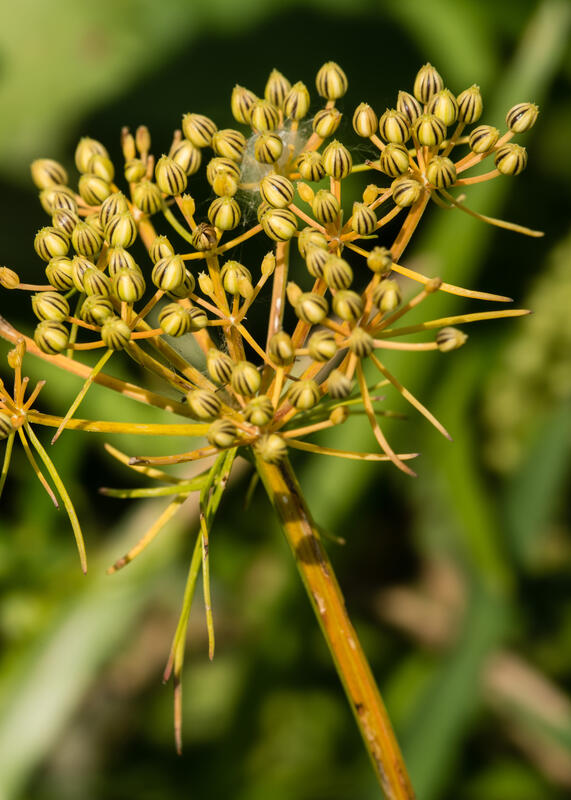
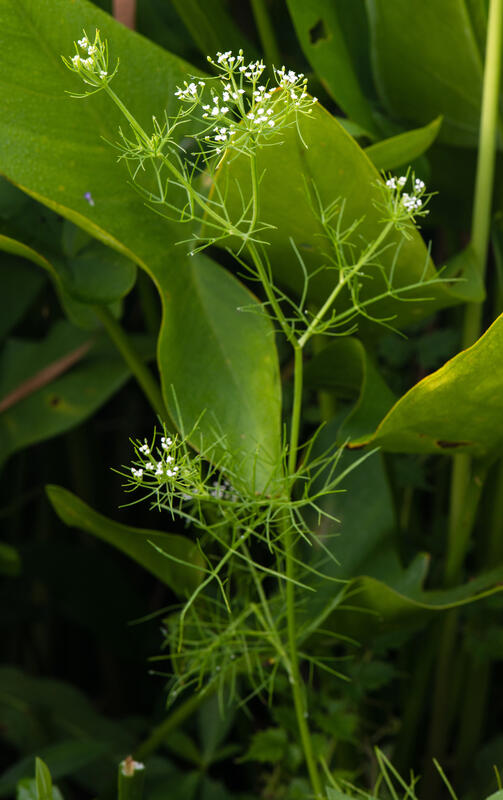
Annual herb with erect, hairless stems 1.3 - 4.2 feet (40 - 130 cm) tall, either unbranched or branched only above mid-stem. Lower stem leaves are narrowly needle-like or with a few, very narrow (< 2 mm) segments, leaves usually withered away by flowering time. Mid- and upper stem leaves are 1 - 8.2 inches (3 - 21 cm) long, divided into 15 - 40 very narrow (< 2 mm) or flattened segments; the leaf stalks are 1 - 10 inches (3 - 25 cm) long, broadly winged and 5-ribbed. Flower clusters are flat-topped umbels, composed of 5 - 7 (occasionally up to 13) smaller, flat-topped clusters (umbelets); both the umbel and the umbelets are surrounded at their bases by a whorl of narrow, sometimes finely divided, bracts. Each umbelet has 5-8 small, white, 5-petaled flowers. Fruits are 2.7 - 4.2 mm long and 1.8 - 2.2 mm wide, slightly flattened and ribbed.
Eastern Bishopweed (Ptilimnium capillaceum) is an annual plant that closely resembles Coastal Bishopweed, and the two may be found growing together. The mid- and upper stem leaves of Eastern Bishopweed are divided into 50 very fine segments usually < 0.5 mm wide (unless submerged), each node usually bearing 3 segments. Each of its umbels has 10 or more umbelets, and each umbelet has 10 or more flowers. The bracts beneath the umbels and the umbelets may be undivided or have up to 5 narrow segments. Its fruits are 1.4 - 2.5 mm long and 0.8 - 1.2 mm wide. Eastern Bishopweed flowers June–August and fruits July–September. It occurs in a variety of wet habitats, including tidal freshwater marshes as well as inland wetlands such as ditches, pond shores, swamps, and wet flatwoods.
Big Bishopweed (Ptilimnium costatum) is a perennial plant with a small, rounded, bulb-like corm at the base of the stem. Its mid-stem leaves have 8 - 16 nodes, each node usually bearing more than 4 whorled segments. Its fruits are 2.2 - 4 mm long. It flowers July–October, and fruits mid-July through October. It is also found in tidal freshwater marshes as well as inland wetlands such as wet prairies and bottomland hardwood forests.
Coastal freshwater or slightly brackish tidal marshes.
Coastal Bishopweed is an annual plant that reproduces only by seed. Its flowers are bisexual. Although little information for Coastal Bishopweed’s reproduction is available, closely related species are capable of self-fertilization and are also cross-pollinated by a variety of pollinators, including small bees, flies, and wasps, that visit the flowers for nectar. Its seeds are dispersed by gravity, water, and wind. All members of the carrot family (Apiaceae) are host to the larval (caterpillar) stage of Black Swallowtail (Papilio polyxenes) butterflies.
Surveys are best conducted during flowering, May to early June, because the plants are more conspicuous then and because the flowering time distinguishes Coastal Bishopweed from Eastern Bishopweed (Ptilimnium capillaceum), which flowers mid-June to early August, and from Big Bishopweed (Ptilimnium costatum), which flowers late July to August.
Coastal Bishopweed is known from Chatham County, Georgia north along the South Carolina coast to southeastern North Carolina. Because tidal marshes are seldom surveyed, it may be more widespread than current sightings suggest.
Invasion of coastal freshwater marshes by exotic pest plants, such as Common Reed (Phragmites australis), Water Hyacinth (Eichhornia crassipes), and Chinese Tallow-tree (Triadica sebifera). Rising sea levels caused by global climate change. Pollution of coastal rivers. Salt water intrusion caused by excessive groundwater pumping.
| Threat 1 | Threat 2 | Threat 3 | |
|---|---|---|---|
| General Threat | Natural system modifications | Natural system modifications | Biological resource use |
| Specific Threat | None | None | None |
Ptilimnium ahlesii is ranked S1 by the Georgia Department of Natural Resources, indicating that it is critically imperiled in the state. Two populations have been discovered in Georgia, both in the Savannah River National Wildlife Refuge.
Eradicate exotic pest plants from coastal habitats. Monitor known populations for effects of rising sea levels. Limit groundwater pumping to prevent salt water intrusion in to coastal groundwater supplies.
GADNR. 2020. Element occurrence records for Ptilimnium ahlesii. Georgia Department of Natural Resources, Wildlife Resources Division, Social Circle, Georgia.
Godfrey, R.K. and J.W. Wooten. 1980. Aquatic and wetland plants of the southeastern United States. University of Georgia Press, Athens.
Les, D.H. 2017. Aquatic dicotyledons of North America: ecology, life history, and systematics. CRC Press, New York.
NatureServe. Ptilimnium ahlesii. NatureServe Explorer. NatureServe, Arlington, Virginia. https://explorer.natureserve.org/Taxon/ELEMENT_GLOBAL.2.155204/Ptilimnium_ahlesii
Weakley, A.S. 2015. Flora of the southern and mid-Atlantic States. University of North Carolina Herbarium, University of North Carolina, Chapel Hill. http://www.herbarium.unc.edu/flora.htm
Weakley, A.S., and G.L. Nesom. 2004. A new species of Ptilimnium (Apiaceae) from the Atlantic Coast. Sida 21(2): 743-752. https://www.jstor.org/stable/41968318?seq=1#metadata_info_ tab_contents
Linda G. Chafin
Linda G. Chafin, 21 November 2020: original account