


Loading profile. Please wait . . .
Pediomelum piedmontanum J.R. Allison, M.W. Morris & A.N. Egan
Dixie Mountain Breadroot




Federal Protection: No US federal protection
State Protection: Endangered
Global Rank: G1
State Rank: S1
Element Locations Tracked in Biotics: Yes
SWAP 2015 Species of Greatest Conservation Need (SGCN): Yes
SWAP 2025 Species of Greatest Conservation Need (SGCN): Yes
2025 SGCN Priority Tier: Highest Conservation Concern
Element Occurrences (EOs) in Georgia: 2
Habitat Summary for element in Georgia: Shallow soils over mafic (serpentine) rock, upland longleaf pine-mixed oak savanna and powerline rights-of-way
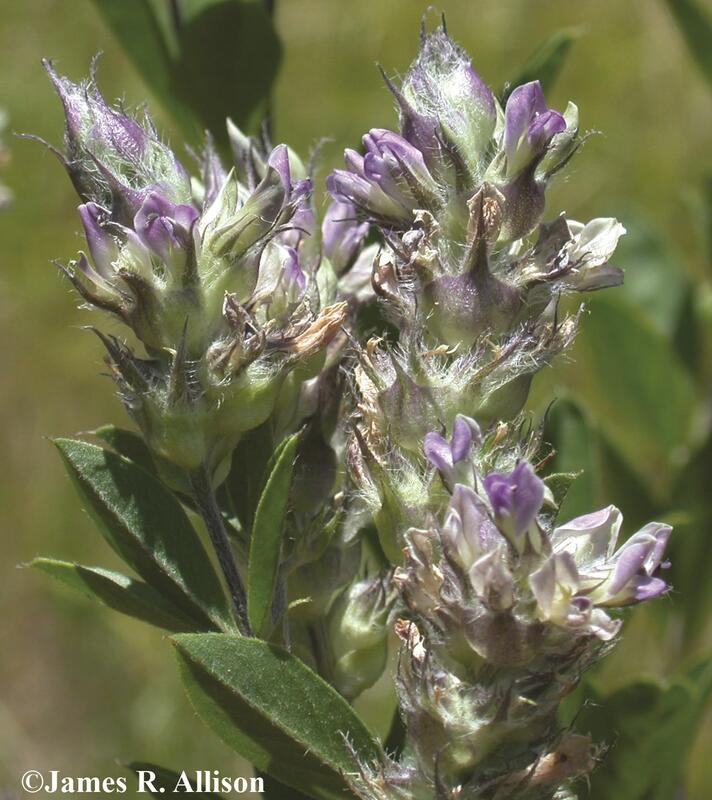
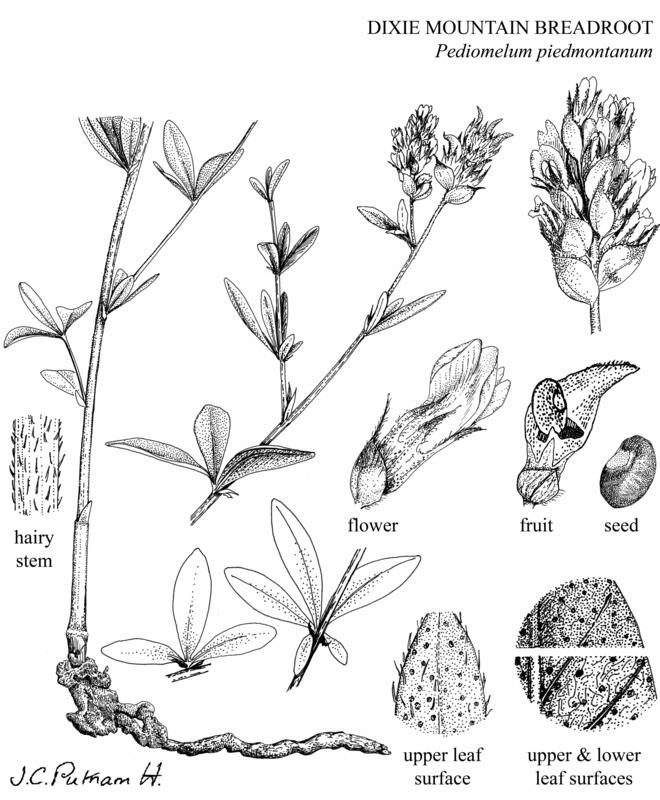
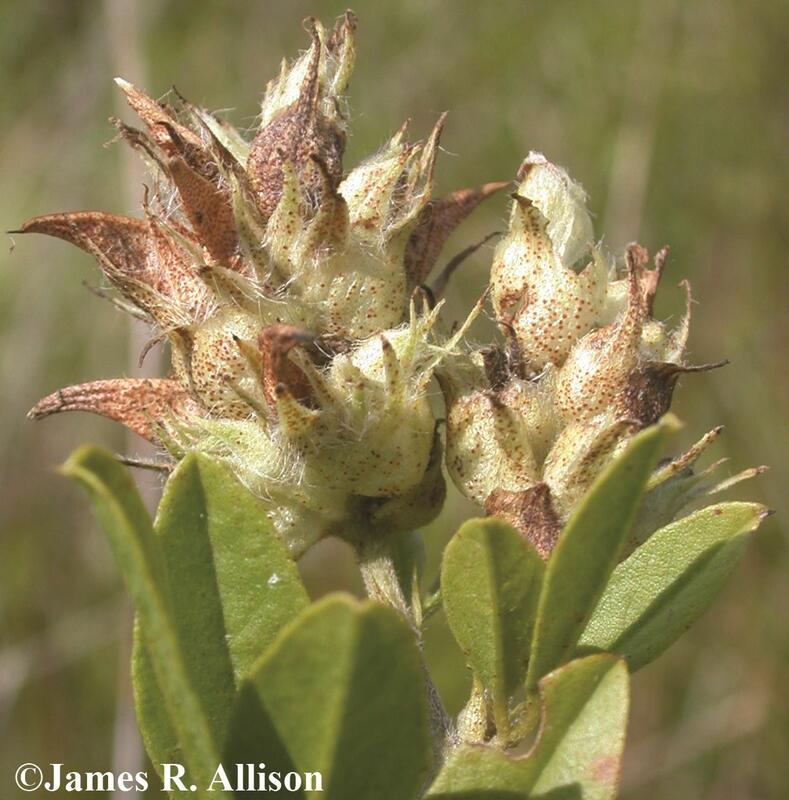
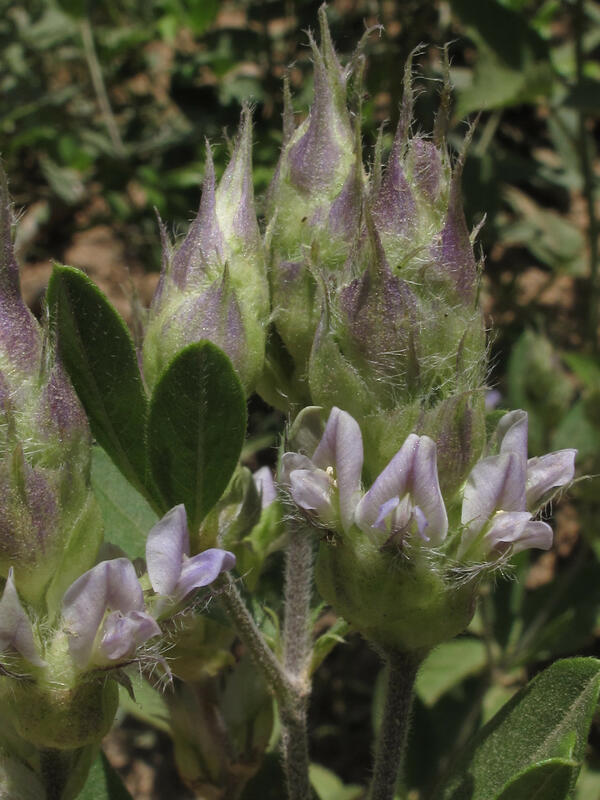
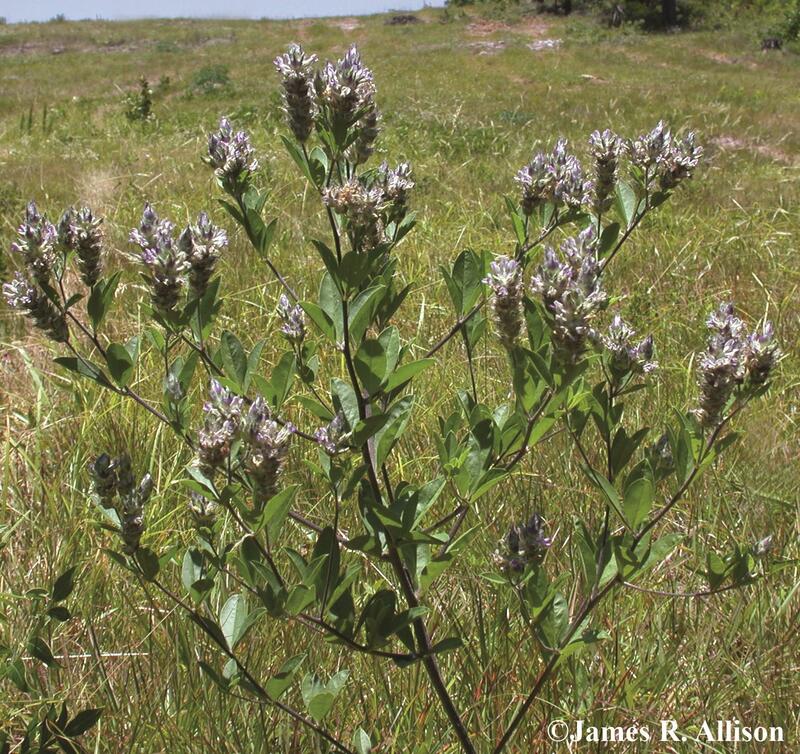
Perennial herb up to 3 feet (1 meter) tall with erect, branching stems covered with tiny, stiff hairs and glandular dots. Its leaves have 3 (rarely 4 or 5) oval leaflets, each up to 2 inches (5 cm) long and 1 inch (2.7 cm) wide, more than twice as long as wide; the leaf stalks are shorter than the leaflet stalks or absent. The flower clusters are about 1 - 2 inches (2.5 - 5.7 cm) long, held at the tips of branches and crowded with several flowers. The flowers are about 0.5 inch (1.4 cm) long, pale lavender-purple or cream-colored with a purple tinge; typical of bean family flowers, their is an upper banner petal and two smaller wing petals that enclose the keel petal; the calyx is hairy and gland-dotted, with five long, pointed lobes and a rounded base. Fruits are about 0.6 inch (1.5 cm) long, including the curved beak, and are covered with amber or brown gland dots. Seeds are about 0.1 inch (3.5 - 5 mm) long, smooth, slightly kidney-shaped, gray-brown.
Pediomelum canescens (Buckroot) occurs in dry, sandy soil in the Coastal Plain. Its leaves have 1 - 3 leaflets, and the pale yellow flowers are loosely arranged so that the stem is easily seen within the cluster.
Pediomelum piedmontanum occurs with Baptisia bracteata (Creamy Wild Indigo), which has pale yellow or cream-colored flowers, widely branching and spreading stems, and grayish green leaves. It's stem rarely exceed 1.5 feet (45 cm) tall.
Nashville Breadroot (Pediomelum subacaule, Special Concern) occurs on limestone glades in Catoosa and Walker Counties. It lacks an aboveground stem; its leaves have long stalks with 5 - 7 leaflets. For more information, see:
https://www.georgiabiodiversity.org/portal/profile?group=plants&es_id=15925
https://www.wildflower.org/plants/result.php?id_plant=PESU5
Sunny openings in dry, rocky woods over serpentine, phyllite, or other rock high in magnesium (i.e. mafic or ultramafic rock); also in roadsides and rights-of-way through these habitats. It usually grows with Blackjack and Post Oak, Shortleaf and Longleaf Pine, Little Bluestem, and Creamy Wild Indigo.
Dixie Mountain Breadroot is a perennial herb adapted to living in a dry, fire-maintained habitat; it thrives in full sun and its large root provides stored resources for drought-resistance and quick re-sprouting after a fire. Dixie Mountain Breadroot reproduces sexually by seed; its flowers are visited by, and probably pollinated by, a variety of insects, including bees and butterflies.
Surveys are best conducted during flowering (late May–July) and fruiting (July–September).
Endemic to one county in Georgia and two counties in South Carolina, just north of the Fall Line.
Conversion of habitat to pine plantations, pasture, and commerical and residential development; broadcast use of herbicides in utility rights-of-way; encroachment by woody plants in the absence of fire or other management.
| Threat 1 | Threat 2 | Threat 3 | |
|---|---|---|---|
| General Threat | Residential & commercial development | Natural system modifications | Transportation & service corridors |
| Specific Threat | None | None | None |
Pediomelum piedmontanum is ranked S1 by the Georgia Department of Natural Resources, indicating that it is critically imperiled in Georgia. Two populations are known from Columbia County; they both occur on private land, one in a powerline right-of-way.
Apply prescribed fire every 3 - 5 years, preferably during the growing season, to reduce woody encroachment. Avoid broadcast use of herbicides in rights-of-way. Limit access to populations to prevent over-collection. Prevent clearing and development of botanically rich areas with mafic or ultramafic bedrock.
Allison, J.R., M.W. Morris, and A.N. Egan. 2006. A new species of Pediomelum (Fabaceae) from the lower Piedmont plateau of Georgia and South Carolina. Sida 22(1): 227-241. https://www.jstor.org/stable/41968575?seq=1
Chafin, L.G. 2007. Field guide to the rare plants of Georgia. State Botanical Garden of Georgia and University of Georgia Press, Athens.
GADNR. 2020. Element occurrence records for Pediomelum piedmontanum. Georgia Department of Natural Resources, Wildlife Resources Division, Social Circle, Georgia.
Isely, D. 1990. Vascular flora of the southeastern United States, Vol. 3, Part 2, Leguminosae (Fabaceae). University of North Carolina Press, Chapel Hill.
NatureServe. 2019. Pediomelum piedmontanum comprehensive report. NatureServe Explorer. Arlington, Virginia. http://explorer.natureserve.org/servlet/NatureServe?searchName= Pediomelum+piedmontanum
Weakley, A.S. 2015. Flora of the southern and mid-Atlantic States. University of North Carolina Herbarium, University of North Carolina, Chapel Hill. http://www.herbarium.unc.edu/flora.htm
Linda G. Chafin
L. Chafin, Jul. 2008: original account
K. Owers, Feb. 2010: added pictures
L. Chafin, Mar. 2020: updated original account