


Loading profile. Please wait . . .
Asplenium heteroresiliens W.H. Wagner
Wagner's Spleenwort




Federal Protection: No US federal protection
State Protection: Threatened
Global Rank: G2
State Rank: S1
Element Locations Tracked in Biotics: Yes
SWAP 2015 Species of Greatest Conservation Need (SGCN): Yes
SWAP 2025 Species of Greatest Conservation Need (SGCN): Yes
2025 SGCN Priority Tier: Highest Conservation Concern
Element Occurrences (EOs) in Georgia: 5
Habitat Summary for element in Georgia: Limestone and marl outcrops; tabby ruins
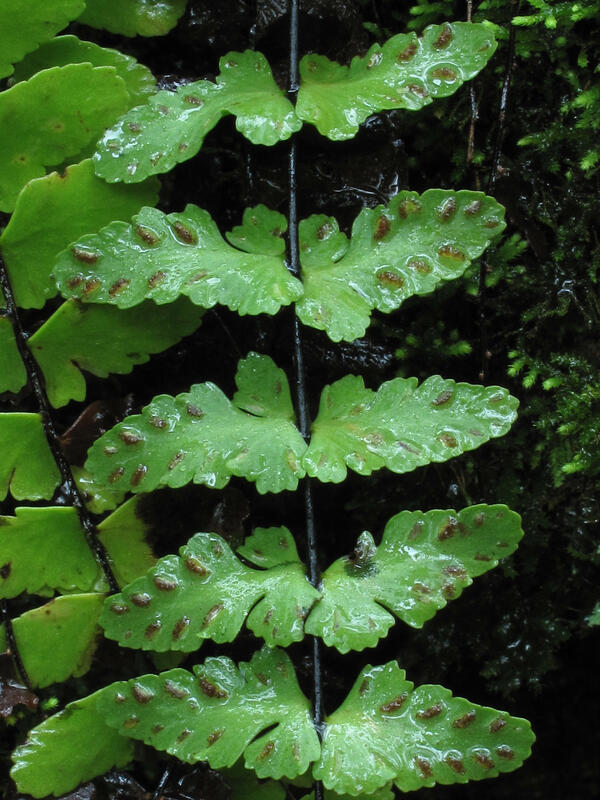
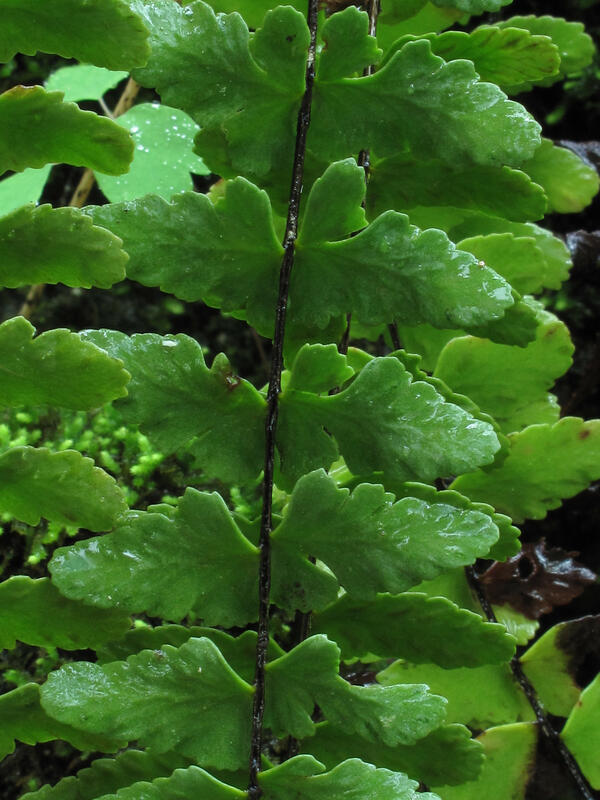
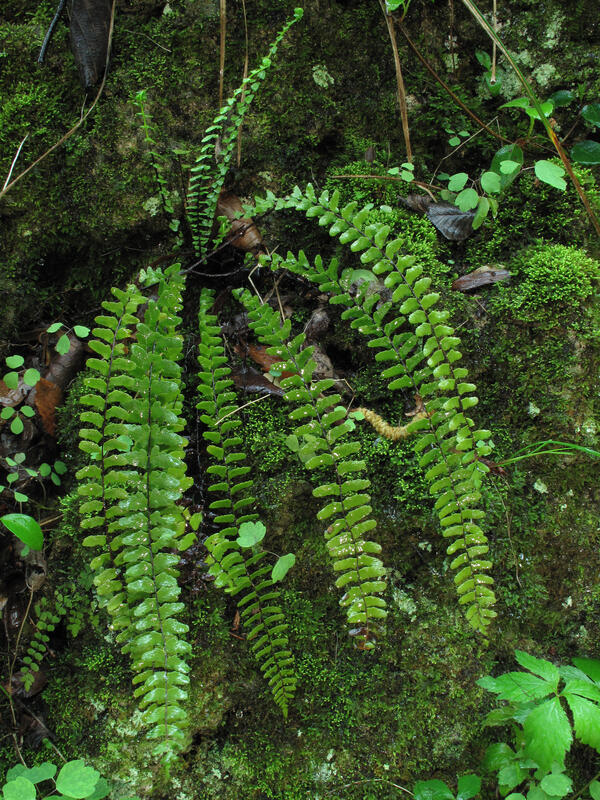
A fern with evergreen fronds. Fronds (leaf blades) are 2 - 6 inches (5 - 15 cm) long and have 12 - 30 pairs of leaflets. The leaf stalk (stipe) is 0.4 - 0.8 inch (1 - 2 cm) long, glossy, dark brown to black. Leaflets (pinnae) are mostly opposite, leathery, scalloped or toothed on both upper and lower margins; the scallop on the upper margin nearest the stalk is usually larger and looks like an “ear." Sori (spore cases) are elongated, in 1 - 5 pairs along small veins on the lower surface of each leaflet; each sorus is partially covered with a flap of white tissue (indusium).
Ebony Spleenwort (Asplenium platyneuron) is common in forests and woodlands throughout Georgia; it has alternate leaflets.
Blackstem Spleenwort (Asplenium resiliens) has opposite leaflets with smooth, untoothed, unscalloped margins; it also occurs in crevices on limestone.
Asplenium bradleyi (Bradley's Spleenwort) occurs in crevices in sandstone, quartzite, and (rarely) granite outcrops in scattered sites throughout north Georgia. For more information, see: http://explorer.natureserve.org/servlet/NatureServe?searchName=Asplenium%20bradleyi AND http://beta.floranorthamerica.org/Asplenium_bradleyi
Asplenium heterochroum (Varicolor Spleenwort) occurs on limestone outcrops and marl exposures in the Coastal Plain. For more information, see: http://beta.floranorthamerica.org/Asplenium_heterochroum
Asplenium ruta-muraria var. cryptolepis (American Wall-rue) occurs on limestone and other calcareous rocks in northwest Georgia. For more information, see: http://beta.floranorthamerica.org/Asplenium_heterochroum AND https://www.carolinanature.com/plants/apsleniumruta-muraria.html
Asplenium x kentuckiense occurs on sandstone and granitic cliffs and ledges in northeast Georgia. For more information, see: https://www.jstor.org/stable/1545932?seq=1#metadata_info_tab_contents https://en.wikipedia.org/wiki/Asplenium_%C3%97_kentuckiense
Asplenium x trudellii (Trudell's Spleenwort) occurs on sandstone, phyllite, and schist outcrops in the Piedmont and Cumberland Plateau in Georgia. For more information, see: https://en.wikipedia.org/wiki/Asplenium_%C3%97_trudellii
Limestone ledges, tabby walls, caves, and outcrops of marl (sandy clay derived from limestone or shell).
Marl Spleenwort originated as a hybrid between Blackstem Spleenwort (Asplenium resiliens) and Varicolor Spleenwort (A. heterochroum) which is why one of the accepted scientific names for this species includes the “x” symbol. In appearance, it is intermediate between the two “parents.” However, Marl Spleenwort produces fertile spores and is not dependent on crosses between its “parents” to perpetuate itself. It does, however, produce some infertile, misshapen spores along with its fertile spores.
Surveys may be conducted year-round since fronds are evergreen. Sori are produced April through October.
Georgia, Florida, Alabama, South Carolina, and North Carolina.
Destruction and degradation of habitat by exotic invasive species, cave explorers, and developers.
| Threat 1 | Threat 2 | Threat 3 | |
|---|---|---|---|
| General Threat | Other options | Invasive & other problematic species, genes & diseases | Biological resource use |
| Specific Threat | None | None | None |
Asplenium heteroresiliens is ranked S2 by the GA Department of Natural Resources, indicating that it is imperiled in the state. It is listed as Threatened by the state of Georgia. Fewer than 5 populations are known in Georgia, and only two are protected in conservation areas.
Control exotic weeds, especially Spider Brake Fern (Pteris multifida) and Chinese Brake Fern (Pteris vittata) at limestone outcrops. Protect caves and cave openings, historic tabby buildings, and limestone and marl outcrops from disturbance.
Chafin, L.G. 2007. Field guide to the rare plants of Georgia. State Botanical Garden of Georgia and University of Georgia Press, Athens.
Chafin, L.G. 2000. Field guide to the rare plants of Florida. Florida Natural Areas Inventory, Tallahassee.
Dunbar, L. 1989. Ferns of the Coastal Plain: their lore, legends, and uses. University of South Carolina Press, Columbia.
Wagner, W.H., Jr., R.C. Moran, C.R. Werth. 1993. Species account for Asplenium X heteroresiliens. Flora of North America, Vol. 2, pteridophytes and gymnosperms. Oxford University Press, New York. Accessed 6 January 2020. http://www.efloras.org/florataxon.aspx?flora_id=1&taxon_id=233500188
GADNR. 2019. Element occurrence records for Asplenium heteroresiliens. Georgia Department of Natural Resources, Wildlife Resources Division, Social Circle, Georgia.
Morzenti, V. M. 1966. Morphological and cytological data on southeastern United States species of the Asplenium heterochroum-resiliens complex. American Fern Journal 56: 167-177. https://www.jstor.org/stable/1545935?seq=1#metadata_info_tab_contents
NatureServe. 2019. Asplenium heteroresiliens comprehensive report. NatureServe Explorer. Arlington, Virginia. Accessed 6 January 2020. http://explorer.natureserve.org/servlet/NatureServe?searchName=Asplenium%20heteroresiliens
Nelson, G. 2000. Ferns of Florida. Pineapple Press, Sarasota, Florida.
Patrick, T.S., J.R. Allison, and G.A. Krakow. 1995. Protected plants of Georgia. Georgia Department of Natural Resources, Natural Heritage Program, Social Circle.
Snyder, L.H., Jr. and J.G. Bruce. 1986. Field guide to the ferns and other pteridophytes of Georgia. University of Georgia Press, Athens.
Wagner, W. H., Jr. 1966. Two new species of ferns from the United States. American Fern Journal 56:3-17. https://www.jstor.org/stable/1546108?seq=1#metadata_info_tab_contents
Weakley, A.S. 2015. Flora of the southern and mid-Atlantic States. University of North Carolina Herbarium, University of North Carolina, Chapel Hill. http://www.herbarium.unc.edu/flora.htm
Linda G. Chafin
Linda Chafin: original account.
K. Owers, Jan. 2010: updated status and ranks, added pictures.
L. Chafin, Jan 2020: updated original account.