

Loading profile. Please wait . . .
Spiranthes longilabris Lindl.
Giant-spiral Ladies'-tresses




Federal Protection: No US federal protection
State Protection: No Georgia state protection
Global Rank: G3
State Rank: S1
Element Locations Tracked in Biotics: Yes
SWAP 2015 Species of Greatest Conservation Need (SGCN): Yes
SWAP 2025 Species of Greatest Conservation Need (SGCN): Yes
2025 SGCN Priority Tier: High Conservation Concern
Element Occurrences (EOs) in Georgia: 3
Habitat Summary for element in Georgia: Pine flatwoods, wet savannas, low hammocks with saw palmetto
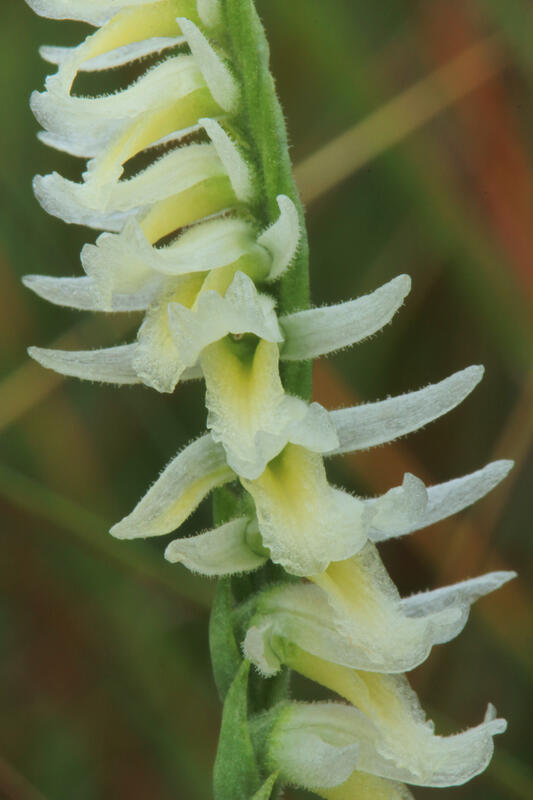
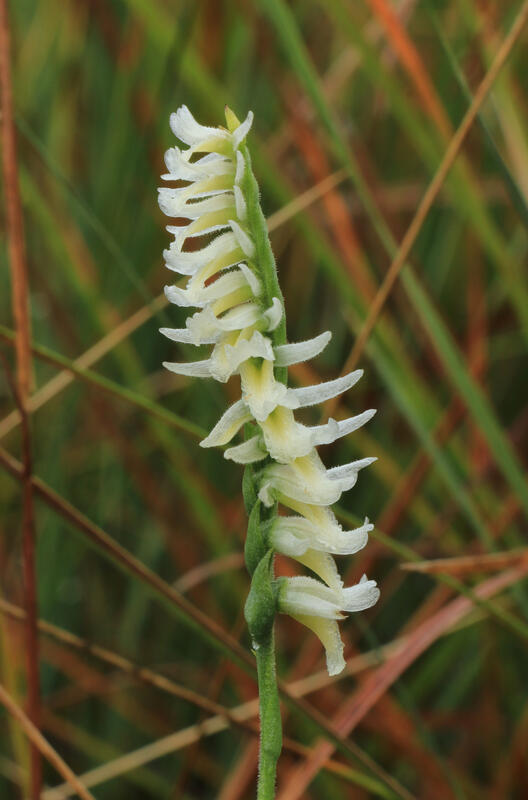
Perennial herb with an erect stem 6 – 20 inches (15 - 50 cm) tall and sparsely covered with club-tipped hairs. Leaves are 2 - 6 inches (5 - 15 cm) long and less than ¼ inch (0.5 cm) wide, spreading, linear-lanceolate, keeled, usually withered before flowering; reduced to small bracts near the top of the stem. Inflorescence a loosely or tightly spiraled spike with 5 - 9 flowers per spiral, for a total of 10 - 30 white and yellow flowers per spike; rachis of the spike is sparsely hairy with some stalked glands. Flowers are about 0.5 inch (1-1.5 cm) long; the lateral sepals are widely spreading and tapered; the upper sepal and two petals overlap to form an upturned hood over the center of the flower; the lip petal is 0.3 - 0.4 inch (8 - 11 mm) long, oblong, white with a yellow center, dilated at the base, generally downcurved but upturned and scalloped at the tip; the flower is sparsely covered with glandular hairs. Fruits are capsules about 0.3 inch (7-8 mm) long.
Although Giant Spiral Ladies-tresses resembles many other species of Ladies-tresses, it is easily distinguished by a combination of these traits: leaves absent at flowering time (October–December); a relatively large flower with widely spreading, narrowly tapered, entirely white lateral sepals; the lip petal is dilated at the base, yellow in the center, and upturned and scalloped (but not fringed) at the tip.
Seven species of Ladies-tresses are rare in Georgia:
Downy Slender Ladies-tresses (Spiranthes brevilabris) occurs in frequently burned wet, pine savannas and flatwoods, cemeteries, and on roadsides through these habitats in the Coastal Plain. For more information, see: https://www.georgiabiodiversity.org/portal/profile?group=plants&es_id=18671
Eaton’s Ladies-tresses (Spiranthes eatonii) occurs in frequently burned pine savannas and dry flatwoods, cemeteries, and on roadsides through these habitats in the Coastal Plain. For more information, see: http://beta.floranorthamerica.org/Spiranthes_eatonii
Florida Ladies-tresses (Spiranthes floridana) occurs in wet savannas, mowed grassy openings in the Okefenokee area, and on roadsides through these habitats in the Coastal Plain. For more information, see: https://www.georgiabiodiversity.org/portal/profile?group=plants&es_id=17359
Long-lipped Ladies-tresses (Spiranthes longilabris) occurs in low hammocks with saw palmetto, seasonally wet depressions in pine flatwoods and savannas, fields, and wet roadside ditches in the Coastal Plain. For more information, see: https://www.georgiabiodiversity.org/portal/profile?group=plants&es_id=19007
Great Plains Ladies-tresses (Spiranthes magnicamporum) occurs in northwest Georgia in grassy areas on limestone cedar glades and in prairie openings in the Coosa River valley. For more information, see: https://www.georgiabiodiversity.org/portal/profile?group=plants&es_id=15517
Northern Oval Ladies-tresses (Spiranthes ovalis var. erostellata) occurs in seepy margins of small streams and floodplain forests throughout Georgia except the southeast corner. For more information, see: http://beta.floranorthamerica.org/Spiranthes_ovalis_var._erostellata
Pale Green Ladies-tresses (Spiranthes sylvatica, synonym S. praecox) occurs in Live Oak hammocks and other open woodlands in the Coastal Plain. For more information, see: http://beta.floranorthamerica.org/Spiranthes_praecox
Low hammocks with saw palmetto, seasonally wet depressions in pine flatwoods and savannas, fields, wet roadside ditches.
Giant Spiral Ladies-tresses produces a leafy flower stalk in early fall with 3-5 leaves up to 6 inches long (5-15 cm) and less than 0.2 inch (0.5 cm) wide; these usually wither before flowering though may occasionally persist. Smaller, leaf-like, sheathing bracts remain on the stem during flowering. Ladies-tresses’ flowers are cross-pollinated by bumblebees and halictid bees.
Self-pollination is discouraged by two sequences of events. First, when a flower opens, a tiny structure at the center of the flower (the column) is pressed against the flower’s lip, covering the stigma and leaving only a narrow space into which a bee can insert its tongue in search of nectar. While the stigma is covered, the flower can’t be pollinated. As the bee sips nectar, two pollen packets stick to its proboscis. Once the bee exits the flower, carrying with it that flower’s pollen packets, the column lifts up, exposing the stigma. The next bee that comes along to sip nectar – possibly carrying pollen packets from another plant – may brush against the exposed stigma and deposit the pollen.
Second, in order to discourage the movement of pollen between flowers on the same plant, the flowers in a spike open from the bottom to the top of the spike. Bees usually work their way from the bottom to the top of a flower spike as they gather nectar. If they pick up pollen from flowers at the bottom of the spike, flowers on the same spike nearer the top will not yet be open and receiving pollen. Instead, the bee flies to an open flower on another plant, gathers nectar and deposits its pollen load, thus cross-pollinating that flower. If pollinated, the flowers produce small capsules containing many dust-like seeds that are dispersed by the wind. As with all species of orchid, the seeds of Giant Spiral Ladies-tresses require the presence of certain species of fungi to germinate and support seedlings.
Survey must be conducted during flowering time, October–December.
Georgia, north in the Coastal Plain to southeastern North Carolina, south to southern peninsular Florida, and west in the Coastal Plain to east Texas. It is rare throughout its range.
Fire suppression, destruction of habitat by clearing or conversion to pine plantations and agricultural fields, ditching and draining of flatwoods and savannas. Use of herbicides in roadside maintenance. Changes in hydrology due to altered temperature and rainfall patterns related to climate change are likely to negatively effect this species.
| Threat 1 | Threat 2 | Threat 3 | |
|---|---|---|---|
| General Threat | Natural system modifications | Invasive & other problematic species, genes & diseases | Residential & commercial development |
| Specific Threat | None | None | None |
Giant Spiral Ladies-tresses is ranked S1 by the Georgia Department of Natural Resources, indicating that it is critically imperiled in the state; it is rare and vulnerable throughout its range. Only three populations have been documented in Georgia: two are on a well managed conservation area , and the other in a wet roadside ditch that hasn’t been seen in 30+ years.
Burn flatwoods and savannas every 1-3 years during the growing season; protect flatwoods from ditching and draining and conversion to pine plantations, fields, and development. Avoid use of herbicides in roadside maintenance. Address hydrological effects of climate change. Field surveys should be conducted in suitable habitat throughout southwest Georgia.
Brown, P.M. and S.N. Folsom. 2004. Wild orchids of the southeastern United States, north of peninsular Florida. University Press of Florida, Gainesville.
Catling, P.M. 1983. Pollination of northeastern North American Spiranthes (Orchidaceae). Canadian Journal of Botany 61(4): 1080–1093. https://www.nrcresearchpress.com/doi/abs/10.1139/b83-116
Lis, R. 2002. Species account for Spiranthes longilabris. Flora of North America North of Mexico, vol. 26. Accessed 24 June 2019. http://www.efloras.org/florataxon.aspx?flora_id=1&taxon_id=242101956
GADNR. 2019. Element occurrence records for Spiranthes longilabris. Georgia Department of Natural Resources, Wildlife Resources Division. Social Circle, Georgia.
NatureServe. 2019. Spiranthes longilabris comprehensive report. NatureServe Explorer: an online encyclopedia of life, Version 7.1. NatureServe, Arlington, Virginia. Accessed 24 June 2019. http://explorer.natureserve.org/servlet/NatureServe?searchName=Spiranthes+longilabris
North American Orchid Conservation Center. Species account for Spiranthes longilabris, Long Lipped Ladies' Tresses. https://goorchids.northamericanorchidcenter.org/species/spiranthes/longilabris/
Weakley, A.S. 2015. Flora of the southern and mid-Atlantic States. University of North Carolina Herbarium, University of North Carolina, Chapel Hill. http://www.herbarium.unc.edu/flora.htm
Linda G. Chafin
Linda G. Chafin, 24 June 2019: original account