


Loading profile. Please wait . . .
Fothergilla major (Sims) Lodd.
Large Witch-alder




Federal Protection: No US federal protection
State Protection: Threatened
Global Rank: G3
State Rank: S1
Element Locations Tracked in Biotics: Yes
SWAP 2015 Species of Greatest Conservation Need (SGCN): Yes
SWAP 2025 Species of Greatest Conservation Need (SGCN): Yes
2025 SGCN Priority Tier: High Conservation Concern
Element Occurrences (EOs) in Georgia: 6
Habitat Summary for element in Georgia: Rocky (sandstone, granite) woods; bouldery stream margins
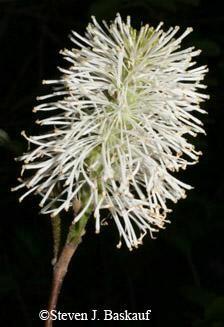
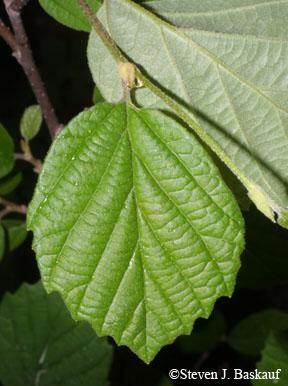
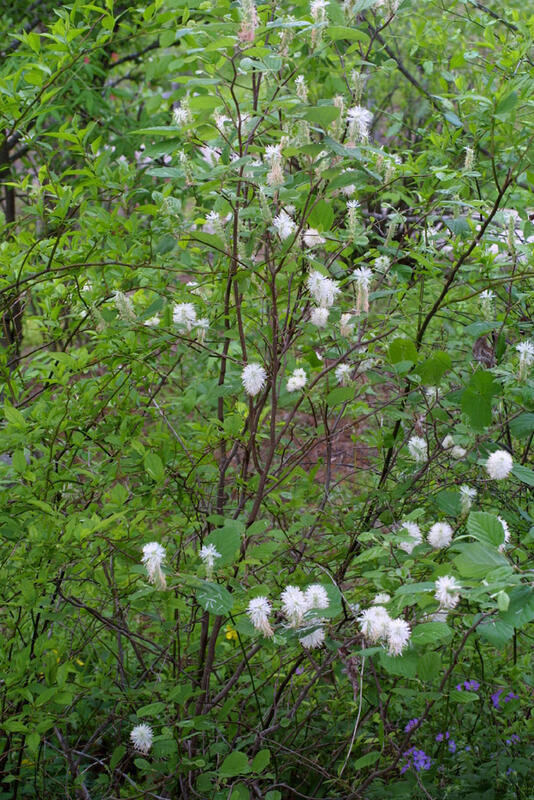
Shrub up to 21 feet tall (6.5 meters), typically about 6 feet (2 meters), densely branched; twigs are robust and have naked (no scales) terminal buds. The leaves are 1 - 5.3 inches (2.5 - 13.5 cm) long and 1.7 - 5 inches (4.2 - 12.5 cm) wide, oval to nearly round, leathery, with blunt teeth on the upper ⅔ of the leaf margins; the leaf base is rounded or broadly wedge-shaped with unequal sides; the upper leaf surface is hairless or has only a few star-shaped hairs, the lower leaf surface has star-shaped hairs; the lowest pair of veins extend for a short length as part of the margin of the leaf; some plants have a waxy coating on the lower leaf surface. Flower clusters are dense “bottlebrush” spikes held at the tips of twigs and contain many flowers. The flowers are bisexual with a bright green pistil and 18 - 32 showy, white stamens; there are no petals and the sepals are tiny and inconspicuous; the flowers are fragrant. Fruit is a beaked capsule 0.2 - 0.5 inch (0.5 - 1.3 cm) long, splitting open to expel 2 shiny, black, pointed seeds. The twigs, buds, and lower leaf surfaces are covered with star-shaped hairs.
Witch Hazel (Hamamelis virginiana) is a large shrub, up to 20 feet tall, that is less densely branched than Witch-alder. It occurs in moist, upland hardwood forests. It has similarly shaped, but fully toothed, leaves; also, the lowest pair of leaf veins are embedded in leaf tissue like the rest of the veins, rather than being part of the margin of the leaf blade. Witch Hazel produces yellow flowers in the late autumn.
Dwarf Witch-alder (Fothergilla gardenii), a similar though smaller species found in Georgia’s Coastal Plain, is listed as Threatened in Georgia. For more information, see: https://www.georgiabiodiversity.org/portal/profile?group=plants&es_id=21157
Mixed hardwood-pine forests on dry, rocky (sandstone or granite) ridges, slopes, and bluffs, usually with acidic soils. Often with pines, Scarlet Oak, and Black Oak; occasionally, found in moist forests with Tulip Tree, Silverbell, and Cucumber Tree along rocky stream banks.
Mountain Witch-alder reproduces sexually as well as vegetatively by the spread of stolons. Its flowers usually emerge before the leaves, in early spring, and are held in showy spikes. The numerous white stamens and sweet fragrance attract bees and other insect pollinators. The fragrant flowers are a rich nectar source. The fruits of Mountain Witch Alder are capsules that shrink as they dry, placing the seeds under pressure. When the seeds are mature, the capsule snaps open and flings the seeds up to 15 feet away, out of reach of competition from the parent plant. Mountain Witch-alder leaves are brilliantly colored in the fall.
Surveys are best conducted during flowering (February–May) and fruiting (spring–early summer) to distinguish from Witch Hazel.
Georgia, South Carolina, North Carolina, Alabama, Tennessee, and Arkansas, mostly in the Piedmont and Blue Escarpment.
Logging and other clearing, housing development on ridgelines, invasion by exotic pest plants.
| Threat 1 | Threat 2 | Threat 3 | |
|---|---|---|---|
| General Threat | Natural system modifications | Energy production & mining | Transportation & service corridors |
| Specific Threat | None | None | None |
Fothergilla major is ranked S1 by the Georgia Department of Natural Resources, indicating that it is critically imperiled in the state. It is listed as Threatened by the state of Georgia. Six populations have been documented in Georgia, five in the last 20 years, but only two occur on conservation lands.
Protect wooded ridgelines, slopes, and bluffs from logging, clearing, and development. Eradicate exotic pest plants.
Chafin, L.G. 2007. Field guide to the rare plants of Georgia. State Botanical Garden of Georgia and University of Georgia Press, Athens.
Dirr, M.A. 1990. Manual of woody landscape plants. Fourth edition. Stipes Publishing Company, Champaign, Illinois.
GADNR. 2020. Element occurrence records for Fothergilla major. Georgia Department of Natural Resources, Wildlife Resources Division, Social Circle, Georgia.
Foote, L.E. and S.B. Jones, Jr. 1989. Native shrubs and woody vines of the southeast. Timber Press, Portland, Oregon.
Fordham, A.J. 1971. Notes from the Arnold Arboretum: propagation of Fothergilla. Arnoldia 31(4): 256-259.
Lance, R. 2004. Woody plants of the southeastern United States: a winter guide. University of Georgia Press, Athens.
Meyer, F.G. 1997. Species account for Fothergilla major. Flora of North America. Vol. 3, Magnoliophyta: Magnoliidae and Hamamelidae. Oxford University Press, New York. http://www.efloras.org/florataxon.aspx?flora_id=1&taxon_id=233500651
NatureServe. 2019. Fothergilla major comprehensive report. NatureServe Explorer. Arlington, Virginia. http://explorer.natureserve.org/servlet/NatureServe?searchName=Fothergilla+major
Radford, A.E., H.E. Ahles, and C.R. Bell. 1968. Manual of the vascular flora of the Carolinas. University of North Carolina Press, Chapel Hill.
Small, J.K. 1933. Manual of the southeastern flora. 1972 Reprint Edition. Hafner Publishing Company, New York.
Weakley, A.S. 2015. Flora of the southern and mid-Atlantic States. University of North Carolina Herbarium, University of North Carolina, Chapel Hill. http://www.herbarium.unc.edu/flora.htm
Weaver, R.E. 1969. Studies in the North American genus Fothergilla. Journal of the Arnold Arboretum 50:599-619.
Weaver, R.E. 1971. The Fothergillas. Arnoldia 31(3): 89-97.
Linda G. Chafin
L. Chafin, May 2008: original account
K. Owers, Jan. 2010: added pictures
L. Chafin, Feb 2020: updated original account