

Loading profile. Please wait . . .
Allium stellatum Nutt. ex Ker-Gawl.
Glade Onion




Federal Protection: No US federal protection
State Protection: No Georgia state protection
Global Rank: G5
State Rank: S1
Element Locations Tracked in Biotics: Yes
SWAP 2015 Species of Greatest Conservation Need (SGCN): No
SWAP 2025 Species of Greatest Conservation Need (SGCN): No
2025 SGCN Priority Tier:
Element Occurrences (EOs) in Georgia: 4
Habitat Summary for element in Georgia: Calcareous prairies, and limestone glades and open cliffs.
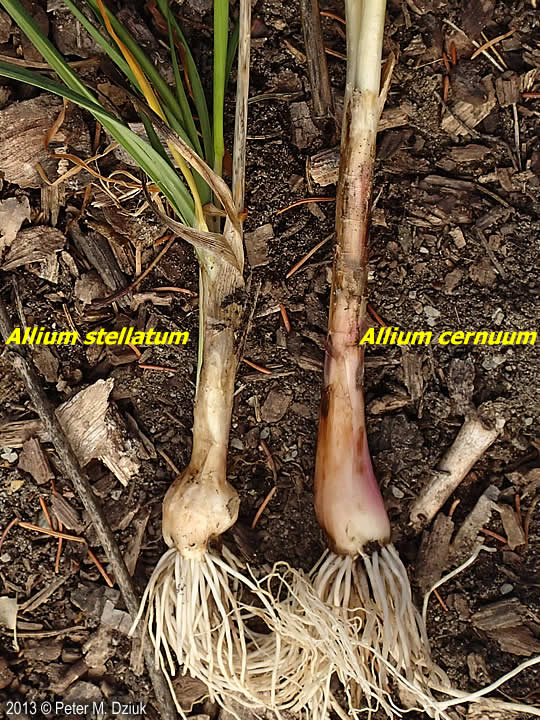
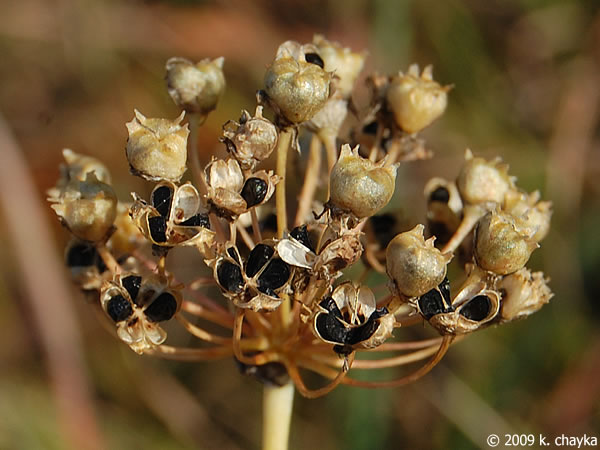
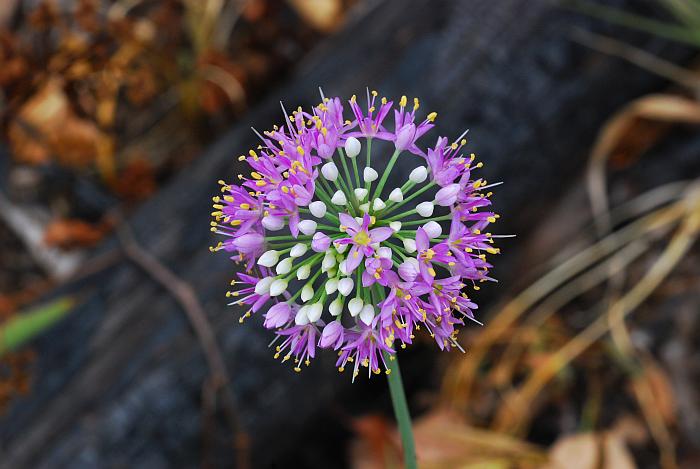
Perennial herb up to 12-18 inches (0.3-0.45 m) tall, with basal leaves (sometimes not present when flowering if the weather is dry). Roots are an ovoid bulb encased by a papery outer coating, with numerous secondary roots off of the bulb base going deeper into the soil. Stems are a scape, green, glaucous (hairless), and erect. The leaves are basal, flat, sometimes recurved, narrow (terete), and solid. Both the bulb and stem have an onion scent. Flowers are an umbel, 1.5-3 inches (3.8-7.5 cm) across, that is nodding, becoming more erect during flowering, with 9-40 small white, pink, or lavender star-like flowers, depending on the substrate. Each flower extends off of a very long pedicel, and is about 0.25" wide (0.6 cm), with 3 petals and 3 tepals that are spreading, and 6 exserted stamens that are yellow to orange. The blooming period occurs during late summer into early fall, and lasts about 1-2 months. Fruits from the flowers are a 3-lobed chambered capsule, with horn-like projections on the apex of each chamber; each chamber holds a single black seed.
In Georgia, Glade Onion is found only in the northwest part of the state, in two counties (See Range Map). 11 other species of Allium are found in Georgia, some of them being widespread while a few are very restricted by habitat type. False Garlic (Nothoscordum bivalve) flowers have yellow centers; its stem is usually less than 1 foot (30 cm) tall, and its leaves and stem lack the onion smell.
One other species of Allium is rare in Georgia, Allium speculae. Allium stellatum is restricted to calcareous habitats in northwest Georgia, while Allium speculae is restricted to granite outcrops in the Piedmont ecoregion of Georgia, and flowers in the late spring to early summer.
Glade Onion is found in dry calcareous habitats, including prairies, limestone glades, and openings on, or edges of limestone cliffs. This species could be found along roadsides or in power line rights-of-way in these habitats, although unconfirmed in Georgia.
Allium stellatum is an herbaceous perennial from a bulb, meaning that it can live several years. It is an open habitat species with a bulb and roots off of the bulb base. A scape with an umbel of flowers emerges each year in late summer and early fall. Flowering lasts for 3 weeks up to 1 month, likely depending on moisture availability. The flowers are pollinated by small bees and flies. Fruits are a small black seed that likely remains near the parent plant, so clusters of plants can be common.
Allium stellatum may be identified in summer and fall by its ovoid papery-covered bulb, terete strap-like solid leaves that may be missing at flowering time, nodding to erect umbel of flowers, with typically pink to lavender flowers that are spreading.
Throughout central North America, with disjunct populations in Tennessee and Georgia. In Georgia, Glade Onion is known from the northwestern portion of the state in two counties (See Range Map).
Logging, conversion of habitat, and wildfires.
Allium stellatum is ranked S1 by the Georgia Department of Natural Resources, indicating that it is critically imperiled in Georgia. It has been observed in four locations in two counties in northwest Georgia. One population is on conservation land.
Protect known populations from habitat being used as logging decks, habitat being used as trash dumps or equipment storage, habitat conversion, and other forms of habitat destruction and fragmentation.
GADNR. 2025. Element occurrence records for Allium stellatum. Georgia Department of Natural Resources, Wildlife Resources Division, Wildlife Conservation Section. Social Circle, Georgia.
Illinois Wildflowers. 2025. https://www.illinoiswildflowers.info/prairie/plantx/cl_onionx.htm.
Minnesota Wildflowers, 2006-2025. https://www.minnesotawildflowers.info/flower/prairie-onion.
Missouri Plants, 2024. https://www.missouriplants.com/Allium_stellatum_page.html.
NatureServe. 2025. Species account for Allium stellatum. NatureServe Explorer: an online encyclopedia of life. NatureServe Network Biodiversity Location Data accessed through NatureServe Explorer [web application]. NatureServe, Arlington, Virginia. Available https://explorer.natureserve.org/Taxon/ELEMENT_GLOBAL.2.161018/Allium_stellatum. February 24, 2025.
Prairie Nursery, 2025. https://www.prairienursery.com/prairie-onion-allium-stellatum.html.
Weakley, A.S. 2020. Flora of the southeast United States. University of North Carolina at Chapel Hill Herbarium, North Carolina Botanical Garden. University of North Carolina, Chapel Hill.
Nathan Thomas
24 February 2025