

Loading profile. Please wait . . .
Corvus corax Linnaeus, 1758
Common Raven




Federal Protection: No US federal protection
State Protection: Rare
Global Rank: G5
State Rank: S2
Element Locations Tracked in Biotics: Yes
SWAP 2015 Species of Greatest Conservation Need (SGCN): No
SWAP 2025 Species of Greatest Conservation Need (SGCN): Yes
2025 SGCN Priority Tier: Data Deficient
Element Occurrences (EOs) in Georgia: 0
Habitat Summary for element in Georgia: High-elevation ridgetops; rocky cliffs
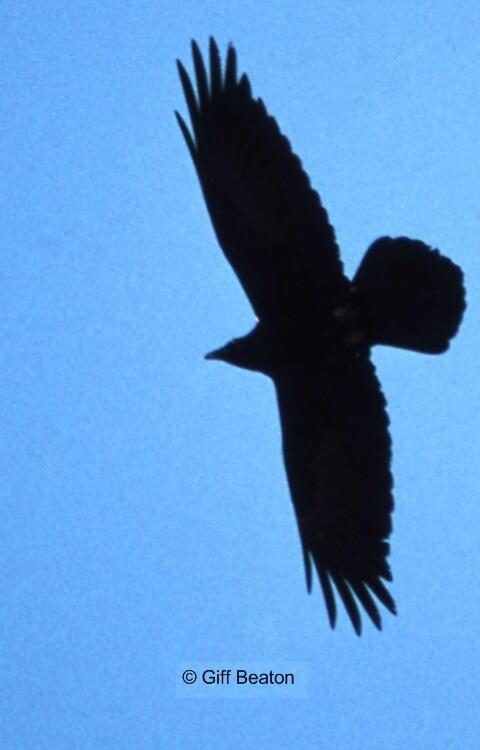
The common raven is the largest member of the crow family with a length of 54-69 cm (21.5-27.0 in) and a wingspan of 117-142 cm (46-56 in). Its entire body is black with a large chisel-like bill, relatively long wings, a wedge-shaped tail, and elongated feathers on its neck called "hackles" that give the throat a shaggy appearance.
The American crow (Corvus brachyrhynchos) is very similar in appearance and its distribution overlaps that of the common raven in Georgia. It is smaller in size with a bill that is somewhat smaller in proportion to its head than that of the raven. The crow's shorter squared-off tail is noticeable in flight and it has shorter wings. In flight it actively flaps whereas the raven has a more hawk-like flight and alternates flapping and gliding and easily soars on thermals and other air currents. The American crow's call is normally a "Caw, Caw, Caw" while the raven uses loud, deep guttural croaking sounds; however, at times American crows can use vocalizations that sound raven-like.
The raven is found in a wide variety of habitats, including rocky seacoasts, steep canyons, dense boreal forests, foothills, mountains, deserts, and Arctic tundra. In Georgia it only occurs in the Blue Ridge Mountains, usually in the vicinity of rocky and remote cliffs, above 1,067 m (3,500 ft). The only known nest site in recent years in the state has been a cliff at Brasstown Bald though several other high elevation areas in Georgia regularly host ravens.
Carrion, garbage, small mammals, berries, nuts, insects, frogs, tadpoles, crayfish, young birds, eggs, and many other food items.
In the Southern Appalachians, nests are usually built on rocky cliff ledges, on the sides of well-shaded cliffs, or in rock crevices; they are rarely built in the tops or crotches of trees. In Georgia the breeding season begins in midwinter, and nests usually have eggs by March and young by April or early May. The large bulky nest of sticks and twigs is heavily lined with mammal fur, bark shreds, dry mosses, grasses, and lichens. Clutch size is usually 3-7 eggs and the female incubates the eggs by herself for 20-25 days before they hatch. The male feeds the female on the nest while she incubates. Both parents feed the young in the nest for 35-42 days until they fledge. There is only one brood per season although replacement clutches are often laid if a nest is destroyed early in the season. Parents feed their young for several weeks after fledging.
Pedestrian surveys along trails at elevations above 1000 m from January through May to locate areas where nesting ravens may be present. Aerial surveys of cliffs, large rock faces, and similar rock substrates in locations likely to have nests. In some areas effective nest searching may also be done from the ground. Annual visits of known nest locations to determine occupancy and possibly track nesting success.
The common raven is found throughout much of North America, parts of Central America, much of Europe, and parts of Asia and North Africa. In the western U.S. it occurs from the Rocky Mountains to the Pacific Ocean. In the eastern U.S. its range includes the northern Midwest, northern New England, and higher elevation areas of the Appalachian Mountains. In Georgia, this species can be found in higher elevation areas of the Blue Ridge Mountains, usually above 1,067 m (3,500 ft). Locations where ravens have been seen consistently include Brasstown Bald, Hightower Bald, and Rabun Bald. They have also been seen in other areas above 1,000 m in Rabun, Union, Towns, and Lumpkin counties.
Raven populations in Georgia are very small and this species seems to prefer some of the most rugged high elevation mountain sites found in the state. While direct habitat loss is not likely to be a significant threat due to the fact that most nesting habitat is on national forest land and protected from development, other human impacts such as disturbance of nest sites by increased recreational use (e.g., rock climbing) could eventually cause the extirpation of this species from Georgia. However, the greatest threat to raven populations in the state over the next several decades may be global climate change. Increasing temperatures and other associated climatic changes could make conditions unsuitable for this species leading to the demise of the small population that presently exists.
| Threat 1 | Threat 2 | Threat 3 | |
|---|---|---|---|
| General Threat | Climate change & severe weather | Human intrusions & disturbance | None |
| Specific Threat | Habitat shifting & alteration | Recreational activities | None |
Breeding Bird Atlas surveys from 1994-2001 documented ravens during the breeding season in seven survey blocks scattered throughout Lumpkin, Rabun, Towns, and Union counties. Sites were located in the Cowrock, Jacks Gap, Mulky Gap, Neels Gap, Rabun Bald, and Satolah 7.5 minute topographic quadrangles. A nest with young was documented at Brasstown Bald in Union County in early May in 1994, 1996, and 1998.
Historically both ravens and crows were persecuted in the eastern U.S., but ravens declined while crows increased. This may have been due in part to the raven's annual reuse of nest sites that made it vulnerable to human disturbance and possibly also due to other facets of its life history. More recently raven populations in the eastern U. S. have increased. Populations in the Southern Appalachians appear to be expanding and are recolonizing areas where they had been extirpated. This may be the result of greater protection from shooting and other forms of persecution and adaptation to some anthropogenic habitat changes. In Georgia, protection of nest sites from human disturbance probably offers the most practical and effective way to try to conserve our small breeding population. Efforts to reduce anthropogenic climate change should also help conservation of this species in Georgia as well.
Bent, A. C. 1946. Life histories of North American jays, crows and titmice. U.S. National Museum Bulletin 191.
Boarman, W. I., and B. Heinrich. 1999. Common Raven (Corvus corax). In A. Poole and F. Gill, eds., The Birds of North America, no. 476. The Birds of North America, Inc., Philadelphia, Pa.
Burleigh, T. D. 1958. Georgia Birds. University of Oklahoma Press, Norman. 746pp.
Hamel, P. B. 1992. The land manager's guide to the birds of the South. The Nature Conservancy, Chapel Hill, NC. 437pp.
Hunter, W. C. 1990. Handbook for nongame bird management in the Southeast Region. U.S. Fish and Wildlife Service, Atlanta, Ga. 178pp.
Johnson, T. W. 2010. Common Raven (Corvus corax). Pp. 266-267 In T. M. Schneider, G. Beaton, T. S. Keyes, and N. A. Klaus, eds. The Breeding Bird Atlas of Georgia. University of Georgia Press, Athens.
Payne, J. A. 1999. Common Raven (Corvus corax). Pp. 40-41 In T. W. Johnson, J. C. Ozier, J. L. Bohannon, J. B. Jensen, and C. Skelton, eds., Protected Animals of Georgia. Georgia Department of Natural Resources, Wildlife Resources Division, Nongame Wildlife–Natural Heritage Section, Social Circle.
Rappole, J. H. 1981. Raven. Pages 978-982 In J. Laerm, ed. A survey of the status, distribution, and abundance of potentially threatened and endangered species. Part III: the birds. Georgia Department of Natural Resources, Atlanta, Ga.
Jerry A. Payne, Terry W. Johnson, Todd M. Schneider, and Nathan A. Klaus
J. Payne-Original Account: 1999
T. Johnson-Breeding Bird Atlas species account: 2010
T. Schneider (modified and edited text): July 2010.
B. Albanese-Added photos and posted: November 2010
N. Klaus and T. Schneider, October 2019; modified and edited text