


Loading profile. Please wait . . .
Elliottia racemosa Muhl. ex Ell.
Georgia Plume




Federal Protection: No US federal protection
State Protection: Threatened
Global Rank: G2?
State Rank: S2S3
Element Locations Tracked in Biotics: Yes
SWAP 2015 Species of Greatest Conservation Need (SGCN): Yes
SWAP 2025 Species of Greatest Conservation Need (SGCN): Yes
2025 SGCN Priority Tier: Highest Conservation Concern
Element Occurrences (EOs) in Georgia: 57
Habitat Summary for element in Georgia: Scrub forests; Altamaha Grit outcrops; open forests over ultramafic rock
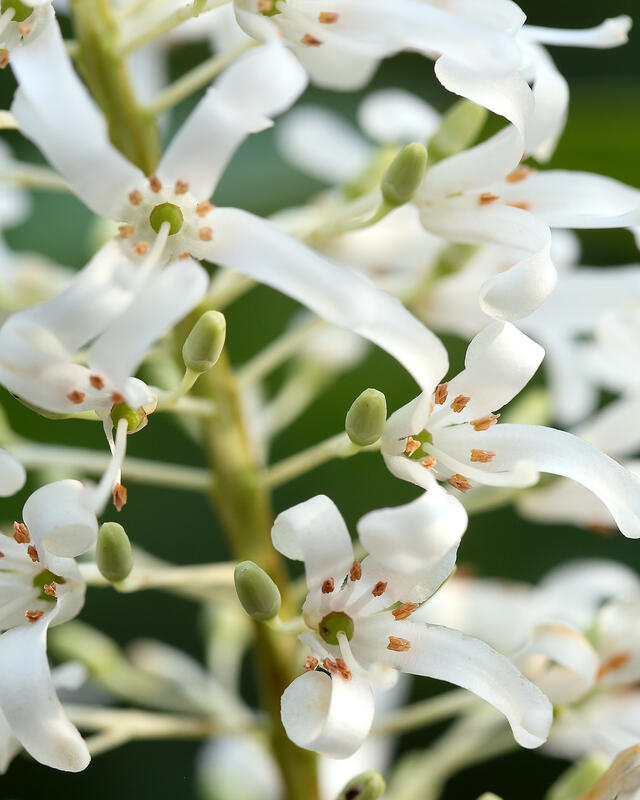
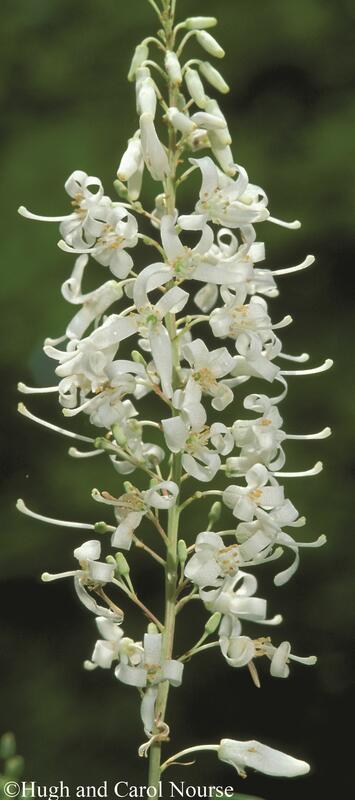
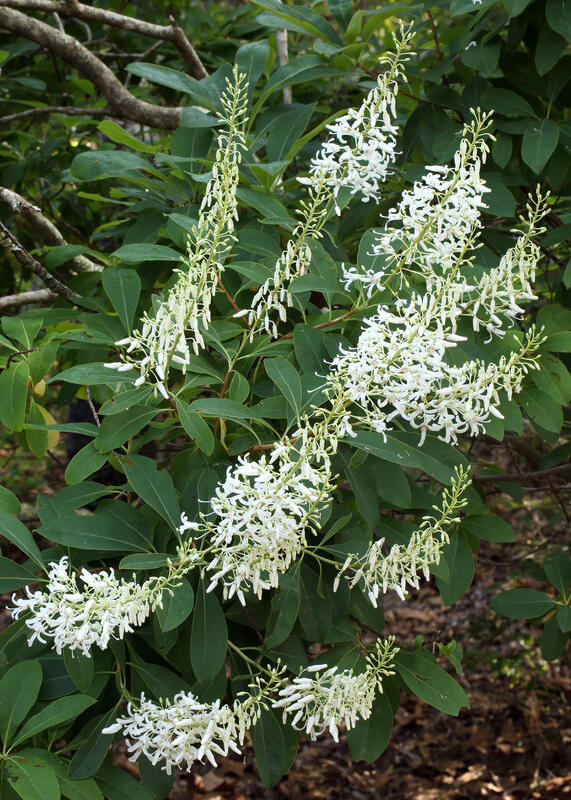
Small tree or shrub up to 33 feet (10 meters) tall, with 1 or more trunks, forming thickets from root sprouts; bark is gray, and vertically cracked; twigs are slightly three-angled. Leaves are 1.6 - 4.7 inches (4 - 12 cm) long and 1.2-2 inches (3 - 5 cm) wide, deciduous, alternate or sometimes appearing whorled, somewhat leathery, often folded upwards along the midvein, tapering at both ends, with a tiny bristle at the tip; upper surface dark green and smooth, lower surface pale and covered with soft hairs; leaf stalks reddish; leaf margins entire. Flower clusters (“plumes”) are showy, 6 - 12 inches (15 - 30 cm) long, held erect at the ends of upper branches. Flowers have 4 - 5 narrow, white petals, about 0.5 inch (1.2 - 1.4 cm) long, curved strongly backwards when fully open; the knob-tipped style extends well beyond the petals and is surrounded by 8 - 10 stamens. Fruit is a round capsule about 0.4 inch (1 - 1.2 cm) wide, splitting into 4 - 5 sections.
American Snowbell (Styrax americanus) and Big-leaf Snowbell (S. grandifolius) have showy, terminal, white-flowered inflorescences similar to Georgia Plume, and their flowers have 5 - 7 petals curved strongly backwards and 10 stamens. Their leaves are thin-textured, not folded along the midvein, and may have low, widely spaced teeth. Both are found in wetter habitats than Georgia Plume, such as moist lower slopes, bottomlands, river banks, and swamps.
None in Georgia
Sand ridges, evergreen hammocks, outcrops of ultramafic or serpentine rock, and Altamaha Grit.
Although Georgia Plume blooms profusely, it rarely produces seeds and apparently spreads only by root sprouts, forming large patches of clonal shrubs with low genetic diversity. Its flowers are visited by numerous types of insects and a few plants even set seeds, yet seedlings have not been observed in the wild. One possible explanation of low seed set may be due to the fact that Georgia Plume plants are incapable of self-pollination and, since most populations consist of large clones, there is little or no opportunity for cross-pollination. When seeds are collected and greenhouse-grown, they produce viable seedlings that readily transplant to the wild, suggesting that environmental factors play at least as large of a role in this problem as do reproductive limitations. Georgia Plume grows in habitats that were historically maintained by frequent, low-intensity fires; the absence of fire likely limits reproduction in some ways not yet discovered.
Surveys are best conducted during flowering (June–August).
Georgia Plume is found only in Georgia; it was once known in South Carolina but that population was destroyed.
Clearcutting, conversion of habitat to agriculture and pine plantations, and fire suppression.
| Threat 1 | Threat 2 | Threat 3 | |
|---|---|---|---|
| General Threat | Agriculture & aquaculture | Natural system modifications | Other options |
| Specific Threat | None | None | None |
Elliottia racemosa is ranked S2S3 by the Georgia Department of Natural Resources, indicating that it is rare and imperiled. It is listed as Threatened by the State of Georgia. More than 50 populations were discovered over the last century, but many of these have been destroyed or are very reduced in size. Only nine populations are protected on conservation lands. None have been known to produce seedlings.
Use hand-clearing or low-intensity fire to reduce competing woody vegetation; smaller plants will survive fire by root-sprouting, older plants will be killed by hot fires and are best burned with cool fires during the winter. Closely monitor the results of all burning and modify burn plans accordingly. Protect sites from clearcutting and mechanical clearing. Continue to research causes of inability of plants to reproduce in the wild.
Ceska, J.F., J.M. Averett, and J.M. Affolter. 2005. Stimulating germination of Elliottia racemosa Muhlenberg ex Elliott seed using charate extract solution. Georgia Plant Conservation Alliance News 3: 23. State Botanical Garden of Georgia, Athens.
Chafin, L.G. 2007. Field guide to the rare plants of Georgia. State Botanical Garden of Georgia and University of Georgia Press, Athens.
Del Trici, P. 1987. Lost and found: Elliottia racemosa. Arnoldia 47(4): 2-8. http://arnoldia.arboretum.harvard.edu/pdf/articles/725.pdf
Duncan, W.H. and M.B. Duncan. 1978. Elliottia in the Piedmont of Georgia. Castanea 43: 182-184. https://www.jstor.org/stable/4032635
GADNR. 2020. Element occurrence records for Elliottia racemosa. Georgia Department of Natural Resources, Wildlife Resources Division, Social Circle, Georgia.
Godt, M.J.W. and J.L. Hamrick. 1999. Population genetic analysis of Elliottia racemosa (Ericaceae), a rare Georgia shrub. Molecular Ecology 8: 75-82. https://onlinelibrary.wiley.com/doi/abs/10.1046/j.1365-294X.1999.00539.x
Kirkman, L.K., C.L. Brown, and D.J. Leopold. 2007. Native trees of the southeast. Timber Press, Portland, Oregon.
Kral, R. 1983. A report on some rare, threatened, or endangered forest-related vascular plants of the South. Technical Publication R8-TP2. United States Forest Service, Atlanta.
Lance, R. 2004. Woody plants of the southeastern United States: a winter guide. University of Georgia Press, Athens.
NatureServe. 2019. Elliottia racemosa comprehensive report. NatureServe Explorer. Arlington, Virginia. http://explorer.natureserve.org/servlet/NatureServe?searchName=Elliottia%20racemosa
Patrick, T.S., J.R. Allison, and G.A. Krakow. 1995. Protected plants of Georgia. Georgia Department of Natural Resources, Natural Heritage Program, Social Circle.
Sanders, B. 2004. William Bartram's botanical discoveries in Georgia. Tipularia 19: 8-17.
Santamour, F.S., Jr. 1967. Cytology and sterility in Elliottia racemosa. University of Pennsylvania, Morris Arboretum Bulletin 18(3):60-63.
Schupska, S. 2008. UGA researcher works to keep plant from extinction: Georgia Plume finds new way to live thanks to UGA horticulturist Hazel Wetzstein. Georgia FACES 17 January 2008 - University of Georgia College of Agricultural and Environmental Sciences. http://georgiafaces.caes.uga.edu/storypage.cfm?storyid=3315
Thompson, D. 2005. Unraveling the Elliottia racemosa puzzle. Georgia Plant Conservation Alliance News 3: 24-25. State Botanical Garden of Georgia, Athens.
Weakley, A.S. 2015. Flora of the southern and mid-Atlantic States. University of North Carolina Herbarium, University of North Carolina, Chapel Hill. http://www.herbarium.unc.edu/flora.htm
Wood, C.E., Jr. 1961. Genera of Ericaceae. Journal of the Arnold Arboretum 42: 20-23. https://www.jstor.org/stable/43781371
Linda G. Chafin
L. Chafin, Feb. 2007: original account
K. Owers, Jan. 2010: added pictures
L. Chafin, Feb 2020: updated original account.