


Loading profile. Please wait . . .
Sarracenia rubra ssp. rubra
Sweet Pitcherplant




Federal Protection: No US federal protection
State Protection: Endangered
Global Rank: G3G4T3T4
State Rank: S1
Element Locations Tracked in Biotics: Yes
SWAP 2015 Species of Greatest Conservation Need (SGCN): Yes
SWAP 2025 Species of Greatest Conservation Need (SGCN): Yes
2025 SGCN Priority Tier: High Conservation Concern
Element Occurrences (EOs) in Georgia: 15
Habitat Summary for element in Georgia: Seepage bogs, Atlantic Coastal Plain
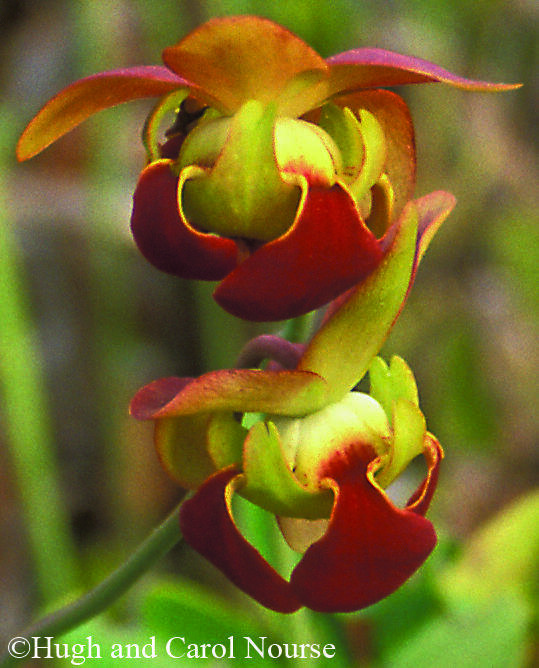
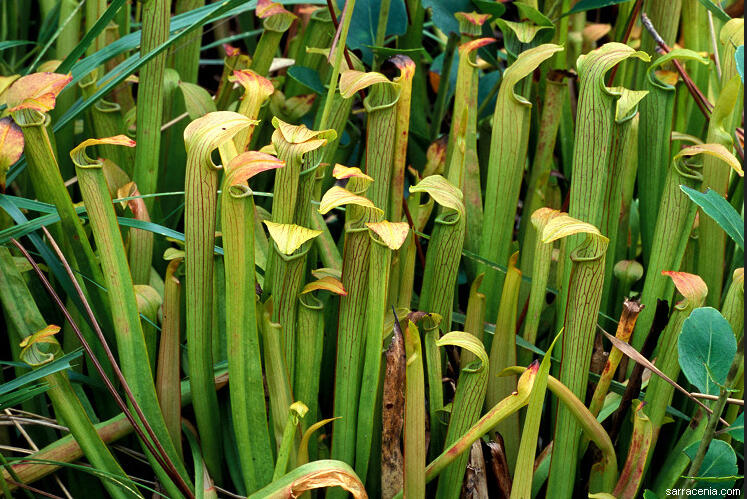
Perennial herb with leaves modified into erect, cylindrical, tubular pitchers. Pitchers are typically up to 12 inches tall (30 cm tall, rarely up to 17 inches or 43 cm tall) and only slightly widening from base to opening, with a narrow wing running the length of the pitcher, which is red or green with a network of darker red veins. The pitcher opening is 0.6 - 0.9 inch (1.5 - 2.3 cm) wide; the pitcher lid is red, pointed, narrowly heart-shaped to strap-like, about twice as long as wide, and held closely over the pitcher opening. The flower stalk is 5 - 30 inches (12 - 75 cm) tall and leafless. The flower has 5 drooping, dark red petals 1 - 1.5 inches (2.5 - 4 cm) long, 5 green to maroon sepals up to 0.7 inch (1.8 - 2.7 cm) long and held horizontally or curved backwards, and a green, umbrella-shaped style disk in the center. Sepals and style disk persist on the plant long after the petals fall and after the fruit, a round, warty capsule up to 0.5 inch (0.6 - 1.2 cm) wide, develops.
Gulf Pitcherplant, Sarracenia rubra ssp. gulfensis: plants of the gulfensis subspecies in Georgia have recently been recognized as subspecies viatorum (Georgia Sweet Pitcherplant). Plants of subspecies viatorum are found only in Georgia's Fall Line ecoregion, usually in or near Atlantic White Cedar swamps. As a result of this split, subspecies gulfensis is now understood to apply only to the Florida Panhandle plants. For more information on this new subspecies, see: Rice (2018a) and https://www.georgiabiodiversity.a2hosted.com/portal/profile?group=plants&es_id=18435
Eleven types of pitcherplant occur in Georgia, including 8 species, 4 varieties, and 2 subspecies. All are considered rare, vulnerable, threatened or endangered.
Sarracenia flava (Yellow Flytrap), https://www.georgiabiodiversity.org/portal/profile?group=plants&es_id=18445
Sarracenia leucophylla (Whitetop Pitcherplant), https://www.georgiabiodiversity.org/portal/profile?group=plants&es_id=18829
Sarracenia minor var. minor (Hooded Pitcherplant), https://www.georgiabiodiversity.org/portal/profile?group=plants&es_id=33691
Sarracenia minor var. okefenokeensis (Okefenokee Giant Pitcherplant), https://www.georgiabiodiversity.org/portal/profile?group=plants&es_id=33687
Sarracenia oreophila (Green Pitcherplant), https://www.georgiabiodiversity.org/portal/profile?group=plants&es_id=16880
Sarracenia psittacina (Parrot Pitcherplant), https://www.georgiabiodiversity.org/portal/profile?group=plants&es_id=15362
Sarracenia purpurea var. montana (Mountain Purple Pitcherplant), https://www.georgiabiodiversity.org/portal/profile?group=plants&es_id=34032
Sarracenia purpurea var. venosa (Southern Purple Pitcherplant), https://www.georgiabiodiversity.org/portal/profile?group=plants&es_id=21623
Sarracenia rosea (Rose Pitcherplant), https://www.georgiabiodiversity.org/portal/profile?group=plants&es_id=34058
Sarracenia rubra ssp. gulfensis (Gulf Sweet Pitcherplant) or Sarracenia rubra ssp. viatorum (Georgia Sweet Pitcherplant), https://www.georgiabiodiversity.org/portal/profile?group=plants&es_id=18435
Sarracenia rubra ssp. rubra (Sweet Pitcherplant), https://www.georgiabiodiversity.org/portal/profile?group=plants&es_id=19129
Bogs, wet savannas, wet pine flatwoods, sunny openings in swamps; powerlines, roadside ditches, and other clearings through these habitats.
Pitcherplants capture and digest insects and other small animals in their pitchers. Nectar is produced by glands around the top of the pitcher, luring animals to the opening with its sweet smell. Stiff, down-pointing hairs line the pitcher, encouraging the animals to slide in and impeding their escape. Enzymes dissolved in water in the base of the pitcher digest the animals, making nutrients, particularly nitrogen, available for absorption by the plant. (Soils of bogs and other permanently saturated wetlands are typically low in nitrogen.)
Pitcherplants reproduce sexually and also vegetatively by spread of underground stems (rhizomes). The unusual shape of their flowers, with drooping petals and umbrella-like style disk, promotes cross-pollination by insects. When an insect, usually a bee, pushes its way past the petals to reach nectar on the interior of the flower, it brushes against one of the stigmas, which are at the pointed tips of the “umbrella,” and deposits pollen gathered from a previously visited flower. Once inside the petals, it picks up pollen from the anthers and from the inner surface of the umbrella and then carries it to the next visited flower, usually avoiding the stigmas as it leaves the flower.
Since it would be a disadvantage to the plant to “eat” its pollinators, most pitcherplants produce flowers before their pitchers are well developed or on tall stalks held well above the pitchers. Pitcherplants are usually 4 - 5 years old before they flower and may live to be 20 - 30 years old.
Sarracenia rubra ssp. rubra blooms April–May, but its pitchers can be identified throughout the growing season.
Sarracenia rubra ssp. rubra: Atlantic Coastal Plain of southeast Georgia, South Carolina, and North Carolina.
Conversion of habitat to pine plantations, agriculture, and developments. Ditching, draining, and filling bogs and wet savannas. Fire suppression, closure of canopy, and encroachment by woody plants. Poaching. Use of herbicides in rights-of-way. Off-road vehicle traffic. Digging by feral hogs.
| Threat 1 | Threat 2 | Threat 3 | |
|---|---|---|---|
| General Threat | Agriculture & aquaculture | Natural system modifications | Natural system modifications |
| Specific Threat | None | None | None |
Sarracenia rubra ssp. rubra is ranked S1 by the Georgia Department of Natural Resources, indicating that it is critically imperiled in the state. It is listed as Endangered by the State of Georgia. Fifteen populations have been documented in Georgia but only half of these have been confirmed since 2000, and only 2 are protected on conservation lands.
Protect sites from conversion to pine plantations. Apply prescribed fire every 2 - 3 years, or hand-clear to control competing vegetation, especially woody plants. Limit access to prevent poaching and off-road vehicle traffic. Avoid ditching and draining wetlands and the use of soil-compacting equipment. Avoid use of herbicides and fertilizers in rights-of-way. Eradicate feral hogs.
Botanical Society of America. 2008. Sarracenia - the pitcher plants. https://botany.org/Carnivorous_Plants/Sarracenia.php
Case, F.W. and R.B. Case. 1976. The Sarracenia rubra complex. Rhodora 78: 270-325.
Chafin, L.G. 2007. Field guide to the rare plants of Georgia. State Botanical Garden of Georgia and University of Georgia Press, Athens.
GADNR. 2020. Element occurrence records for Sarracenia rubra ssp. rubra. Georgia Department of Natural Resources, Wildlife Resources Division, Social Circle, Georgia.
Godfrey, R.K. and J.W. Wooten. 1981. Aquatic and wetland plants of southeastern United States, Vol. 2, dicotyledons. University of Georgia Press, Athens.
Godt, M.J.W. and J.L. Hamrick. 1998. Allozyme diversity in the endangered pitcher plant, Sarracenia rubra ssp. alabamensis and its close relative S. rubra ssp. rubra. American Journal of Botany 85(6): 802-810.
Jennings, D.E. and J.R. Rohr. 2011. A review of the conservation threats to carnivorous plants. Biological Conservation 144: 1356-1363. https://www.sciencedirect.com/science/article/pii/S0006320711001078
McDaniel, S. 1971. The genus Sarracenia. Bulletin 9, Tall Timbers Research Station, Tallahassee, Florida.
Mellichamp, T.L. and F.W. Case. 2009. Sarracenia rubra subsp. rubra species account. Flora of North America, Vol. 8. http://beta.floranorthamerica.org/Sarracenia_rubra_subsp._rubra
NatureServe. 2020. Sarracenia rubra subsp. rubra species account. NatureServe Explorer. Arlington, Virginia. https://explorer.natureserve.org/Taxon/ELEMENT_GLOBAL.2.149667/Sarracenia_rubra_ssp_rubra
Patrick, T.S., J.R. Allison, and G.A. Krakow. 1995. Protected plants of Georgia. Georgia Department of Natural Resources, Natural Heritage Program, Social Circle.
Rice, B.A. 2018a. The long overdue recognition of Sarracenia rubra subsp. viatorum. Carnivorous Plant Newsletter 47: 152-156. www.sarracenia.com › pubs › cpn47-152-159
Rice, B.A. 2018b. The Sarracenia rubra complex. The Carnivorous Plant FAQ v. 12. http://www.sarracenia.com/faq/faq5544.html
Schnell, D.E. 1977. Infraspecific variation in Sarracenia rubra Walt.: some observations. Castanea 42: 149-170.
Schnell, D.E. 1978. Sarracenia rubra Walter: infraspecific nomenclatural corrections. Castanea 43: 260-261.
Schnell, D.E. 1979. Sarracenia rubra Walter ssp. gulfensis: a new subspecies. Castanea 44: 217-223.
Schnell, D.E. 2002. Carnivorous plants of the United States and Canada, 2nd edition. Timber Press, Inc. Portland, Oregon.
Weakley, A.S. 2015. Flora of the southern and mid-Atlantic States. University of North Carolina Herbarium, University of North Carolina, Chapel Hill. http://www.herbarium.unc.edu/flora.htm
Weakley, A.S. 2020. “Sarraceniaceae” in: Flora of the Southern and Mid-Atlantic States. University of North Carolina Herbarium, University of North Carolina, Chapel Hill.
Linda G. Chafin
L.Chafin, Aug. 2008: original account
D.Weiler, Jan. 2010: added pictures
L. Chafin, May 2020: updated original account.