


Loading profile. Please wait . . .
Elliptio purpurella (I. Lea, 1857)
Inflated Spike




Federal Protection: No US federal protection
State Protection: Threatened
Global Rank: G3
State Rank: S3
Element Locations Tracked in Biotics: Yes
SWAP 2015 Species of Greatest Conservation Need (SGCN): Yes
SWAP 2025 Species of Greatest Conservation Need (SGCN): Yes
2025 SGCN Priority Tier: High Conservation Concern
Element Occurrences (EOs) in Georgia: 38
Habitat Summary for element in Georgia: Medium creeks to small rivers; clay, sand, and gravel substrate; moderate current
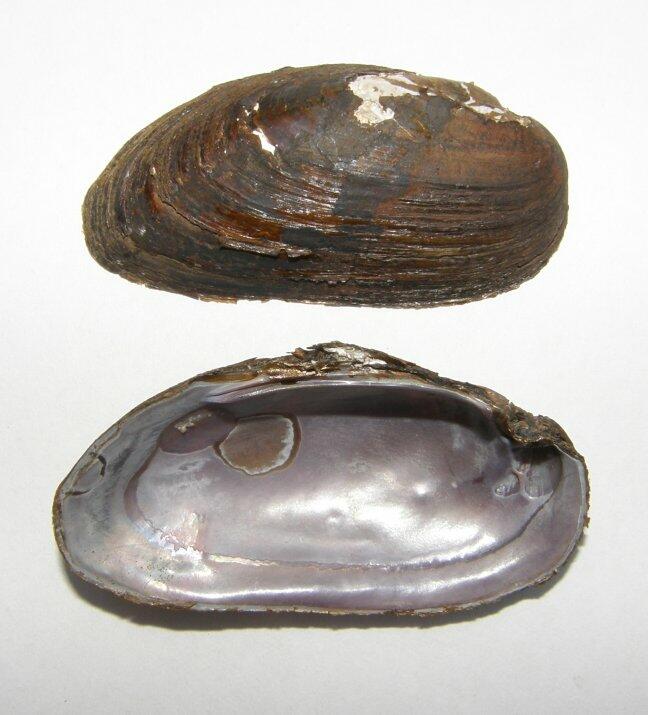
Shell is small, inflated, and elliptical or elongate in shape. Maximum length is approximately 65 mm (2.6 inches). Anterior margin is broadly rounded while posterior margin is typically rounded or truncated. Ventral margin is relatively straight to slightly arcuate. Umbos project slightly above hingeline. Posterior ridge rounded and flattens posterioventrally. Periostracum typically green to dark brown or black in adults. Often with broad green rays present. Left valve with two triangular pseudocardinal teeth and short, straight lateral teeth. Umbo cavity typically shallow and wide. Nacre typically purple or white.
Delicate Spike (Elliptio arctata), Gulf Slabshell (Elliptio fumata), and Gulf Spike (Elliptio pullata). The Inflated Spike can be distinguished from the Delicate Spike, Gulf Slabshell, and Gulf Spike by the former being relatively more inflated than the other species. The Inflated spike typically has a slightly arcuate outline whereas Gulf Slabshell and Gulf Spike often have a straight to broadly rounded ventral margin and sometimes the presence of a wing and more pointed posterior terminus.
Sand and limestone shoals in medium sized creeks to large rivers. Occasionally found in sand-bottomed runs with slow, steady current; often found in clay-bottomed streams.
The diets of unionids are poorly understood but are believed to consist of algae and/or bacteria. Some studies suggest that diets may change throughout the life of a unionid with juveniles collecting organic materials from the substrate though pedal feeding and then developing the ability to filter feed during adulthood (Vaughn and Hakenkamp 2001).
The life history of this species has been poorly studied. Surveys conducted during the early 1990’s checked 369 individuals between the months of May and September but failed to find any gravid females. However, several brooding individuals were found during sampling of Spring Creek (Miller County) during May of 2012 and 2013. This suggests that the species likely broods from early to mid-spring until May.
Surveyors should consider sampling during periods when female individuals are spawning or brooding as this species may have higher detection rates during this period. However, since basic life history information for many of Georgia’s unionids is lacking, sampling during periods when closely related species are spawning or brooding may increase probability of detection.
Historically presumed as endemic to the Apalachicola River Basin in Alabama, Florida, and Georgia. However recent collections from the Ochlockonee River Basin have expanded the range of this species. The Inflated Spike appears to be limited in its distribution throughout the lower Flint River basin, but often occurs in relatively high abundance when present.
Excess sedimentation due to inadequate riparian buffer zones, development, and agriculture covers suitable habitat and could potentially bury mussels. Poor agricultural practices may also cause eutrophication and degrade water quality. Excessive agriculture water pumping in the lower Flint River basin appears to stress the aquatic resources of the Flint and Ochlockonee river basins in periods of extreme drought.
| Threat 1 | Threat 2 | Threat 3 | |
|---|---|---|---|
| General Threat | Natural system modifications | Pollution | Transportation & service corridors |
| Specific Threat | Dams & water management/use | Agricultural & forestry effluents | Roads & railroads |
The Inflated Spike is not known from any state or federal lands in Georgia. Unlike terrestrial species, the occurrence of an aquatic species on state or federal lands may not eliminate habitat degradation due to the influences of upstream and downstream disturbances.
Examination of basic life history was identified as a top research priority needed for the conservation of this species in the Georgia Wildlife Action Plan. Understanding the basic life history of this species will provide the foundation upon which all other research and conservation actions should be built. Developing environmental flow criteria and investigating the effects of low dissolved oxygen concentration, desiccation, and thermal tolerance was also identified as a priority research need for the species.
Brim Box, J. and J.D. Williams. 2000. Unionid mollusks of the Apalachicola basin in Alabama, Florida, and Georgia. Alabama Museum of Natural History Bulletin 21. 143 pp.
Herod, J.J. 2004. Elliptio purpurella, Inflated Spike. Pp. 45 in R.E. Mirarchi, J.T. Garner, M.F. Mettee, P.E. O’Neil (eds.). Alabama Wildlife, Volume 2, Imperiled Aquatic Mollusks and Fishes. The University of Alabama Press, Tuscaloosa.
Shea, C.P., J.T. Peterson, M.J. Conroy, and J.M. Wisniewski. 2013. Evaluating the influence of land use, drought, and reach isolation on the occurrence of freshwater mussel species in the lower Flint River Basin, Georgia (U.S.A.). Freshwater Biology 58:382-395.
Vaughn C.C. and C.C. Hakenkamp. 2001. The functional role of burrowing bivalves in freshwater ecosystems. Freshwater Biology 46:1431-1446.
Williams, J.D., A.E. Bogan, and J.T. Garner. 2008. Freshwater mussels of Alabama and the Mobile Basin in Georgia, Mississippi, and Tennessee. The University of Alabama Press, Tuscaloosa, Alabama.
Williams, J.D., R.S. Butler, G.L. Warren, and N.A. Johnson. 2014. Freshwater Mussels of Florida. University of Alabama Press, Tuscaloosa, Alabama.
Wisniewski, J.M., N.M. Rankin, D.A. Weiler, B.A. Strickland, and H.C. Chandler. 2013. Occupancy and detection of benthic macroinvertebrates: a case study of unionids in the lower Flint River, Georgia, USA. Freshwater Science 32:1122-1135.
Wisniewski, J.M., N.M. Rankin, D.A. Weiler, B.A. Strickland, and H.C. Chandler. 2014. Use of occupancy modeling to assess the status and habitat relationships of freshwater mussels in the lower Flint River, Georgia, USA. Walkerana 17:24-40.
Jason Wisniewski
2018-03-19