


Loading profile. Please wait . . .
Allium speculae Ownbey & Aase
Flatrock Onion




Federal Protection: No US federal protection
State Protection: Threatened
Global Rank: G2
State Rank: S2
Element Locations Tracked in Biotics: Yes
SWAP 2015 Species of Greatest Conservation Need (SGCN): Yes
SWAP 2025 Species of Greatest Conservation Need (SGCN): Yes
2025 SGCN Priority Tier: Highest Conservation Concern
Element Occurrences (EOs) in Georgia: 20
Habitat Summary for element in Georgia: Granite outcrops (limited to Lithonia Gneiss types)
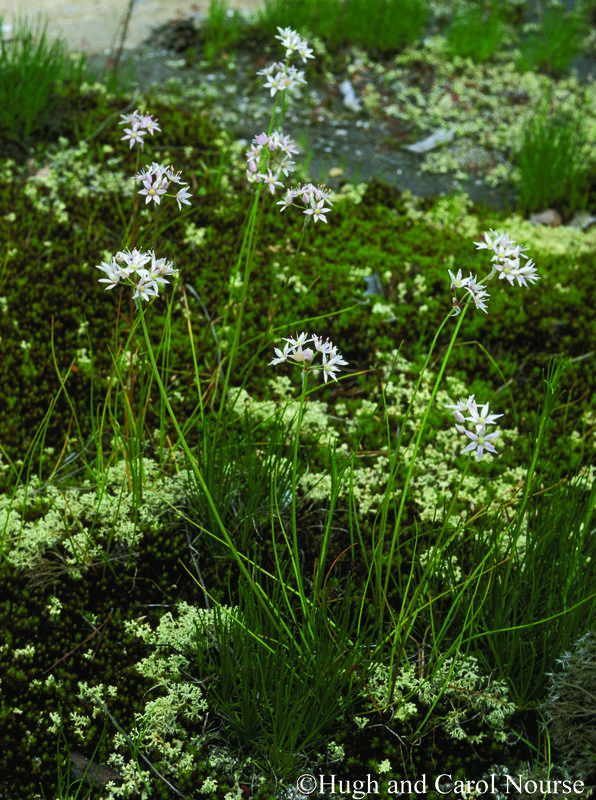
Perennial herb rising from a bulb; all parts of the plant have a distinct onion odor. Leaves usually 4 - 5 per plant, 8 - 10 inches (20 - 25 cm) long, narrow and grass-like, fleshy, flat or curved in cross-section with a long, deep groove running the length of the leaf. Flower stalks are 8 - 12 inches (20 - 30 cm) tall, leafless, round in cross-section. The flower cluster has 10 - 15 flowers; the base of the cluster is enclosed by a papery sheath that splits into 3 segments, each segment with a single, faint vein. Flowers are 0.5 inch (1.3 cm) across, with 6 spreading, white or pinkish tepals (3 petals + 3 sepals) and green centers. Fruits 3-lobed, rounded, with a series of low crests alternating with lobes.
Cuthbert’s Onion (Allium cuthbertii) has 2 - 3 leaves per plant, 5 - 7 veins per sheath segment, down-curved tepals, and green, knobby crests on its fruits.
Canada Onion (Allium canadense var. canadense) produces a cluster of small bulbs with, or instead of, flowers.
Mobile Onion (Allium canadense var. mobilense) has 3 - 7 veins per sheath segment, and its fruits lack crests.
False Garlic (Nothoscordum bivalve) flowers have yellow centers; its stem is usually less than 1 foot (30 cm) tall, and its leaves lack the onion smell.
Allium stellatum (Glade Onion) occurs in calcareous prairies and limestone cedar glades in northwest Georgia. Its flowers are dark pink and bloom July–September. The flower cluster is nodding when in bud, but becomes erect during flowering. The leaves are usually withered by flowering time. For more information, see: https://www.illinoiswildflowers.info/prairie/plantx/cl_onionx.htm AND http://explorer.natureserve.org/servlet/NatureServe?searchName=Allium%20stellatum
In Georgia, seepy edges of vegetation mats on granite outcrops of Lithonia gneiss; in Alabama, shallow depressions on sandstone outcrops.
Several types of insect are known to visit the flowers of Flatrock Onion, including honey bees, bumble bees, and butterflies. Seed dispersal occurs when the capsule opens; seeds fall to the ground and germinate near the parent plant, leading to a clumped growth pattern. The seeds of some western species of Allium are dispersed when the inflorescence breaks off from the plant and is carried by the wind, but this has not yet been observed with Flatrock Onion.
Surveys are best conducted during flowering (mid-May–June) and fruiting (mid-June–mid-July).
Georgia and northeast Alabama (on Sand and Lookout Mountains, where it is known as Little River Canyon Onion).
Granite outcrops are threatened by quarrying, trash dumping, off-road vehicle use, and development.
| Threat 1 | Threat 2 | Threat 3 | |
|---|---|---|---|
| General Threat | Energy production & mining | Transportation & service corridors | Biological resource use |
| Specific Threat | None | None | None |
Flatrock Onion is ranked S2 by the Georgia Department of Natural Resources, indicating that the species is imperiled in Georgia. It is listed as Threatened by the State of Georgia. Flatrock Onion occurs at 20 outcrops in three counties, none on conservation land.
Protect granite outcrops from quarrying, trash dumping, and off-road vehicle use. Direct foot traffic away from rare plant sites. Create buffers and limit development around outcrops. Protect outcrops with conservation easements.
Allison, J.R. 1989. Status report on Allium speculae Ownby & Aase in Georgia. Georgia Department of Natural Resources, Wildlife Resources Division, Social Circle.
Chafin, L.G. 2007. Field guide to the rare plants of Georgia. State Botanical Garden of Georgia and University of Georgia Press, Athens.
McNeal, D.W., Jr. and T. D. Jacobsen. 2003. Allium speculae species account. Flora of North America. Vol. 26, Magnoliophyta: Liliidae: Liliales and Orchidales. Oxford University Press, New York. http://beta.floranorthamerica.org/Allium_speculae
GADNR. 2019. Element occurrence records for Allium speculae. Georgia Department of Natural Resources, Wildlife Resources Division. Social Circle, Georgia.
NatureServe. 2020. Allium speculae species account. NatureServe Explorer. Arlington, Virginia. http://explorer.natureserve.org/servlet/NatureServe?searchName=Allium%20speculae
Ownbey, M. and H.C. Aase. 1959. Allium speculae, a new species of the Allium canadense alliance from Alabama. Rhodora 61:70-72. https://www.jstor.org/stable/23306294?seq=1#metadata_info_tab_contents
Patrick, T.S., J.R. Allison, and G.A. Krakow. 1995. Protected plants of Georgia. Georgia Department of Natural Resources, Wildlife Resources Division, Social Circle.
Schotz, A.R. 1998. Status survey report on Allium speculae, Little River Canyon onion, in Alabama. Alabama Natural Heritage Program, Montgomery.
Weakley, A.S. 2015. Flora of the southern and mid-Atlantic States. University of North Carolina Herbarium, University of North Carolina, Chapel Hill. http://www.herbarium.unc.edu/flora.htm
Linda G. Chafin
L. Chafin, Sept. 2007: original account.
K. Owers, Jan. 2010: updated status and ranks, added pictures.
L. Chafin, Jan 2020: updated original account.

