


Loading profile. Please wait . . .
Ammospiza nelsoni (Allen, 1875)
Nelson's Sparrow




Federal Protection: No US federal protection
State Protection: No Georgia state protection
Global Rank: G5
State Rank: S3
Element Locations Tracked in Biotics: Yes
SWAP 2015 Species of Greatest Conservation Need (SGCN): Yes
SWAP 2025 Species of Greatest Conservation Need (SGCN): Yes
2025 SGCN Priority Tier: Moderate Conservation Concern
Element Occurrences (EOs) in Georgia: 0
Habitat Summary for element in Georgia: Tidal brackish and salt marsh (low marsh)
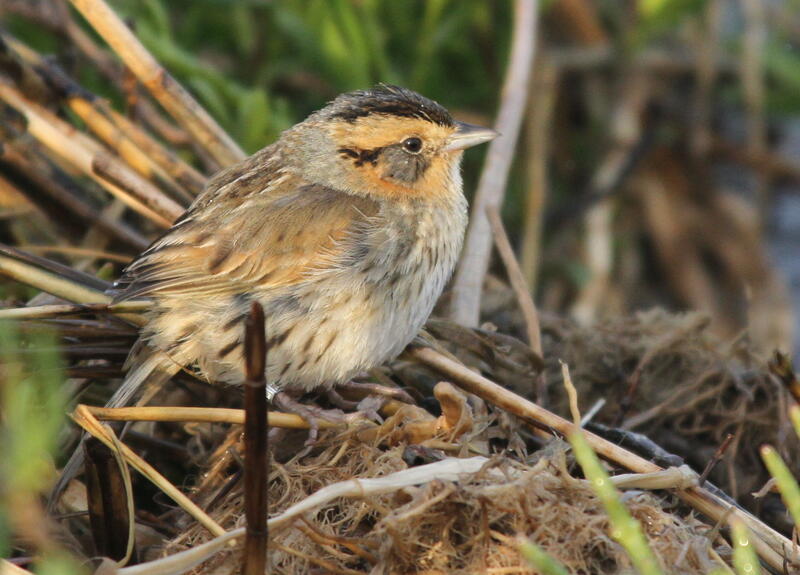
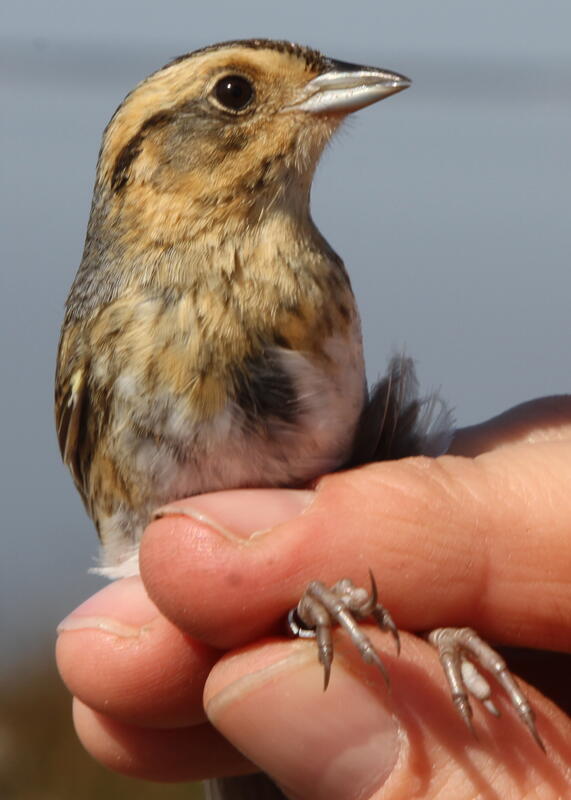
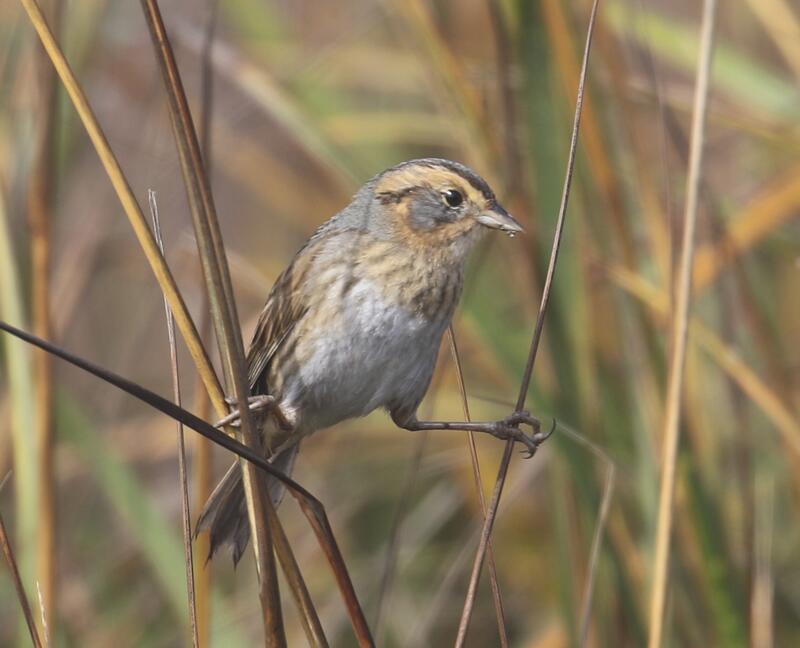
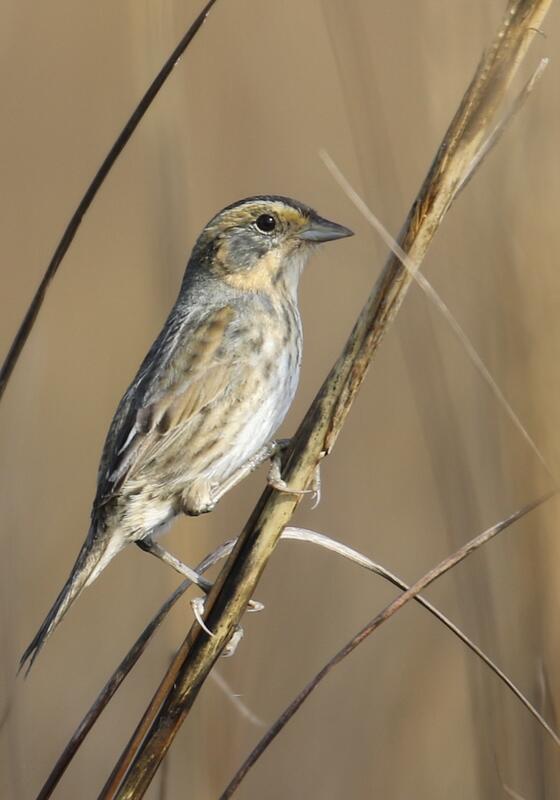
This bird is a small flat-headed sparrow with a relatively short bill and tail. Two inland nesting subspecies (A. n. nelsoni and A. n. alterus) look quite similar and are typically brightly colored, while the coastal nesting subspecies (A. n. subvirgatus) is much duller overall with a grayish cast and yellowish lores. The two interior nesting subspecies have a buff colored face with a gray auricular (area surrounding the ear). A wide gray median crown stripe is flanked by narrower brown stripes. The nape is gray, often with some brown. The breast and flanks are buff with streaking of varying intensity over a buffy breast with a well-defined transition to a white belly. Nelson’s sparrow shows little distinction in color between throat and malars (cheeks).
This bird is most similar to the saltmarsh sparrow (Ammospiza caudacuta). Nelson’s and saltmarsh sparrow were considered conspecific (the same species) until 1995. The saltmarsh sparrow usually has faint yellowish buff color on the breast and flanks and the streaking is dark and more well-defined than that of the Nelson’s sparrow. A hybrid zone exists in southern Maine where the coastal subspecies (A. n. subvirgatus) of Nelson’s sparrow interbreeds with the northern subspecies of saltmarsh sparrow (A. c. caudacuta). These hybrids are sometimes intermediate in appearance but can look identical to either species. Nelson’s also looks similar to the LeConte’s sparrow (Ammospiza leconteii); however, LeConte’s is a lighter buff color on the face and yellow buff color on the flanks, which have heavy dark streaking. It has a thin white median crown stripe flanked by wide dark stripes and small purplish spotting on the nape. The tertials (flight feathers nearest the body) are edged in white.
Breeding habitat differs among subspecies. A. n. nelsoni nests in freshwater marshes in the prairie pothole region of central Canada and the north central United States. It selects areas where cordgrass, sedges, and Phragmites are common. A. n. alterus nests along the shores of Hudson Bay and James Bay in sedge bogs that are often interspersed with willow (Salix sp.) and dwarf birch (Betula sp.). The coastal subspecies, A. n. subvirgatus, breeds in saltmarsh habitats, farm fields, and wet riparian grasslands in the Canadian Maritime Provinces and Northeastern U. S. In winter all three subspecies use tidal wetlands along the southeast Atlantic Coast where cordgrass (Spartina alterniflora, S. patens) and black needle rush (Juncus spp.) predominate. A. n. nelsoni also winters along the Gulf Coast.
Primarily invertebrates during the nesting season including beetles, grasshoppers, ants, wasps, moths, flies, leafhoppers, earwigs, other adult and larval insects, spiders, fiddler crabs, amphipods and mollusks. Animal prey are supplemented with seeds of various grasses during migration and winter including cordgrass (Spartina spp.), panic grass (Panicum spp.), wild rice, and other species.
The Nelson’s sparrow is a secretive bird inhabiting dense wet grasslands and marshes on both breeding and wintering grounds. This species does do not form pair bonds or defend territories during the breeding season, but instead males inhabit large overlapping home ranges and fight aggressively over females receptive to mating. The female builds a simple cup nest in grass that occasionally includes a partial dome. She lays 2-6 eggs, which she incubates by herself for 11-12 days. Brooding and feeding of young is also done exclusively by the female. Young typically leave the nest at 8-11 days old. The short duration of the nesting cycle allows coastal birds to nest between peak tides, greatly reducing the chance of flooding. Renesting is common after failure; however, it usually does not occur until about 10 days after nest loss. This can at times lead to asynchrony with the tides and higher likelihood of flooding. Double brooding has been documented. Banding in Georgia, has documented high intra and inter annual winter site fidelity for this species. All three subspecies are regularly found on our coast in winter. About 20% of captures are the rarer coastal breeding subspecies A. n. subvirgatus. The remaining 80% of captures are divided fairly evenly between the two interior subspecies. In winter these birds often form very large and dense mixed species flocks with saltmarsh and seaside sparrows (Ammospiza maritima), particularly at high tide along the edge of the saltmarsh in black needle rush (Juncus roemerianus) and seaside oxeye (Borrichia frutescens).
Georgia DNR has banded wintering Nelson’s sparrows since 2011. We have documented all three subspecies of Nelson’s Sparrow at a number of locations from Tybee Island south to St. Andrews Sound (Cumberland Island area). A survey designed to estimate wintering numbers could indicate the importance of the Georgia coast to the wintering populations due to the extensive available marshes in the state. Mercury level monitoring may also highlight potential local threats through mercury uptake in contaminated regions of the coast.
Three distinct breeding populations occur across the United States and Canada. A. n. nelsoni breeds across a wide expanse of prairie pothole habitat from northern Alberta southeast to North Dakota and northwestern Minnesota. A. n. alterus nests along the southern shores of Hudson Bay and the western and southern shores of James Bay, Canada. A. n. subvirgatus nests in the coastal areas of the Canadian Maritime Provinces south to Maine. All three subspecies winter along the Atlantic Coast of the southeastern United States from Maryland to Florida, while A. n. nelsoni also winters on the Gulf Coast from south Texas to Florida.
Threats vary with subspecies. Across all subspecies however historic and ongoing wetland loss is likely the largest concern. Recent wetland protections will hopefully slow the conversion and loss of nesting habitat. Mowing, ditching, draining, plowing, burning, or insecticide application can all impact nesting success for this species. Tidal flooding is one of the main causes of nest loss for the subspecies nesting in tidal environments, and nest depredation is a major cause of nest failure across all nesting populations. The coastal nesting subspecies is estimated at only 6,000-8,000 individuals, making them particularly vulnerable to any loss of productivity driven by sea level rise, coastal development, wetland loss, or contaminants. Nesting sparrows are also vulnerable to depredation by the garter snake, northern harrier, short-eared owl, American crow, Norway rat, various wading birds, and other predators.
| Threat 1 | Threat 2 | Threat 3 | |
|---|---|---|---|
| General Threat | Climate change & severe weather | Climate change & severe weather | Climate change & severe weather |
| Specific Threat | Habitat shifting & alteration | Storms & flooding | Storms & flooding |
Survey work conducted on wintering populations since 2011 reveals that Georgia has significant numbers of all three subspecies. A. n. subvirgatus is by far the rarest, and likely the most vulnerable, of the subspecies. Conservation efforts should focus as much as possible on this subspecies.
Although Georgia has extensive salt and brackish marsh (153,000 ha) much of this habitat is threatened by sea level rise and other factors. While the clearest threats to the Nelson’s sparrow likely occur on the breeding grounds there will probably be deterioration in the quality of wintering habitat associated with increased tidal flooding, marsh erosion, and fragmentation. The potential impacts of these changes are unknown for the species. Predictive models similar to those for the MacGillivray’s seaside sparrow need to be developed to guide conservation planning and actions. Strategically acquiring upland areas adjacent to tidal marshes through fee simple purchases or conservation easements will allow marsh migration to take place in an effective manner in the future. This is one of the most critical steps that can be taken to mitigate predicted habitat loss due to sea level rise. Experimentation with thin layer sediment application to raise marsh elevation in key areas is another action that would offer possible ways to mitigate the negative effects of sea level rise.
Cristol, D. A., F. M. Smith, C. W. Varian-Ramos, and B. D. Watts. (2011). Mercury levels of Nelson's and Saltmarsh sparrows at wintering grounds in Virginia, USA. Ecotoxicology 20:1773-1779.
Shriver, W. G., T. P. Hodgman, and A. R. Hanson (2011). Nelson’s Sparrow (Ammodramus nelsoni), version 2.0. In The Birds of North America (P. G. Rodewald, Editor). Cornell Lab of Ornithology, Ithaca, NY, USA.
Walsh, J., W. G. Shriver, B. J. Olsen, K. M. O’Brien, and A. Kovach. 2015. Relationship of phenotypic variation and genetic admixture in Saltmarsh-Nelson’s sparrow hybrid zone. Auk 132:704-716.
Wiest, W. A., M. D. Correll, B. J. Olsen, C. S. Elphick, T. P. Hodgman, D. R. Curson, and W. G. Shriver. 2016. Population estimates for tidal marsh birds of high conservation concern in the northeastern USA from a design-based survey. Condor 118:274-288.
Winder, V. L., A. K. Michaelis, and S. D. Emslie. 2012. Winter survivorship and site fidelity of Nelson’s, Saltmarsh and Seaside Sparrows in North Carolina. Condor 114:421-429.
Tim Keyes
12/11/2018