

Loading profile. Please wait . . .
Amsonia sp. 2
Lithonia Bluestar




Federal Protection: No US federal protection
State Protection: No Georgia state protection
Global Rank: GNR
State Rank: S2
Element Locations Tracked in Biotics: Yes
SWAP 2015 Species of Greatest Conservation Need (SGCN): Yes
SWAP 2025 Species of Greatest Conservation Need (SGCN): No
2025 SGCN Priority Tier:
Element Occurrences (EOs) in Georgia: 33
Habitat Summary for element in Georgia: Open woods near granite outcrops (limited to Lithonia Gneiss types)
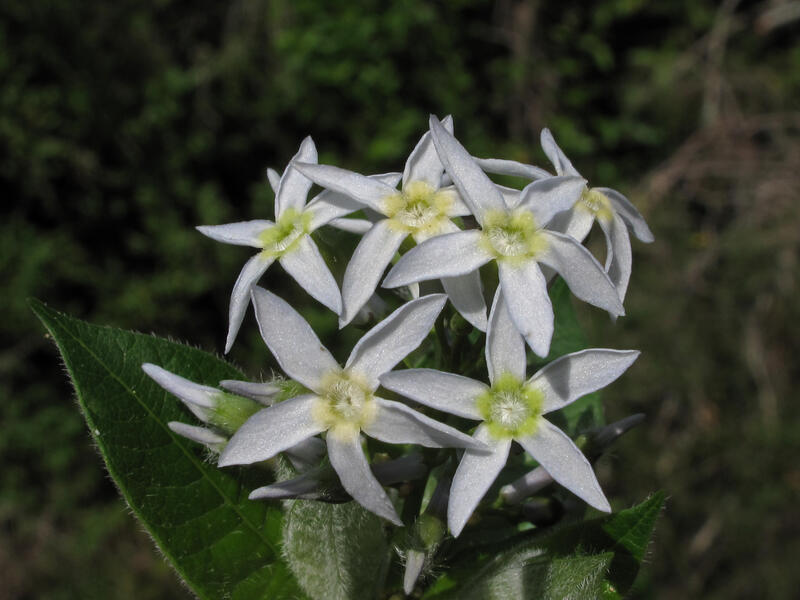
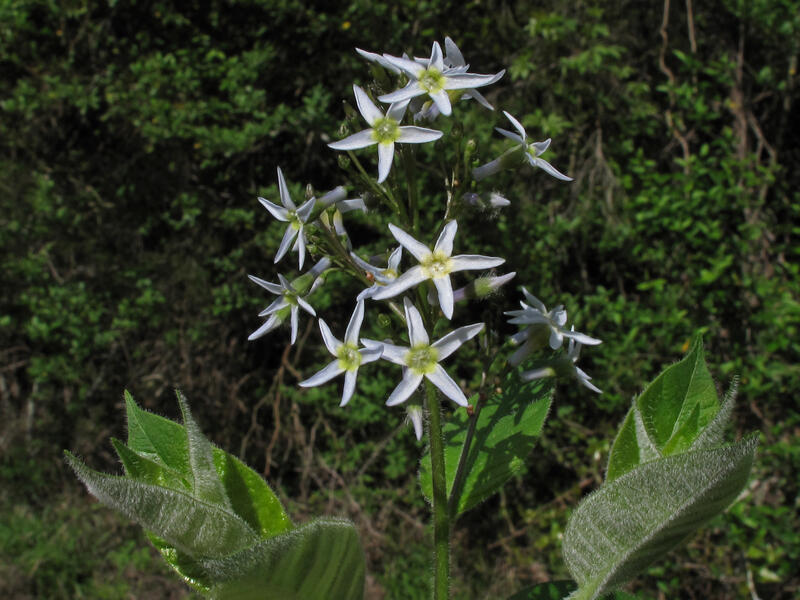
Perennial herb with one to several erect stems 1 - 3 feet (30 - 100 cm) tall; stems are hairy early in the growing season, smooth later. Leaves are 3 - 6 inches (8 - 15 cm) long and 0.4 - 2.4 inches (1 - 6 cm) wide, alternate, broadly elliptic and pointed at the tip, smooth and green on the upper surface and densely hairy and whitish on the lower surface; leaf stalks are less than 0.25 inch (3 - 6 mm) long. The flower cluster is held at the top of the stem with few to many, pale blue flowers, each with a yellowish-green star in the center. Flowers are 0.5 - 0.8 inch (1 - 2 cm) wide, with 5 pointed lobes spreading from the top of a hairy tube with a hairy throat; the calyx is also hairy. Fruits are held in pairs at the tip of a short stalk; they are 3 - 4 inches (8 - 10 cm) long, slender and pod-like, hairy at the upper end.
Blue Star (Amsonia tabernaemontana) is very similar; its leaves, stems, calyxes, and fruits are hairless or nearly so. It occurs in moist, upland woodlands and forests and floodplain forests.
None in Georgia.
In Georgia, Louisiana Blue Star occurs in open woodlands around Lithonia gneiss rock outcrops. Elsewhere in its range, Louisiana Blue Star is found in pine flatwoods, small-stream riparian forests, and bottomland forests.
There is little published information on the life history of Louisiana Blue Star. Studies on the common and closely related Blue Star (Amsonia tabernaemontana) found that its flowers are pollinated by hummingbirds, long-tongued bees, hummingbird moths, and butterflies and probably require cross-pollination to set fruit. The throat of Amsonia flowers is encircled by a ring of hairs that probably excludes nectar thieves such as ants. The seeds are thought to be gravity-dispersed. The leaves and stems of all Amsonia species contain a milky latex that is toxic and discourages herbivory by mammals. Genetic diversity in Georgia’s populations of Louisiana Blue Star were recently studied (Smallwood et al. 2018). The researchers determined that “Overall, there appears to be a high level of diversity and connectivity within the Georgia populations of Louisiana Blue Star,” but warned that, for a perennial species, these results may reflect historic trends rather than current conditions in Georgia’s rapidly developing and increasingly fragmented Piedmont.
Louisiana Blue Star is most conspicuous when in flower, April–May, and in fruit, May–June. However, vegetative traits, such as the milky latex and very hairy, white lower leaf surfaces, are diagnostic throughout the growing season.
Georgia, Mississippi, Louisiana, and Texas.
In Georgia, the habitat where Louisiana Bluestar occurs – granitic outcrops in metropolitan Atlanta – is under intense pressure from residential and commercial development, logging, trash dumping, quarrying, off-road vehicle traffic, and especially exotic pest plant invasion, primarily Chinese Privet.
Amsonia ludoviciana is ranked S2 by the Georgia Department of Natural Resources, indicating that it is imperiled in Georgia. There is a relatively large number of populations – 33 in four counties – but most are in serious danger of quarrying, development, and Chinese Privet invasion. Only two sites are in conservation ownership.
The granitic outcrops where Louisiana Blue Star occurs are in need of the highest levels of conservation action and management, including fee simple purchase, conservation easement, access restriction, habitat restoration activities such as exotic pest plant eradication, and rare species monitoring and re-introduction. The ecotones that support Louisiana Blue Star are especially vulnerable to human disturbance and should be prioritized for protection and ecological management.
Doffitt, C., C. Allen, P. Lewis, and D. Lewis. 2014. Amsonia ludoviciana (Apocynaceae) new to the flora of Texas (USA.). Journal of the Botanical Research of Texas 8(2):663-664. http://eds.b.ebscohost.com/eds/pdfviewer/pdfviewer?vid=1&sid=0adc6621-fbd5-4e6c-81d8-ed161db1d1bf%40pdc-v-sessmgr04
GADNR. 2019. Element occurrence records for Amsonia ludoviciana. Georgia Department of Natural Resources, Wildlife Resources Division. Social Circle, Georgia.
Hilty, J. 2019. Bluestar, Amsonia tabernaemontana. Illinois Wildflowers. Accessed 6 July 2019. http://www.illinoiswildflowers.info/woodland/plants/bluestar.htm
Lemke, D. E. 1987. Recent collections and a re-description of Amsonia ludoviciana Vail (Apocynaceae). Sida 12(2):343- 346.
NatureServe. 2019. Species account for Amsonia ludoviciana. NatureServe Explorer: an online encyclopedia of life, Version 7.1. NatureServe, Arlington, Virginia. Accessed 5 July 2019. http://explorer.natureserve.org/servlet/NatureServe?searchName=Amsonia+ludoviciana
Smallwood, P., M.D. Caspary, and J.E. Russell. 2018. Investigation of Population Structure in the Rare Amsonia ludoviciana Vail (Louisiana Bluestar; Apocynaceae). Southeastern Naturalist 17(3):456-469. https://www.jstor.org/stable/41967421?seq=1#metadata_info_tab_contents
Weakley, A.S. 2015. Flora of the southern and mid-Atlantic States. University of North Carolina Herbarium, University of North Carolina, Chapel Hill. http://www.herbarium.unc.edu/flora.htm
Linda G. Chafin
Linda G. Chafin, 7 July 2019: original account