


Loading profile. Please wait . . .
Parascalops breweri (Bachman, 1842)
Hairy-tailed Mole




Federal Protection: No US federal protection
State Protection: No Georgia state protection
Global Rank: G5
State Rank: SU
Element Locations Tracked in Biotics: Yes
SWAP 2015 Species of Greatest Conservation Need (SGCN): Yes
SWAP 2025 Species of Greatest Conservation Need (SGCN): Yes
2025 SGCN Priority Tier: Data Deficient
Element Occurrences (EOs) in Georgia: 3
Habitat Summary for element in Georgia: Deciduous woodlands with thick humus; prefers well-drained light moist soil
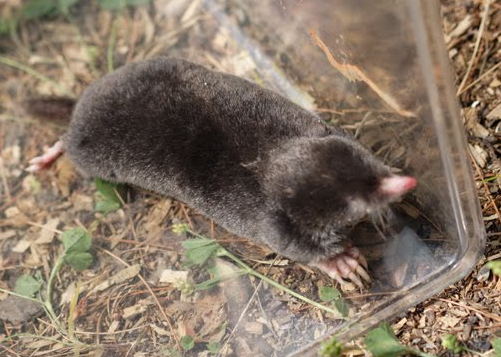
The hairy-tailed mole is a medium-sized burrowing mammal that has short, dense fur, reduced eyes, no external ears, and a long narrow snout. Its name comes from the thick, fleshy, short, and bristle-haired tail, which is unique to this species. Head and body length of an average adult ranges from 115-133mm (4.5 – 5.2 in), and the tail is 26 – 33 mm (1 – 1.3 in) long. Average adult weight is 40 – 65 g (1.4 – 2.3 oz.). Forefeet are broad and equipped with large, scoop-like claws with a hind foot length of 20 mm (0.8 in). Stiff sensory whiskers are located on the snout, top of the head, and on the bottom of its feet. Young moles tend to be dark brown to black on the snout, tail and feet. Hair becomes grayer with age, and eventually becomes pure white on very old individuals. Small white spots on the breast or abdomen may be present on some individuals.
The hairy-tailed mole is similar in size and ecology to the eastern mole (Scalopus aquaticus). The hairy-tailed mole, however, has more coarse fur than S. aquaticus and S. aquaticus is better at digging in compacted soils and has a much wider distribution. The star-nosed mole (Condylura cristata) has tentacles on the snout. The hairy-tailed mole’s most distinctive feature is its hairy tail and has a shorter snout than other Scalopus sp. All similar mole species have hairless tails.
The hairy-tailed mole requires soft, loamy, loose soils that are well-drained to create its burrows. They can be found in a variety of cover types, given that the soil is suitable. They use mature heavily wooded forests, younger and more open forests, open and cultivated fields, and areas along roadsides. They do not tolerate areas that are permanently wet, have no cover from shrubs or trees, have high clay content, or have hard, dry, or sandy soils. The species has been found in cultivated fields and near rivers in rhododendron thickets.
This species is insectivorous, with earthworms and insects making up more than 75% of the diet. They consume both larval and pupal insects, as well as adults. They also consume millipedes, centipedes, snails and slugs, sowbugs, and detritus.
Sexual dimorphism is evident in this species, males average about 7 g (0.25 oz) heavier than females. Both sexes build burrows and regularly patrol them for food. They create both surface tunnels for foraging and deep tunnels for nesting, breeding, and shelter. They will repair depressions or obstructions in their burrows primarily during the daylight hours. Individuals leave their burrows at night to forage in the leaf litter on the soil surface. There is little evidence of a diurnal, nocturnal, or crepuscular activity pattern like many other mammals. Instead, they exhibit a cathemeral activity pattern, meaning their activity is evenly distributed throughout the day and night, presumably driven by their high metabolism and the need to feed frequently. In winter, individuals typically spend more time in deeper tunnels to stay warm. Hairy-tailed moles molt twice per year, once in the spring and again in the fall. Breeding occurs in spring, and females produce one litter of 4-5 young per year and gestation lasts 4-6 weeks. Juveniles are weaned around 1 month and become sexually mature around 10 months. Individuals are solitary throughout their lives, except during the breeding season. Adults live an average of 4-5 years in the wild. Home ranges of adults are about 0.081 ha (0.2 acres), and densities may range from 3 to 27 individuals per hectare, depending on habitat.
Trapping for hairy-tailed moles is difficult and often results in the mole’s death. To determine presence, surveys for mole hills, the mounds of soil created during the construction of tunnels may be used. Surveys for surface ridges are also used, but the surface ridges created by hairy-tailed moles are often less pronounced than those of the eastern mole.
Range: The hairy-tailed mole’s distribution is limited by its need for a specific soil type. It is limited to areas with sufficient moisture and ground cover with loosely packed soils. The species is found as far north as southern Quebec and Ontario, extending into the New England range, and its range extends as far south as the Great Smoky Mountains. The hairy-tailed mole can be found in eastern Tennessee, northern Georgia, and western North Carolina. Their range in Georgia is restricted to the extreme northeastern corner of the state.
Hairy-tailed moles can harbor many parasites, such as fleas and mites, as well as acanthocephalid worms in the intestines. However, it is not known how much of an impact these parasites and worms have on the health of the individual. Predators include red fox, opossum, short-tailed shrew, owls, snakes, and other typical predators of small mammals.
This species is probably present in very low numbers in Georgia, due to the small extension of their range within northeastern Georgia.
This species is considered one of least concern, due to its large range and relative stability across the United State and Canada. However, the distribution of the species is less known in the southern portion of its range. Survey efforts to ascertain the species' full distribution range within the Southern Appalachians and Great Smoky Mountains are needed. Within the southeast, proper management of areas with suitable soil types will benefit the species.
Cassola, F. 2016. Parascalops breweri. The IUCN Red List of Threatened Species 2016 <http://dx.doi.org/10.2305/IUCN.UK.20163.RLTS.T41469A22322790.en>
Eadie, W. R. 1939. A Contribution to the Biology of Parasclops breweri. Journal of Mammalogy 20(2):150-173.
Hamilton, W.R., Jr. 1939. Activity of Brewer’s Mole (Parasclops breweri). Journal of Mammalogy 20(3):307-310.
Hallett, J. G. (1978). Parascalops breweri. Mammalian Species. (98): 1-4.
Kellogg, R. 1939. Annotated List of Tennessee Mammals: Parascalops breweri. Smithsonian Institution, Proceedings of the US National Museum 86, no. 3051.
Lin, Y. F., A. Chappuis, S. Rice, and E.R. Dumont. 2017. The effects of soil compactness on the burrowing performance of sympatric eastern and hairy-tailed moles. Journal of Zoology 301:310-319.
Lindahl, M. 2003. Parascalops breweri. Animal Diversity Web. <http://animaldiversity.org/accounts/Parascalops_breweri/>
Parascalops breweri Fact Sheet. Smithsonian National Museum of Natural History.<https://naturalhistory.si.edu/mna/image_info.cfm?species_id=245>
Silcox, M. T., and M. F. Teaford. 2002. The diet of worms: An analysis of mole dental microwear. Journal of Mammalogy, 83(3):804-814.
Trani, M. K., W. M. Ford, and B. R. Chapman. 2007. Hairy-tailed mole. Pp.117-119 in The Land Manager’s Guide to the Mammals of the South (M. K. Trani,W. M.
Ford, B. R. Chapman, eds.). The Nature Conservancy, Southeastern Region, Durham, North Carolina, USA.
Kristin Engebresten
K. Engebretsen, December. 2017
M. MacKnight, December. 2018
P. Sirajuddin, April. 2019
S. Krueger, Dec. 2019