

Loading profile. Please wait . . .
Balduina atropurpurea Harper
Purple Honeycomb-head




Federal Protection: No US federal protection
State Protection: Rare
Global Rank: G2
State Rank: S2S3
Element Locations Tracked in Biotics: Yes
SWAP 2015 Species of Greatest Conservation Need (SGCN): Yes
SWAP 2025 Species of Greatest Conservation Need (SGCN): Yes
2025 SGCN Priority Tier: Highest Conservation Concern
Element Occurrences (EOs) in Georgia: 84
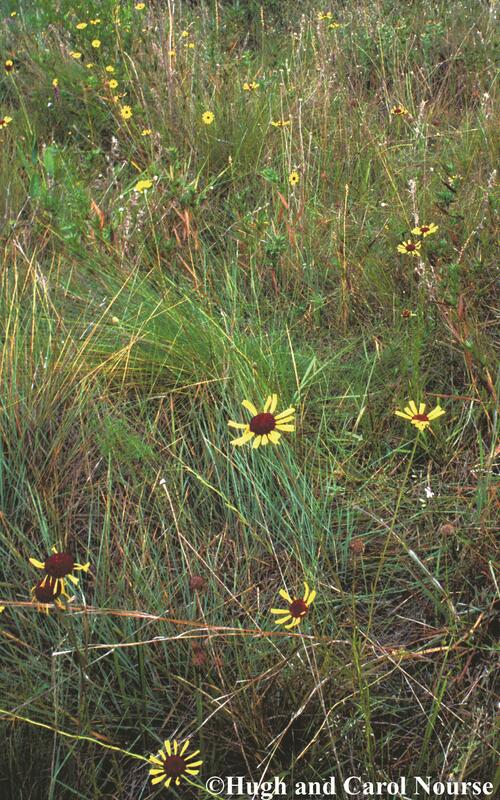
Habitat Summary for element in Georgia: Wet savannas, pitcherplant bogs
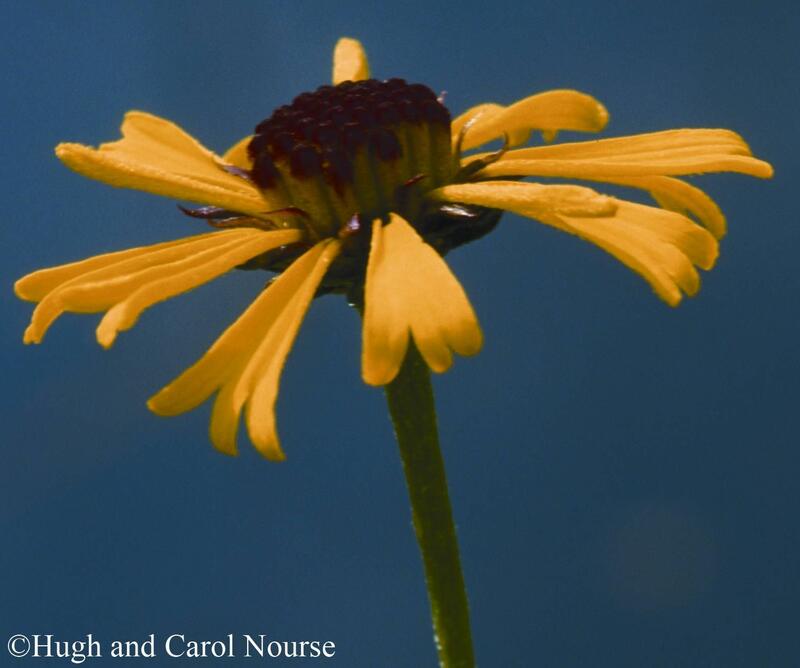
Perennial herb 1 - 3.3 feet (30 - 100 cm) tall. Stems are erect, angled (but not winged), and purplish at the base. Basal leaves are up to 5 inches (12 cm) long and 0.4 inch (1 cm) wide, with dark red leaf stalks. Stem leaves are smaller, alternate, widely spaced, slightly fleshy, spoon-shaped, and dotted with tiny translucent glands. Flower heads have many dark, reddish-purple disk flowers in the center, and 10 - 20 yellow ray flowers, each ray with 3 - 5 teeth at the tip. Fruits are small, dry, and seed-like, held on a “honeycombed” receptacle at the center of the head; the “honeycomb” may be seen by removing the disk flowers or the fruits. Balduina species are the only members of the Aster family with honeycombed heads.
Yellow Honeycomb-head (Balduina uniflora) often grows with Purple Honeycomb-head; it has yellow disk flowers.
Southeastern Tickseed (Coreopsis gladiata) has dark red disk flowers, but only 5 - 8 ray flowers and no “honeycomb.”
Sneezeweeds (Helenium spp.) often have purple disk flowers but they bloom in the spring and early summer, and lack the gland-dotted leaves and honeycombed receptacle.
Blanket Flower (Gaillardia spp.) has yellow rays and dark disk flowers, but occurs only in dry, sandy uplands.
None in Georgia.
Wet pine flatwoods and savannas, seepage slopes, pitcherplant bogs, and wet ditches through these habitats; often occurs with Yellow Honeycomb-head.
Purple Honeycomb-head is a perennial herb that reproduces sexually by seed and asexually by the spread of shallowly buried rootstocks. It produces a basal rosette of leaves during its first year and flowering stems in following years. Purple Honeycomb-head is self-incompatible, relying on a variety of insects, including bumblebees and butterflies, to effect cross-pollination. All life stages – from seed germination to growth to flower and seed production – depend on high light and moisture levels. Different species in the genus Balduina do not hybridize. Purple Honeycomb-head often occurs with Yellow Honeycomb-head but may be prevented from hybridizing by their differently sized pollen grains and different chromosome numbers. Plants at Fort Stewart, Georgia were found to have low seed production but high seed viability compared to other composites.
Surveys are best conducted during flowering (August–October) and fruiting (September–October), preferably during high-rainfall years as the plants tend to go dormant during droughts.
Coastal Plain of Georgia, Florida, South Carolina, and, possibly, Alabama and North Carolina.
Loss of habitat due to ditching, draining, and filling in wetlands. Fire suppression and plowing firebreaks through the species' habitats. Conversion of habitat to pine plantations, agriculture, and developments. Feral hog digging. Changes in hydrology due to altered temperature and rainfall patterns related to climate change.
| Threat 1 | Threat 2 | Threat 3 | |
|---|---|---|---|
| General Threat | Natural system modifications | Natural system modifications | Human intrusions & disturbance |
| Specific Threat | None | None | None |
Balduina atropurpurea is ranked S2S3 by the Georgia Department of Natural Resources, indicating that it is either imperiled (S2) or vulnerable to imperilment (S3), but that more information is needed to make a definitive ranking. Nearly 80 populations have been documented in 21 counties over the last century but this number has declined to 38 currently known populations in 13 counties. Only 7 of these occur on conservation land or land protected by a conservation easement.
Apply prescribed fire every 2 - 3 years during the growing season. Avoid soil disturbance, ditching, draining, firebreak construction, bedding, and mechanical clearing in wetlands. Eradicate feral hogs.
Chafin, L.G. 2007. Field guide to the rare plants of Georgia. State Botanical Garden of Georgia and University of Georgia Press, Athens.
Chafin, L.G. 2000. Field guide to the rare plants of Florida. Florida Natural Areas Inventory, Tallahassee.
Cronquist, A. 1980. Vascular flora of the southeastern United States, Vol. 1, Asteraceae. University of North Carolina Press, Chapel Hill.
GADNR. 2019. Element occurrence records for Balduina atropurpurea. Georgia Department of Natural Resources, Wildlife Resources Division, Social Circle, Georgia.
Godfrey, R.K. and J.W. Wooten. 1981. Aquatic and wetland plants of southeastern United States, Vol. 2, dicotyledons. University of Georgia Press, Athens.
Harper, R.M. 1901. On a collection of plants made in Georgia in the summer of 1900. Bulletin of the Torrey Botanical Club 28: 454-484. https://www.jstor.org/stable/2478593?seq=1#metadata_info_tab_contents
Harper, R.M. 1904. Explorations in the Coastal Plain of Georgia during the season of 1902. Bulletin of the Torrey Botanical Club 31(1): 9-27. https://www.jstor.org/stable/2478750?seq=1#metadata_info_tab_contents
Keener, B.R. 2006. Balduina atropurpurea species account. Flora of North America, vol. 21. http://beta.floranorthamerica.org/Balduina_atropurpurea
Kral, R. 1983. A report on some rare, threatened, or endangered forest-related vascular plants of the South. Technical Publication R8-TP2. United States Forest Service, Atlanta.
Lincicome, D.A. 1998. The rare perennial Balduina atropurpurea (Asteraceae) at Fort Stewart, Georgia. U.S. Army Corps of Engineers Construction Engineering Research Laboratories Technical Report 98/75. https://tinyurl.com/y8fl8cxw
NatureServe. 2020. Balduina atropurpurea. NatureServe Explorer. Arlington, Virginia. https://explorer.natureserve.org/Taxon/ELEMENT_GLOBAL.2.132712/Balduina_atropurpurea
Nelson, G. 2006. Atlantic Coastal Plain wildflowers. Globe Pequot Press, Guilford, Connecticut.
Parker, E.S. and S.B. Jones, Jr. 1975. A systematic study of the genus Balduina (Compositae, Heliantheae). Brittonia 27: 355-361. https://link.springer.com/article/10.2307/2805514
Patrick, T.S., J.R. Allison, and G.A. Krakow. 1995. Protected plants of Georgia. Georgia Department of Natural Resources, Natural Heritage Program, Social Circle.
USFWS. 2019. Species status assessment report - Purpledisk Honeycomb-head. U.S. Fish and Wildlife Service, Southeast Region, Atlanta, GA. Accessed 7 January 2020. https://www.regulations.gov/document?D=FWS-R4-ES-2019-0095-0002
Weakley, A.S. 2015. Flora of the southern and mid-Atlantic States. University of North Carolina Herbarium, University of North Carolina, Chapel Hill. http://www.herbarium.unc.edu/flora.htm
Linda G. Chafin
L. Chafin, Aug. 2007: original account
K. Owers, Jan. 2010: updated status and ranks, added pictures
L. Chafin, Jan 2020: updated original account.