

Loading profile. Please wait . . .
Platanthera flava var. herbiola (R. Br. ex Ait. f.) Luer
Pale Green Orchid




Federal Protection: No US federal protection
State Protection: No Georgia state protection
Global Rank: G5T5
State Rank: SH
Element Locations Tracked in Biotics: Yes
SWAP 2015 Species of Greatest Conservation Need (SGCN): Yes
SWAP 2025 Species of Greatest Conservation Need (SGCN): Yes
2025 SGCN Priority Tier: High Conservation Concern
Element Occurrences (EOs) in Georgia: 1
Habitat Summary for element in Georgia: Red maple-gum swamps
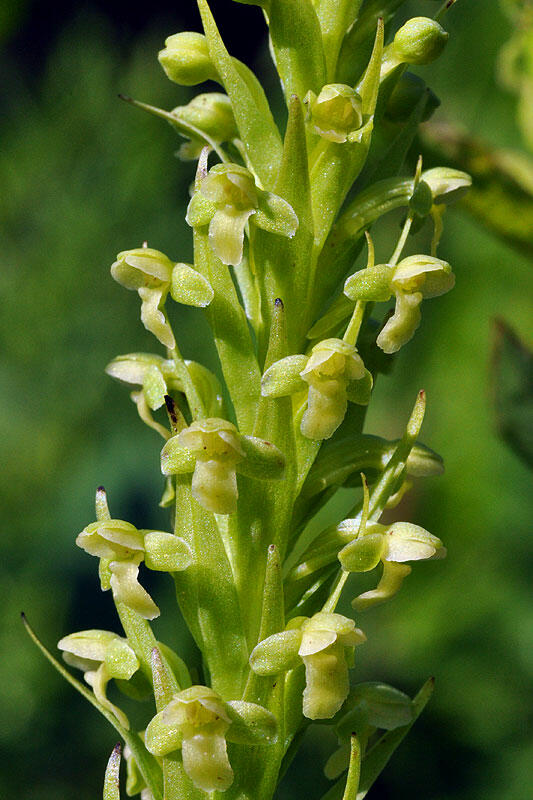
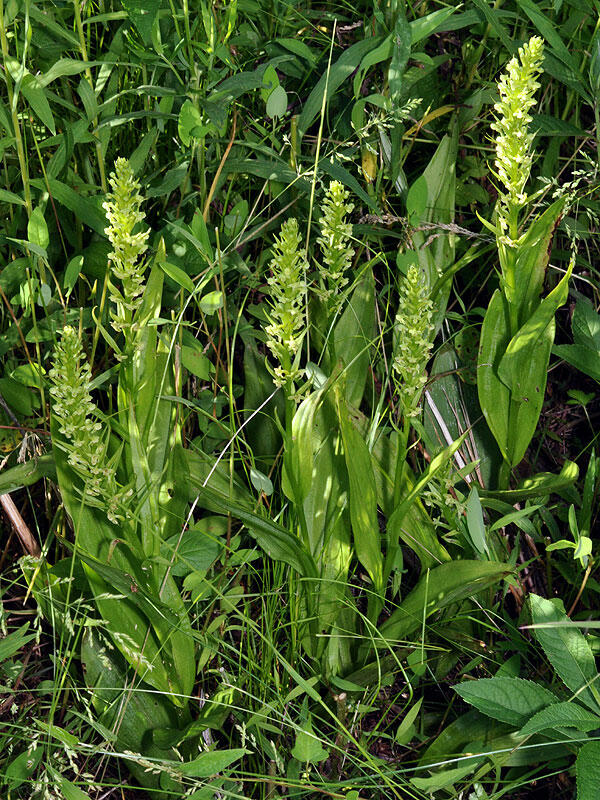
Perennial herb with an erect, hairless stem, 5 - 26 inches (13 - 65 cm) tall. Leaves 2 - 14 inches (5 - 35 cm long) long and 0.4 - 2.75 inches (1 - 7 cm) wide, 2 - 5 leaves per stem, alternate, oblong to broadly lance-shaped at the base of the stem, gradually becoming small bracts at the top of the stem. The flower cluster is a narrow spike, 2 - 8 inches (5 - 20 cm) tall, held at the top of the stem, with 15 - 40 closely packed, pale green or yellowish-green flowers that open first at the bottom of the cluster then upward; the spike includes numerous narrow green bracts that extend outward well beyond the flowers. The flowers are about 0.25 inch (5 - 6 mm) wide. Sepals and petals are similar; the upper sepal and the two lateral petals overlap to form a hood over the top of the flower. The lip petal is less than 0.25 inch (2 - 6 mm) long, oblong, downwardly curved, slightly toothed on the margins, with a conspicuous bump (tubercle) near the base. The nectar-producing spur, a backward extension of the lip petal, is usually less than 0.3 inch (4 - 8 mm) long. Fruits are erect capsules about 0.3 inch (8-10 mm) long with many tiny seeds.
Pale Green Orchid (Platanthera flava var. herbiola) is very similar to the closely related Southern Rein Orchid (Platanthera flava var. flava). Usually considered two varieties of the same species, they are sometimes treated as separate species. Southern Rein Orchid spikes have widely spaced flowers with short bracts that do not extend beyond the flowers (except for the lowermost few). The lip petal of Southern Rein Orchid is about the same length as width, nearly round or square. Southern Rein Orchid occurs infrequently in many counties in Georgia; Pale Green Orchid (Platanthera flava var. herbiola) is known only from a single mountain seep in Union County.
Small Green Wood Orchid (Platanthera clavellata) is found in many north Georgia counties in bogs and other wet sites. It usually has only one large leaf, held near the middle or base of the stem, although much smaller bracts extend up the stem. The flower cluster is less than 3.5 inches (2 - 9 cm) tall, the flowers are often cream-colored, and the lip petal lacks the central bump.
There are 10 rare species of Platanthera in Georgia. For information on each of these, see: https://www.georgiabiodiversity.org/portal/element_lists?group=plant
Seepage bogs and sunny edges of swamps.
Pale Green Orchid is a perennial herb that reproduces sexually. Its flowers are pollinated by mosquitoes and moths. When an insect lands on the flower’s lip, the bump (tubercle) on the lip blocks it from entering through the middle of the flower and forces it to enter from the sides, thus limiting the type of insects that can access the nectar-producing spur. As the insect probes the spur to collect nectar, a sticky mass of pollen (called a pollinarium) attaches to its proboscis. Pollination occurs when a pollinarium is transferred to a flower on another plant – the flowers must be cross-pollinated for fruit to set. Each fruit contains thousands of dust-like seeds that are wind-dispersed and contain no stored food reserves (endosperm). Seeds must land on a patch of soil containing specific fungi that provide nutrients for germination and subsequent plant growth.
Pale Green Orchid blooms May–September. Flowers must be present to distinguish Pale Green Orchid from other Platanthera species.
Georgia northwest to Arkansas and north to Minnesota and Nova Scotia. In Georgia, Pale Green Orchid has been documented in only one county, Towns, in north Georgia.
Pale Green Orchid is threatened range-wide by ditching, draining, filling, soil compaction, impoundment, and other disturbances to the hydrology of its wetland habitat; encroachment by woody plants; invasion by exotic pest plants; and, deer browsing. Orchids are targeted by orchid collectors and poachers even though plants dug from the wild rarely survive. Climate change is likely to bring changes to the hydrology of Pale Green Orchid habitat and to its fungal symbionts which could prove fatal.
| Threat 1 | Threat 2 | Threat 3 | |
|---|---|---|---|
| General Threat | Invasive & other problematic species, genes & diseases | Natural system modifications | Climate change & severe weather |
| Specific Threat | None | None | None |
Pale Green Orchid is ranked S1 by the Georgia Department of Natural Resources, indicating that the species is critically imperiled. The single documented site for Pale Green Orchid in Georgia is owned by the Georgia Department of Natural Resources and is frequently monitored.
Georgia’s plants are the southernmost population of this species. Plants occurring at the periphery of a species’ range are thought to be of special conservation importance. Peripheral populations are usually smaller and less genetically diverse within the population, but genetically divergent from centrally located populations. These genetic differences may confer special survival traits that plants in other portions of the species’ range lack, such as the ability to survive changes in the climate or the arrival of a new pathogen. Peripheral populations may be in the process of evolving into a new species. They are especially deserving of conservation action.
Because it thrives in sunny conditions, Pale Green Orchid benefits from prescribed fire or hand clearing that maintains a semi-open canopy. Every effort should be made to protect and maintain the natural hydrologic regime of seeps and bogs. Take steps to exclude or discourage deer and feral hogs. Georgia’s population of Pale Green Orchid is the southernmost for this species, and likely possesses unusual genetic traits that should be preserved in ex situ or safeguarding collections. Exact location information of rare orchid populations should not be disclosed to the general public to discourage poaching.
Argue, C.L. 2012. The pollination biology of North American orchids: Volume 1, North of Florida and Mexico, Part II: subfamily Orchidoideae (part one), Chapter 8, Platanthera. Springer Science+Business Media, LLC. https://link.springer.com/content/pdf/10.1007%2F978-1-4614-0592-4.pdf
Brown, P.M. and S.N. Folsom. 2004. Wild orchids of the southeastern United States, north of peninsular Florida. University Press of Florida, Gainesville.
Catling, P.M. 1991. A synopsis of breeding systems and pollination in North American orchids. Lindleyana 6:187-210.
Drake, J. 2013. Fringed orchids of the southeastern United States: a guide to the genus Platanthera. Breath o’ Spring, Inc. P.O. Box 2957, Suwanee, Georgia 30024.
Esposito, F., H. Jacquemyn, M. Waud, and D. Tyteca. 2016. Mycorrhizal fungal diversity and community composition in two closely related Platanthera (Orchidaceae) species. PLoS One 11(10): e0164108. https://www.ncbi.nlm.nih.gov/pmc/articles/PMC5047478/
GADNR. 2019. Element occurrence record for Platanthera flava var. herbiola. Georgia Department of Natural Resources, Wildlife Resources Division. Social Circle, Georgia.
Hilty, J. 2019. Species account for Tubercled Orchid, Platanthera flava herbiola. Illinois Wildflowers. https://www.illinoiswildflowers.info/wetland/plants/tub_orchid.html
North American Orchid Conservation Center. 2019. Species account for Platanthera flava. Accessed 11 June 2019. https://goorchids.northamericanorchidcenter.org/species/platanthera/flava/
Chayka, K. and P. Dziuk. 2019. Species account for Platanthera flava var. herbiola (Tubercled Rein Orchid). Minnesota Wildflowers – a field guide to the flora of Minnesota. Accessed 11 June 2019. https://www.minnesotawildflowers.info/flower/tubercled-rein-orchid
NatureServe. 2019. Species account for Platanthera flava var. herbiola. NatureServe Explorer: An online encyclopedia of life, Version 7.1. NatureServe, Arlington, Virginia. Accessed: June 10, 2019 https://explorer.natureserve.org/Taxon/ELEMENT_GLOBAL.2.132743/Platanthera_flava_var_herbiolahttp://explorer.natureserve.org.
Sheviak, C.J. 2002. Species account for Platanthera flava. Flora of North America, vol. 26. Accessed 11 June 2019. http://www.efloras.org/florataxon.aspx?flora_id=1&taxon_id=242101835
Weakley, A.S. 2015. Flora of the southern and mid-Atlantic States. University of North Carolina Herbarium, University of North Carolina, Chapel Hill. http://www.herbarium.unc.edu/flora.htm
Linda G. Chafin
Linda G. Chafin, 11 June 2019: original account