

Loading profile. Please wait . . .
Liatris laevigata (Nutt.) Small
Smooth Blazing-star




Federal Protection: No US federal protection
State Protection: No Georgia state protection
Global Rank: GNR
State Rank: S1?
Element Locations Tracked in Biotics: Yes
SWAP 2015 Species of Greatest Conservation Need (SGCN): Yes
SWAP 2025 Species of Greatest Conservation Need (SGCN): No
2025 SGCN Priority Tier:
Element Occurrences (EOs) in Georgia: 3
Habitat Summary for element in Georgia: Open oak or pine woods
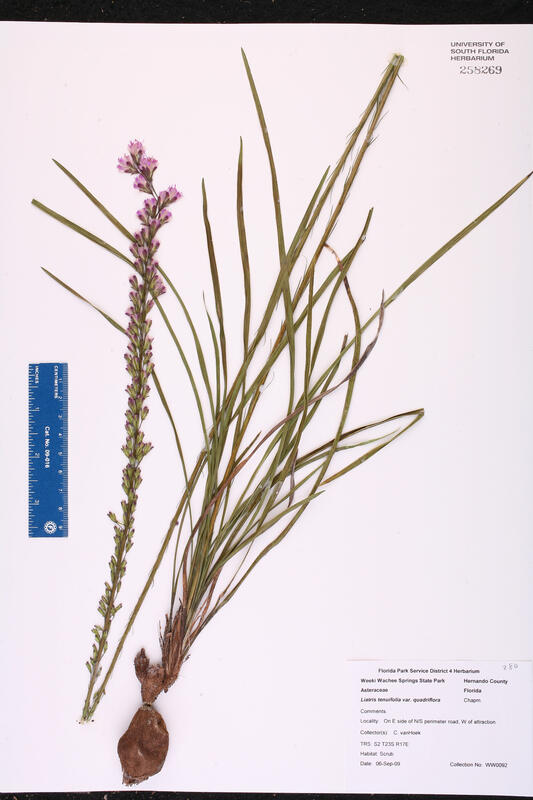
Perennial herb with erect, hairless stems 1.3 - 6 feet (40 - 180 cm) tall. Leaves 4 - 15 inches long and up to 0.3 inch wide (10 - 38 cm long and up to 0.9 cm wide), grass-like, linear to narrowly lance-shaped, clustered at congested nodes near the base of the stem, abruptly becoming smaller near the middle of the stem, hairless, dotted with minute, white stomates on both surfaces but with few or no glandular dots. Flower heads are held in densely flowered, narrowly spike-like clusters. Each head has 3 - 5 pink flowers, each bearing a long branched style. The base of each head is surrounded by a cuplike involucre composed of several reddish green, hairless bracts with translucent borders and rounded tips with a tiny point. Fruit is dry and seed-like, tipped with bristles.
Shortleaf Blazing Star (Liatris tenuifolia) has narrower leaves (1 - 2.5 mm) that arise from separated (not congested) nodes near the base of the stem; the leaves may be either abruptly or gradually reduced up the stem. The lowest parts of the leaves have long hairs on the margins, and both surfaces are gland-dotted. Its stem may be smooth or sparsely hairy.
Florida scrub, scrubby pine flatwoods, longleaf pine sandhills, pine rocklands.
Smooth Blazing-star is a perennial herb that grows in fire-maintained habitats and produces larger plants with more flowers in the year after a fire. It reproduces sexually by seed. Its stem rises from a corm in the early spring and begins to produce its narrowly cylindrical flower cluster in mid-summer. Flowers begin opening in late August and are visited by a variety of insect pollinators, especially bees and butterflies. Its seeds are dispersed by birds and other small animals.
Surveys are best conducted during flowering, August–October.
Southeast Georgia to south Florida.
Logging, conversion of habitat to pasture and pine plantations, and fire suppression.
Liatris laevigata is ranked S1? by the Georgia Department of Natural Resources, indicating that it is likely to be critically imperiled in the state but that information needed to make a definite ranking is lacking. Three populations were documented in the 1990s but have not been confirmed since; none occurred on conservation lands.
Protect sandhills and Longleaf Pine woodlands from logging and habitat conversion. Apply prescribed fire every 2 - 3 years in the growing season.
Carter, R., W.W. Baker, and M.W. Morris. 2009. Contributions to the flora of Georgia, U.S.A. Vulpia 8: 1-54.
Coastal Plain Plants. 2019. Liatris tenuifolia. http://coastalplainplants.org/wiki/index.php/Liatris_tenuifolia
GADNR. 2020. Element occurrence records for Liatris tenuifolia var. quadriflora. Georgia Department of Natural Resources, Wildlife Resources Division. Social Circle, Georgia.
NatureServe. 2019. Species account for Liatris tenuifolia var. quadriflora. NatureServe Explorer. NatureServe, Arlington, Virginia. https://explorer.natureserve.org/Taxon/ELEMENT_GLOBAL.2.155900/Liatris_tenuifolia_var_quadriflora
Nesom, G.L. 2006. Species account for Liatris laevigata. Flora of North America North of Mexico, vol. 21. http://beta.floranorthamerica.org/Liatris_laevigata
Weakley, A.S. 2015. Flora of the southern and mid-Atlantic States. University of North Carolina Herbarium, University of North Carolina, Chapel Hill. http://www.herbarium.unc.edu/flora.htm
Weakley, A.S., and Southeastern Flora Team. 2025. Flora of the southeastern United States Web App. University of North Carolina Herbarium, North Carolina Botanical Garden, Chapel Hill, U.S.A. https://fsus.ncbg.unc.edu/main.php?pg=show-taxon-detail.php&lsid=urn:lsid:ncbg.unc.edu:taxon:{094B3238-C515-4B6C-A181-70B97CF8A214}. Accessed Oct 21, 2025.
Linda G. Chafin
Linda G. Chafin, 11 November 2019: original account