


Loading profile. Please wait . . .
Eriophorum virginicum L.
Tawny Cottongrass




Federal Protection: No US federal protection
State Protection: No Georgia state protection
Global Rank: G5
State Rank: S1
Element Locations Tracked in Biotics: Yes
SWAP 2015 Species of Greatest Conservation Need (SGCN): Yes
SWAP 2025 Species of Greatest Conservation Need (SGCN): Yes
2025 SGCN Priority Tier: High Conservation Concern
Element Occurrences (EOs) in Georgia: 5
Habitat Summary for element in Georgia: Mountain bogs; peaty wet meadows in alluvial flats in Fall Line sandills; also in Okefenokee Swamp
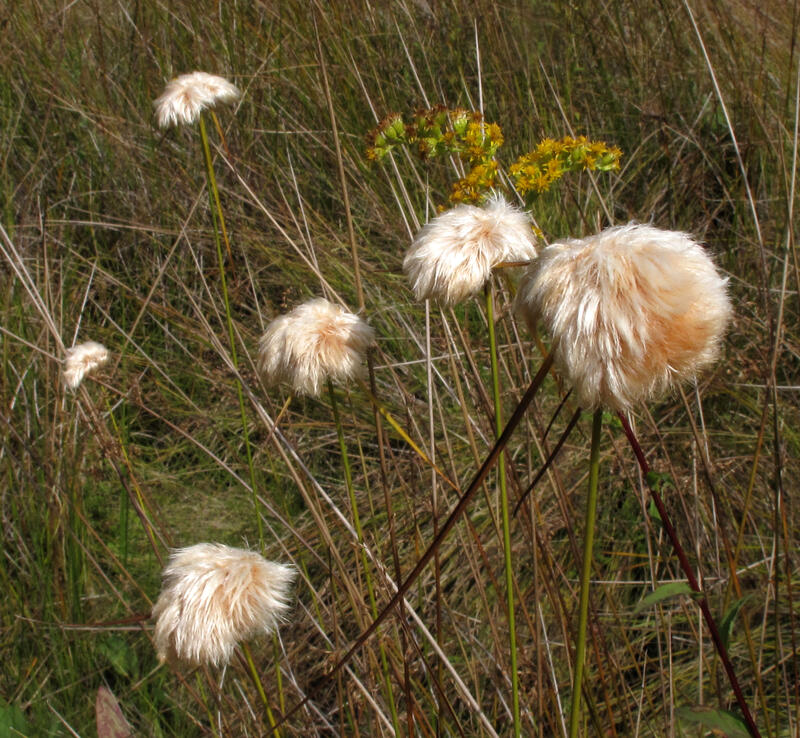
Perennial sedge with colony-forming rhizomes and erect, hairless, unbranched stems 1.5-4 feet (0.5-1.25 meters) tall. The stems are weakly three-angled to round in cross-section, growing singly or in clumps; old, tan, fibrous leaf bases often persist around the base of the stems. Leaves 2-12 inches long and less than 0.25 inch wide, hairless, and rough along the edges due to very fine teeth. The stems are topped with a woolly head of 2-10 crowded flower clusters; 2-5 leaf-like bracts up to 6 inches (15 cm) long surround the base of the head. The many florets that make up the clusters are covered in coppery-brown scales (often with a green center) and have at least 10 tan to reddish-brown (rarely white), thread-like bristles around their bases; the bristles lengthen to 0.5-0.75 inch (1-2 cm) long at seed maturity, giving the heads a woolly or cottony appearance. The seeds are dark brown to black, less than 0.2 inch (2.5-4 mm) long.
Tawny Cotton-grass is the only species of Eriophorum known from the Southeast U.S. Other, more northern species of Eriophorum have consistently white bristles.
Despite its name, Tawny Cotton-grass is a member of the Sedge family, Cyperaceae. More than 80 species in this family are rare in Georgia.
Tawny Cotton-grass occurs in mountain bogs, peaty wet meadows in Fall Line sandhills, and the Okefenokee Swamp.
Tawny Cotton-grass is a perennial that reproduces vegetatively by spread of rhizomes and sexually by seed. It is wind-pollinated. Its seeds are also dispersed by wind, aided by the long, thread-like bristles that surround the base of each seed. The leaves and stems are eaten by white-tailed deer, bear, and Canada geese; the seeds are eaten by a variety of birds.
Surveys are best conducted during flowering and fruiting, mid-summer to fall, when the plants are most conspicuous.
Tawny Cotton-grass occurs throughout eastern and upper midwestern North America, from Florida north to Labrador and Ontario.
Tawny Cotton-grass habitats – bogs and other peaty wetlands – are threatened by ditching and draining for silviculture and pasture, stream impoundment, and fire suppression.
| Threat 1 | Threat 2 | Threat 3 | |
|---|---|---|---|
| General Threat | Natural system modifications | Agriculture & aquaculture | None |
| Specific Threat | None | None | None |
One population is known in Georgia, on a GADNR Wildlife Management Area. The population has been augmented by plants grown from seeds collected at that site. The site is predicted to improve in quality as the bog is cleared of woody plants, treated with prescribed fire, and cleared of feral hogs.
Except for those in the Okefenokee Swamp, bogs are extremely rare in Georgia and are a top priority for conservation purchase and management. Because of the likelihood of plant and animal poaching, their locations should be kept secret. Bogs should be protected from hydrological alterations such as ditching, draining, or filling. Fire or hand and mechanical clearing should be used to prevent encroachment by woody plants. “Mud-bogging” and other vehicular access should be excluded and prosecuted on public lands. Control of feral hogs is essential for long-term survival of bog plants.
Ball, P.W. and D.E. Wujek. 2002. Eriophorum virginicum species account. Flora of North America, vol. 23. Oxford University Press, New York. http://www.efloras.org/florataxon.aspx?flora_id=1&taxon_id=242357819 (Accessed 20 May 2019)
Chayka, K. and P. Dziuk. 2019. Minnesota Wildflowers: Field Guide to the Flora of Minnesota–Eriophorum virginicum (Tawny Cottongrass) species account. https://www.minnesotawildflowers.info/grass-sedge-rush/tawny-cottongrass
GADNR. 2019. Element occurrence record for Eriophorum virginicum. Georgia Department of Natural Resources, Wildlife Resources Division, Social Circle.
Godfrey, R.K. and J.W. Wooten. 1979. Aquatic and wetland plants of southeastern United States. University of Georgia Press, Athens.
Hilty, J. 2019. Tawny Cotton Grass, Eriophorum virginicum species account. Illinois Wildflowers. https://www.illinoiswildflowers.info/grasses/plants/twn_cottongrass.html.
NatureServe. 2019. Eriophorum virginicum species account. NatureServe Explorer: An online encyclopedia of life, Version 7.1. NatureServe, Arlington, Virginia. http://explorer.natureserve.org. Accessed 19 May 2019.
Weakley, A.S. 2015. Flora of the southern and mid-Atlantic States. University of North Carolina Herbarium, University of North Carolina, Chapel Hill. http://www.herbarium.unc.edu/flora.htm
Linda G. Chafin
L. Chafin, 22 May 2019: original account