

Loading profile. Please wait . . .
Rhynchospora macra (C.B. Clarke) Small
Southern White Beaksedge




Federal Protection: No US federal protection
State Protection: No Georgia state protection
Global Rank: G3G4
State Rank: S1?
Element Locations Tracked in Biotics: Yes
SWAP 2015 Species of Greatest Conservation Need (SGCN): Yes
SWAP 2025 Species of Greatest Conservation Need (SGCN): Yes
2025 SGCN Priority Tier: High Conservation Concern
Element Occurrences (EOs) in Georgia: 4
Habitat Summary for element in Georgia: Peaty, sandhill seepage slopes; streamhead pocosins
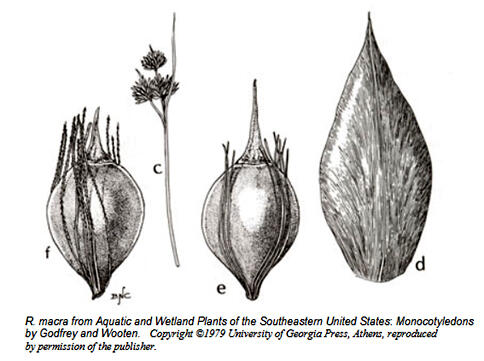
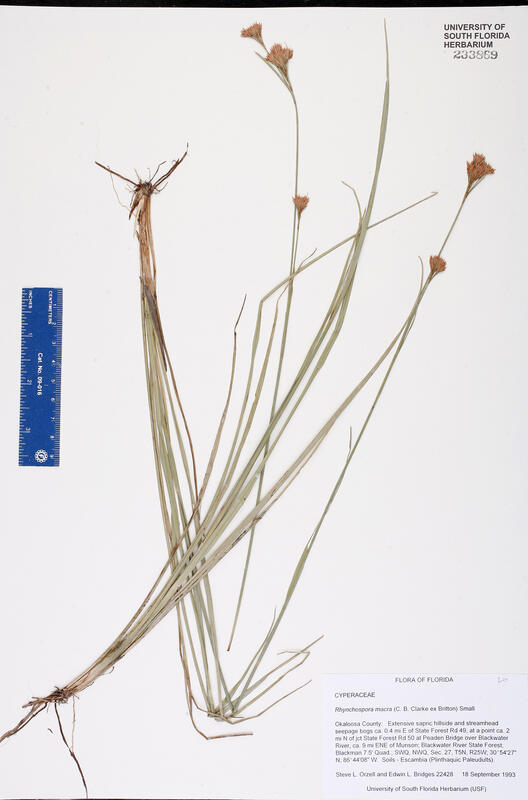
Perennial sedge forming dense clumps of leaves and stems. Stems are 12 - 28 inches (30 - 70 cm) tall, stiff and sharply triangular in cross-section. Leaves are shorter than the stem and usually less than 0.1 inch (3.5 mm) wide. One to three flower clusters are held at the top of the stem; each cluster is fan-shaped in outline, up to 1 inch (1.5 - 3 cm) wide, and composed of several rusty-brown, tan, or white spikelets, each about 0.25 inch (4-7 mm) long, and subtended by several narrow bracts. The fruit is a brown, hard, seed-like achene that is somewhat flattened (not three-sided) and pointed at both ends. The achene is topped with a flat, triangular “cap” (tubercle) about 1 mm long. A whorl of 15 - 26 bristles surrounds the base of the achene and reaches the top of the tubercle. The bristles are lined with tiny barbs, most of which point downward, though some near the tip of the bristle point upwards (viewing the barbs requires 10 - 20x magnification).
There are about 60 species of Rhynchospora in Georgia and many are very similar in appearance. The differences among them are mostly technical and require magnification. Large Beakrush is easier to identify than many due to its sharply triangular stems, narrow leaves, and white spikelets that turn tan or brown with age. It is also distinguished by a combination of these traits: flattened achenes, small size of the tubercle (1 mm long), and by having 15 - 20 barbed bristles, the barbs at the base of the bristle pointing downward and those near the tip of the bristle pointing upwards.
Fifteen species of beaksedge are rare in Georgia. For more information, see:
Northern White Beaksedge (Rhynchospora alba) http://beta.floranorthamerica.org/Rhynchospora_alba
Bearded Beaksedge (Rhynchospora crinipes) https://www.georgiabiodiversity.org/portal/profile?group=plants&es_id=20946
Georgia Beaksedge (Rhynchospora culixa) https://www.georgiabiodiversity.org/portal/profile?group=plants&es_id=17285
Decurrent Beaksedge (Rhynchospora decurrens) https://www.georgiabiodiversity.org/portal/profile?group=plants&es_id=21032
Fernald's Beakrush (Rhynchospora fernaldii) https://www.georgiabiodiversity.org/portal/profile?group=plants&es_id=20462
Harper's Beaksedge (Rhynchospora harperi) https://www.georgiabiodiversity.org/portal/profile?group=plants&es_id=17092
Many-bristled Beaksedge (Rhynchospora macra) https://www.georgiabiodiversity.org/portal/profile?group=plants&es_id=19539
Feather-bristle Beaksedge (Rhynchospora oligantha) http://beta.floranorthamerica.org/Rhynchospora_oligantha
Clonal Thread-leaved Beak (Rhynchospora pleiantha) https://www.georgiabiodiversity.org/portal/profile?group=plants&es_id=19634
Spotted Beaksedge (Rhynchospora punctata) https://www.georgiabiodiversity.org/portal/profile?group=plants&es_id=20475
Long-beak Beaksedge (Rhynchospora scirpoides)
Solitary Beaksedge (Rhynchospora solitaria) https://www.georgiabiodiversity.org/portal/profile?group=plants&es_id=21235
Chapman's Beakrush (Rhynchospora stenophylla) http://beta.floranorthamerica.org/Rhynchospora_stenophylla
Thorne’s Beaksedge (Rhynchospora thornei) https://www.georgiabiodiversity.org/portal/profile?group=plants&es_id=22487
Torrey's Beaksedge (Rhynchospora torreyana) http://beta.floranorthamerica.org/Rhynchospora_torreyana
Sandhill seepage slopes with peaty soils, wet pine savannas, and sphagnum bogs.
Many-bristled Beakrush is a perennial, clump-forming herb that reproduces sexually as well as vegetatively by producing lateral offshoots from the base of the plant. All beakrush flowers are wind-pollinated; their seeds are dispersed by water, gravity, and animals, assisted by the tiny, barbed bristles at the base of the fruit which attach to fur and feathers.
Many-bristled Beakrush flowers July–September; during flowering the white spikelets are fairly conspicuous. Mature fruits (August–October) are needed to confirm identification.
Southeastern Coastal Plain: north Florida north to south-central North Carolina and west to southeastern Texas (it is rare and imperiled in every state where it occurs); also Nicaragua and Puerto Rico.
Many-bristled Beakrush is threatened by hydrological disturbances such as ditching, draining, and filling in its wet savannah/bog habitat. It is also threatened by fire suppression, conversion of habitat to pine plantations or development, and invasion by exotic pest plants such as Cogon Grass and feral hogs. Changes in hydrology due to altered temperature and rainfall patterns related to climate change are likely to negatively effect this species.
| Threat 1 | Threat 2 | Threat 3 | |
|---|---|---|---|
| General Threat | Energy production & mining | Transportation & service corridors | Biological resource use |
| Specific Threat | None | None | None |
Many-bristled Beakrush is ranked S1 by the Georgia Department of Natural Resources, indicating that is critically imperiled in Georgia. There are only three documented populations in Georgia, about which little is known and all of which occur on private land.
Conduct field surveys of pitcherplant bogs and wet savannas to determine current status of this species. Apply prescribed fire every 2 - 3 years during the growing season. Avoid logging and bedding or other mechanical disturbance of soils and ground vegetation in its wetland habitat. Avoid draining, ditching, or plowing firebreaks in wetlands. Monitor populations for invasion of Cogon Grass or other invasive plants. Eradicate feral hogs. Address climate change.
GADNR. 2019. Element occurrence records for Rhynchospora macra. Georgia Department of Natural Resources, Wildlife Resources Division. Social Circle, Georgia.
Kral, R. 2003. Species account for Rhynchospora macra. Flora of North America North of Mexico, vol. 23. http://www.efloras.org/florataxon.aspx?flora_id=1&taxon_id=242101826
NatureServe. 2019. Species account for Rhynchospora macra. NatureServe Explorer: an online encyclopedia of life, Version 7.1. NatureServe, Arlington, Virginia. Accessed 12 June 2019. http://explorer.natureserve.org/servlet/NatureServe?searchName=Rhynchospora+macra
Godfrey, R.K. and J.W. Wooten. 1979. Aquatic and wetland plants of the Southeastern United States. University of Georgia Press, Athens.
Weakley, A.S. 2015. Flora of the southern and mid-Atlantic States. University of North Carolina Herbarium, University of North Carolina, Chapel Hill. http://www.herbarium.unc.edu/flora.htm
Linda G. Chafin
Linda G. Chafin, 18 June 2019: original account