


Loading profile. Please wait . . .
Cirsium virginianum (L.) Michx.
Virginia Thistle




Federal Protection: No US federal protection
State Protection: No Georgia state protection
Global Rank: G4
State Rank: S3
Element Locations Tracked in Biotics: Yes
SWAP 2015 Species of Greatest Conservation Need (SGCN): Yes
SWAP 2025 Species of Greatest Conservation Need (SGCN): Yes
2025 SGCN Priority Tier: Moderate Conservation Concern
Element Occurrences (EOs) in Georgia: 5
Habitat Summary for element in Georgia: Moist pinelands; moist longleaf pine/wiregrass savannas
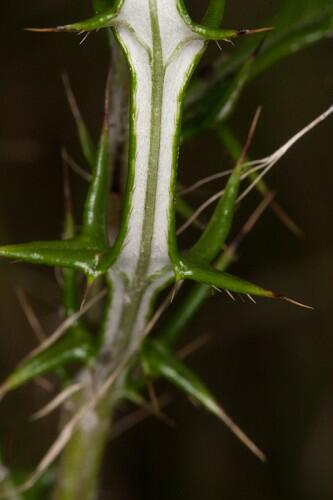
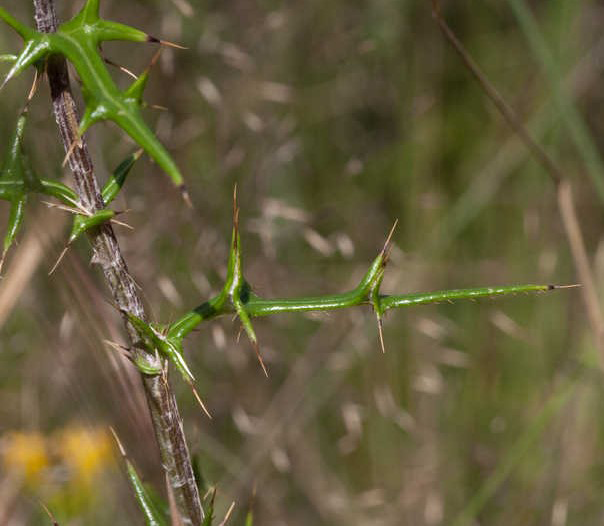
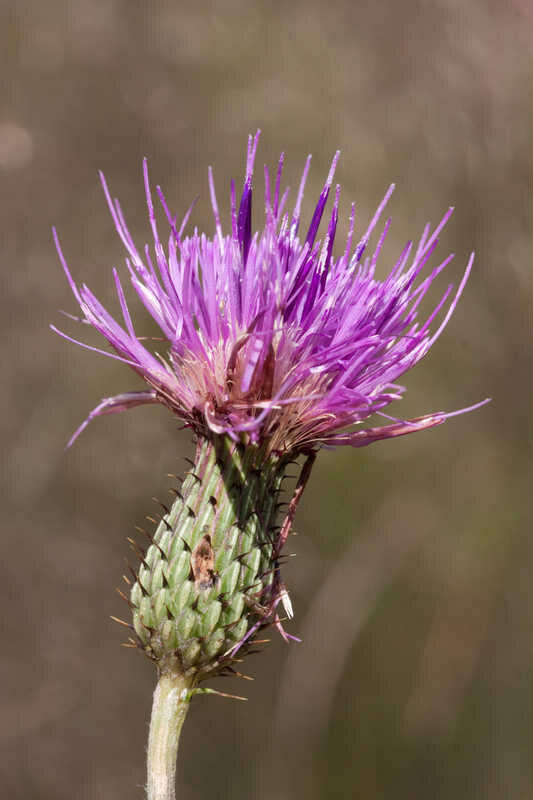
Biennial (or short-lived perennial) herb with an erect stem 2 - 5 feet (60 - 150 cm) tall. During its first year, the plant forms a rosette of basal leaves. During its second or third year, a stem emerges from the rosette bearing 30 - 70 leaves, and the rosette withers away. Stem leaves are up to 6 inches (15 cm) long and 0.8 inch (2 cm) wide, alternate, not decurrent on the stem, stiff and firm, deeply lobed with broad sinuses, margins spiny and often rolled under, spines slender and up to 3.5 inches (9 mm) long, upper surfaces green, lower surfaces densely white-hairy. Flower heads held on stalks 4 - 6 inches long (10 - 15 cm) long. Flower heads 0.6 - 1 inch (1.5 - 2.5 cm) high, surrounded at the base by a cylindrical involucre of spine-tipped bracts; the bracts are green to brown with a prominent white midrib. Numerous dark pink to purple, 5-lobed disk flowers emerge from the top of the involucre; there are no ray flowers. Dark purple stamens and long pink styles arise from mature disk flowers. After fertilization, the flowers are replaced by dry, seed-like fruits bearing long, tan bristles (pappus) that aid in dispersal.
There are at least six species of thistle in Georgia’s Coastal Plain and Fall Line ecoregions. Virginia Thistle is distinguished by its small heads (less than 1 inch high) held on long stalks, deeply lobed leaves less than 2 inches wide, and lower leaf surfaces that are densely white-hairy. Carolina Thistle (Cirsium carolinianum), see below, is very similar to Virginia Thistle but is found in the upper Piedmont.
Musk Thistle or Nodding Thistle (Carduus nutans) is a widespread, highly invasive thistle native to Eurasia that occurs in sunny, disturbed areas such as roadsides and pastures. Its stems have spiny wings and the leaves are green on both surfaces; at maturity, the flower heads droop or nod at the top of the stem.
Carolina Thistle (Cirsium carolinianum) occurs in northeast and northwest Georgia in cedar glades, dry to wet prairies, open pine-oak woods and rights-of-way through these habitats, over mafic, ultramafic, or calcareous rocks.
LeConte's Thistle (Cirsium lecontei) occurred in two counties in Georgia’s Coastal Plain in wet pine savannas and seepage bogs but has not been seen for many decades.
Swamp Thistle (Cirsium muticum) occurs in six Georgia counties in floodplains, live oak hammocks, and wet flatwoods and prairies.
Virginia Thistle occurs in Georgia’s Coastal Plain in wet to fairly dry pine savannas and flatwoods, bogs, and ecotones between dry uplands and wet savannas.
Virginia Thistle is a biennial (or short-lived perennial) herb. During its first year, the plant forms a flattened rosette of basal leaves; during its second or third year, a tall stem emerges from the rosette, divides into one or a few branches at the top, and produces 1 - 10 flower heads. The flower heads are visited by a variety of insect pollinators and produce many seeds that are prized by seed-eating birds, especially finches, and other small animals. The seed-like fruits are tipped with plume-like bristles and are dispersed by the wind.
Virginia Thistle is most conspicuous during flowering, August–October. Earlier in the growing season, it may be distinguished from other Coastal Plain thistles by the deeply lobed, narrow leaves (less than 2 inches wide) and lower leaf surfaces that are densely coated with white hairs.
In Georgia, Virginia Thistle is known from one Fall Line Sandhill county and one upper Coastal Plain county. Range-wide, it occurs from Florida north to New Jersey; it is rare throughout its range.
Virginia Thistle is threatened by fire suppression and by conversion of habit to pine plantations, commercial and residential development, and agriculture.
| Threat 1 | Threat 2 | Threat 3 | |
|---|---|---|---|
| General Threat | Energy production & mining | Transportation & service corridors | Biological resource use |
| Specific Threat | None | None | None |
Virginia Thistle is ranked S3 by the Georgia Department of Natural Resources, indicating that it is rare and vulnerable in the state. One population occurs on U.S. Department of Defense land, the other on privately owned land without a conservation easement or agreement.
The habitats where Virginia Thistle occurs require frequent fire, every 2 - 3 years during the growing season, to prevent the encroachment of shrubs and trees. Avoid soil disturbance, ditching, draining, firebreak construction, bedding, and mechanical clearing in savannas and bogs.
Cronquist, A. 1980. Vascular Flora of the Southeastern United States: Volume 1, Asteraceae. University of North Carolina Press, Chapel Hill.
GADNR. 2019. Element occurrence records for Cirsium virginianum. Georgia Department of Natural Resources, Wildlife Resources Division. Social Circle, Georgia.
Helzer, Chris. 2015. Saving pollinators one thistle at a time. Prairie Ecologist, 26 August 2015. The Nature Conservancy, Nebraska. https://prairieecologist.com/2015/08/26/saving-pollinators-one-thistle-at-a-time/
NatureServe. 2019. Species account for Cirsium virginianum. NatureServe Explorer: an online encyclopedia of life, Version 7.1. NatureServe, Arlington, Virginia. Accessed 8 June 2019. https://explorer.natureserve.org/Taxon/ELEMENT_GLOBAL.2.132864/Cirsium_virginianum
Flora of North America. 2006. Species account for Cirsium virginianum. Flora of North America North of Mexico, vol. 19. Accessed 30 October 2019. http://beta.floranorthamerica.org/Cirsium_virginianum
Sorrie, B.A. 2011. Field guide to wildflowers of the Sandhills Region of North Carolina, South Carolina, and Georgia. University of North Carolina Press, Chapel Hill.
Weakley, A.S. 2015. Flora of the southern and mid-Atlantic States. University of North Carolina Herbarium, University of North Carolina, Chapel Hill. http://www.herbarium.unc.edu/flora.htm
Linda G. Chafin
Linda G. Chafin, 30 October 2019: original account