


Loading profile. Please wait . . .
Macromia margarita Westfall, 1947
Mountain River Cruiser




Federal Protection: No US federal protection
State Protection: No Georgia state protection
Global Rank: G3
State Rank: S1S2
Element Locations Tracked in Biotics: Yes
SWAP 2015 Species of Greatest Conservation Need (SGCN): Yes
SWAP 2025 Species of Greatest Conservation Need (SGCN): Yes
2025 SGCN Priority Tier: High Conservation Concern
Element Occurrences (EOs) in Georgia: 1
Habitat Summary for element in Georgia: Rocky mountain streams and rivers with good current
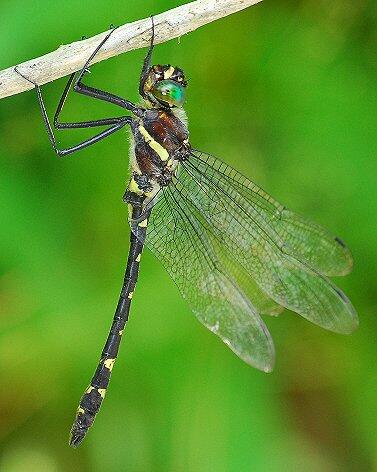
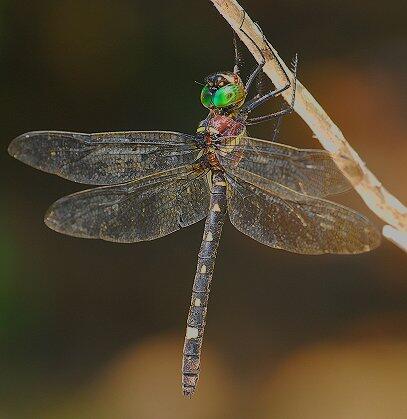
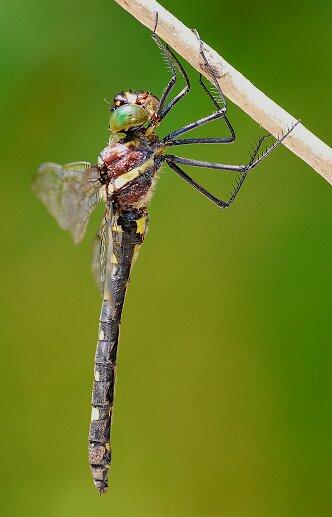
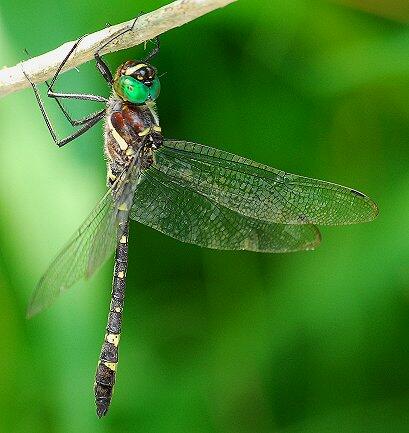
Like all cruisers in the genus Macromia, the Mountain River Cruiser is a fairly large brown and black dragonfly with yellow markings, averaging about 75mm in length. The eyes are green and there is a yellow line across the black face. The thorax is black in adults (brown in immatures) with the single diagonal yellow stripe typical of this genus. The abdomen is black with the following yellow markings: a ring around segment 2 that is interrupted on top, paired spots on the top of segments 3-6, larger spots on the top of segments 7 and 8, and a small spot on the lower surfaces of segments 8 and 9 near the tip. Females are similar but browner, including the wings, and larger spots on a thicker abdomen.
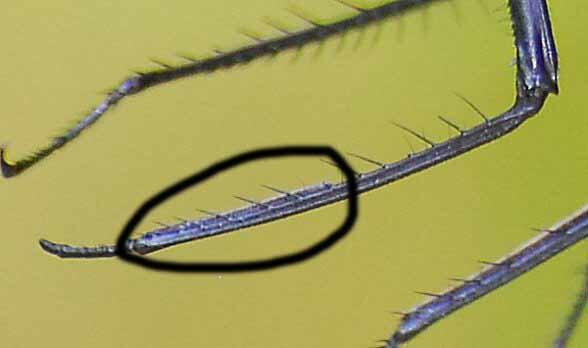
Specific ID in this genus is very tricky, and there are three species in Georgia which are similar: Allegheny River Cruiser, Illinois River Cruiser, and Georgia River Cruiser (the latter two are both subspecies of Swift River Cruiser). Mountain River Cruisers can be told from other members of the genus Macromia by the combination of where the yellow ring on S2 is broken (on top or on the sides or not at all), the thickness of the line across the face, and most importantly by the length of a keel which runs down the lower section (tibia) of the middle leg called the mesotibial keel. This keel is longest in Mountain River Cruiser (50-58% length of the tibia), a little shorter in Illinois (38-42%), and much shorter in Allegheny (14-20%) and Georgia (23-34%). This is best determined in the hand, which is partially why there are so few confirmed records of this species. Finally, visible only in the hand under great magnification, the tip of the male hamule is much less tapered and more robust Mountain than in any of the other Macromias.
Clean mountain streams and rivers with rocks and a fast current.
Like all dragonflies, just about insect, they can catch on the wing. Larvae will also eat just about anything they can catch.
Very little is known about this dragonfly due to its small range and the difficulty of identification, but it is on the wing from about late May to the middle of August. The species seems to be uncommon to rare, but this is not fully known either. Adult males patrol up and down the length or creeks and rivers but very little is known about the rest of their life history or about females at all.
This species is badly in need of targeted surveys in clean rivers and streams in the Blue Ridge physiographic region of northeast Georgia. Surveying is best accomplished during the flight season in late May through mid-August, but winter larval surveys could also be effective. This species is very difficult to survey for since there are two very similar species that occur in the same exact habitat. Surveying for this species requires not only finding potential individuals but netting them to take measurements. The difficulty in surveying for larvae is that many of the rivers they inhabit are too large to wade easily.
The core of the range is southern Blue Ridge: extreme northeast Georgia, extreme northwestern South Carolina, eastern Tennessee and western North Carolina. Also occurs in the upper Piedmont of North Carolina but not known to do so in Georgia. There are also a couple of confirmed records well out of the Blue Ridge in northwestern Alabama and south-central Tennessee, but it is not currently known what the exact range is at least partly due to the difficulty of identifying this species.
Habitat loss through degradation or development. The primary threat to this species is habitat alteration associated with agricultural practices and commercial and residential development in the northeast Georgia mountains. Failure to follow agricultural best-management practices results in sedimentation and bank destabilization and potential degradation of water quality from pesticide and fertilizer runoff. Additionally, this species may be particularly susceptible to siltation.
| Threat 1 | Threat 2 | Threat 3 | |
|---|---|---|---|
| General Threat | Residential & commercial development | Pollution | Pollution |
| Specific Threat | None | Domestic & urban waste water | Agricultural & forestry effluents |
S1S2 for Georgia. Presently known only from the Chattooga River drainage on the Georgia/South Carolina border. At least some of the Chattooga River population occurs along the “Wild and Scenic” portion of the river, and is on U.S. Forest Service property.
First, to try to determine which drainages support this species, and then to protect some of the waterways it inhabits. Incentive programs to help farmers implement best-management practices could improve instream habitat by decreasing sedimentation and runoff and increasing riparian forest cover. Forestry operations should follow best-management practices (BMPs) for water quality. Conservation groups should work cooperatively with developers and local governments to minimize the impacts from new home construction and commercial development.
Donnelly, T.W., and K.J. Tennessen. 1994. Macromia illinoiensis and georgina: A study of their variation and apparent subspecific relationship (Odonata: Corduliidae). Bulletin of American Odonatology 2: 27-61.
Dunkle, S.W. 2000. Dragonflies through binoculars. New York: Oxford University Press, 266 pp.
Mauffray, B., and G. Beaton. 2005. The distribution of dragonflies and damselflies (Odonata) in Georgia. Bulletin of American Odonatology 9: 21-66.
Needham, J.G., M.J. Westfall, Jr., and M.L. May. 2014. Dragonflies of North America, 3rd Edition. Scientific Publishers, Gainesville, FL. 656 pp.
Odonata Central Website. 2020. Available from: https://www.odonatacentral.org/app/#/data/records/?filterqs=%7Ctaxons%3A45652 (Accessed 26 Dec 2020.)
Paulson, D. 2011. Dragonflies and Damselflies of the East. Princeton University Press, Princeton NJ. 538 pp.
Roble, S. M. 1997. Status survey for the mountain river cruiser (MACROMIA MARGARITA) in Virginia, and a rangewide assessment of the status of the species. Natural Heritage Technical Report 97-17. Virginia Department of Conservation and Recreation, Division of Natural Heritage, Richmond. Unpublished report to U.S. Fish and Wildlife Service. 9 pp.
Giff Beaton
22 December 2020