Loading profile. Please wait . . .
Viburnum bracteatum Rehd.
Limerock Arrow-wood




Federal Protection: No US federal protection
State Protection: Endangered
Global Rank: G1G2
State Rank: S1
Element Locations Tracked in Biotics: Yes
SWAP 2015 Species of Greatest Conservation Need (SGCN): Yes
SWAP 2025 Species of Greatest Conservation Need (SGCN): Yes
2025 SGCN Priority Tier: Highest Conservation Concern
Element Occurrences (EOs) in Georgia: 3
Habitat Summary for element in Georgia: Mesic hardwood forests over limestone
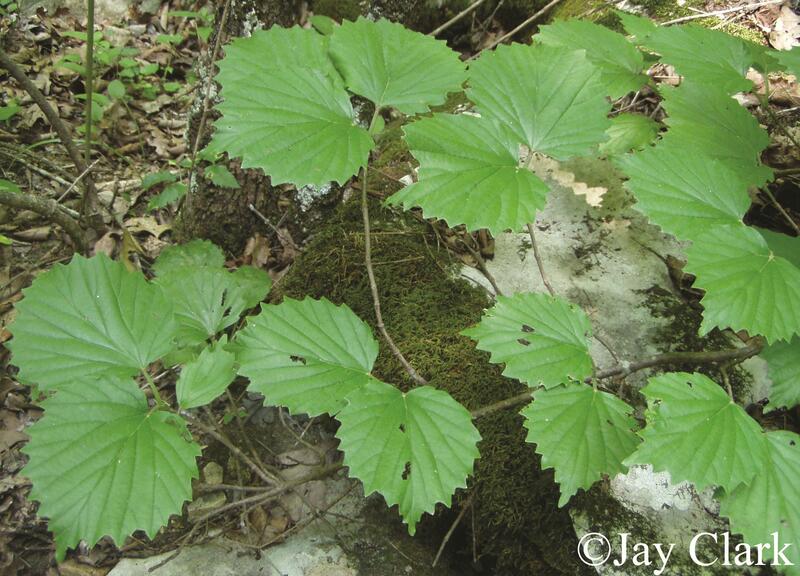
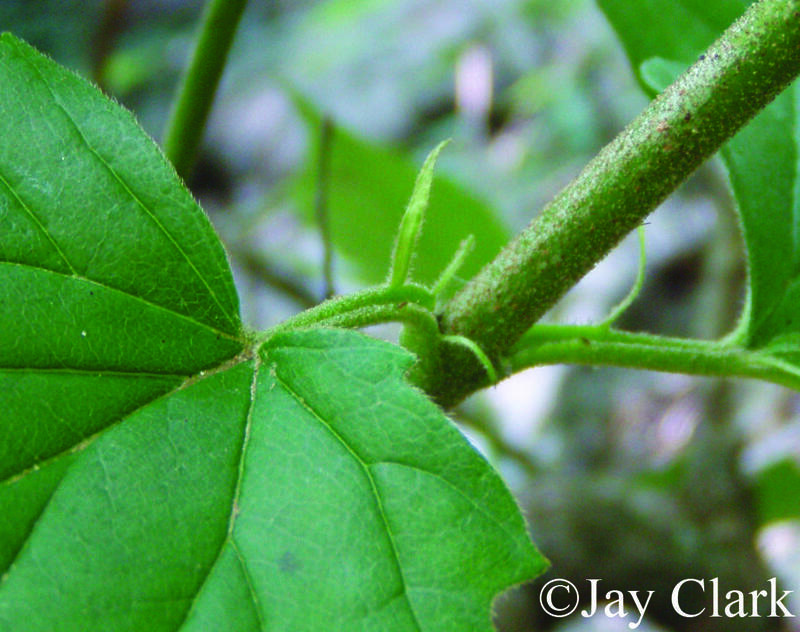
Deciduous, colony-forming shrub up to 10 feet (3 meters) tall with smooth, tight, gray bark; twigs of the current season are hairy. The leaves are 2 - 4.7 inches (5 - 12 cm) long, opposite, broadly oval to nearly round, with rounded or heart-shaped bases, pointed tips, and margins with large, sharp teeth; secondary veins on the upper surface are conspicuous and parallel; veins of the lower leaf surface are hairy. Leaf stalks are about 0.7 inch (1.5 - 2 cm) long and short-hairy, with 4 persistent, narrow, bract-like stipules at the junction of leaf stalk and stem. Flower clusters are held on erect, hairy, glandular, 2-inch (5 - 6 cm) stalks with 2 conspicuous bracts at the base; the cluster is 1.6 - 2.4 inches (4 - 6 cm) across, flat-topped, with many flowers about 0.4 inch (0.8 -1.2 cm) wide with 5 white petals; the flower stalks are covered with hairs and stalked glands. Fruits are 0.4 inch (1 - 1.2 cm) long, elliptical, and blue-black when mature.
A number of Viburnum species are superficially similar, including Southern Arrow-wood (Viburnum dentatum), Carolina Arrow-wood (Viburnum carolinianum), and two varieties of Downy Arrow-wood (see below). Limerock Arrow-wood is distinguished by the combination of these traits: its leaf stalks are long, about 0.7 inch (1 - 2.5 cm) long; the stipules at the base of the leaf stalk are persistent throughout the growing season; the lower leaf surfaces are hairy only on the veins and in the angle at the base of the veins; and the fruits are elliptical and large (1 - 1.2 cm).
Limerock Downy Arrow-wood (Viburnum rafinesquianum var. affine, Special Concern) resembles Limerock Arrow-wood. It occurs in rocky woods and on bluffs over amphibolite, granite, and limestone in Bartow, DeKalb, and Floyd counties. It has very short or no leaf stalks. For more information, see: https://www.georgiabiodiversity.org/portal/profile?group=plants&es_id=17717
Downy Arrowwood (Viburnum rafinesquianum var. rafinesquianum) occurs on steep, rocky slopes in the western Georgia Piedmont and northwest Georgia. The lower surfaces of its leaves are hairy both on the veins and between the veins. Variety affine has hairs only on the veins on the lower leaf surface.
Witch-hobble (Viburnum lantanoides) occurs in northern hardwood forests and boulderfields in northeast Georgia mountains. Its leaves are heart-shaped and up to 8 inches (20 cm) long. For more information, see: https://gobotany.nativeplanttrust.org/species/viburnum/lantanoides/
Limestone bluffs above the Coosa River and on rocky slopes of the Cumberland Plateau.
There is little published information about Limerock Arrow-wood’s biology. A closely related species, Southern Arrow-wood (Viburnum dentatum), is better known and probably shares many life history traits (some botanists consider V. bracteatum to be the same species as V. dentatum). Viburnum flowers offer little nectar and are most frequently visited by pollen-gathering insects such as bees; solitary bees are thought to be the most effective Viburnum pollinators. Southern Arrow-wood is self-incompatible and must be cross-pollinated in order to produce fruit. Fruits are produced by the third year and are dispersed primarily by birds. Limerock Arrow-wood also reproduces vegetatively, by the spread of short rhizomes and by sprouts from the root crown. Many Viburnum species have extra-floral nectaries, small glands at the base of the leaf that produce a sugar-rich nectar. It is thought that extra-floral nectaries attract insects that may defend the plant from leaf-eating insects. Some biologists have speculated that the stipules at the base of some Viburnum leaves are highly modified nectaries.
Surveys are best conducted during flowering (mid-April–mid-May) and fruiting (July–October).
Fewer than 15 sites are known in Georgia, Alabama, and Tennessee. Several sites have been destroyed by mining.
Logging, limerock quarrying, and mechanical clearing. Plant poaching. Lack of sexual reproduction. Viburnum Leaf Beetle (Pyrrhalta viburni) is threatening other species of Viburnum in this group of closely related species and may eventually pose a hazard to Limerock Arrow-wood. The beetles are capable of defoliating a shrub by mid-summer. The beetle is so far confined to the northeastern U.S., but may become a threat if it moves southward.
| Threat 1 | Threat 2 | Threat 3 | |
|---|---|---|---|
| General Threat | Energy production & mining | Other options | None |
| Specific Threat | None | None | None |
Limerock Arrow-wood (Viburnum bracteatum) is ranked S1 by the Georgia Department of Natural Resources, indicating that is critically imperiled in Georgia. It is listed as Endangered by the State of Georgia. Three populations are known, all on conservation land. These plants rarely flower or set fruit.
Avoid logging, quarrying, or other mechanical disturbances on limestone bluffs. Safeguard location information and prosecute plant poachers.
Allison, J.R. 1999. Status survey for Crataegus triflora and Viburnum bracteatum in Georgia. Georgia Department of Natural Resources, Wildlife Resources Division, Social Circle, Georgia.
Chafin, L.G. 2007. Field guide to the rare plants of Georgia. State Botanical Garden of Georgia and University of Georgia Press, Athens.
Clark, R.C. 1971. The woody plants of Alabama. Annals Missouri Botanical Garden 58: 99-242. https://www.jstor.org/stable/2394932?seq=1#metadata_info_tab_contents
Cullina, W. 2002. Native trees, shrubs, and vines: a guide to using, growing, and propagating North American woody plants. Houghton Mifflin Company, New York.
Estes, D. 2010. Viburnum bracteatum (Adoxaceae) expanded to include Viburnum ozarkense. Castanea 75(2): 277-293.
GADNR. 2020. Element occurrence records for Viburnum bracteatum. Georgia Department of Natural Resources, Wildlife Resources Division, Social Circle, Georgia.
Kollmann, J. and P.J. Grubb. 2002. Viburnum lantana L. and Viburnum opulus L. (V. lobatum Lam., Opulus vulgaris Borkh.). Journal of Ecology 90(6): 1044 - 1070. https://www.jstor.org/stable/3072311?seq=1#metadata_info_tab_contents
Kral, R. 1983. A report on some rare, threatened, or endangered forest-related vascular plants of the South. Technical Publication R8-TP2. United States Forest Service, Atlanta.
NatureServe. 2020. Viburnum bracteatum species account. NatureServe Explorer. Arlington, Virginia. https://explorer.natureserve.org/Taxon/ELEMENT_GLOBAL.2.144580/Viburnum_bracteatum
Patrick, T.S., J.R. Allison, and G.A. Krakow. 1995. Protected plants of Georgia. Georgia Department of Natural Resources, Natural Heritage Program, Social Circle.
USDA. 2017. Plant guide: arrow-wood viburnum, Viburnum dentatum. NRCS National Plant Data Center and Biota of North America Program. https://plants.usda.gov/java/factSheet
USDA. 2002. Plant fact sheet: arrow-wood viburnum, Viburnum dentatum. NRCS National Plant Data Center and Biota of North America Program. https://plants.usda.gov/java/factSheet
Weakley, A.S. 2015. Flora of the southern and mid-Atlantic States. University of North Carolina Herbarium, University of North Carolina, Chapel Hill. http://www.herbarium.unc.edu/flora.htm
Linda G. Chafin
L.Chafin, Jan. 2009: original account.
D.Weiler, Jan. 2010: added pictures.
L. Chafin, June 2020: updated original account.