Loading profile. Please wait . . .
Pseudemys nelsoni Carr, 1938
Florida Redbelly Turtle




Federal Protection: No US federal protection
State Protection: No Georgia state protection
Global Rank: G5
State Rank: S2
Element Locations Tracked in Biotics: Yes
SWAP 2015 Species of Greatest Conservation Need (SGCN): No
SWAP 2025 Species of Greatest Conservation Need (SGCN): No
2025 SGCN Priority Tier:
Element Occurrences (EOs) in Georgia: 7
Habitat Summary for element in Georgia: Blackwater creeks; ponds; lakes; swamps
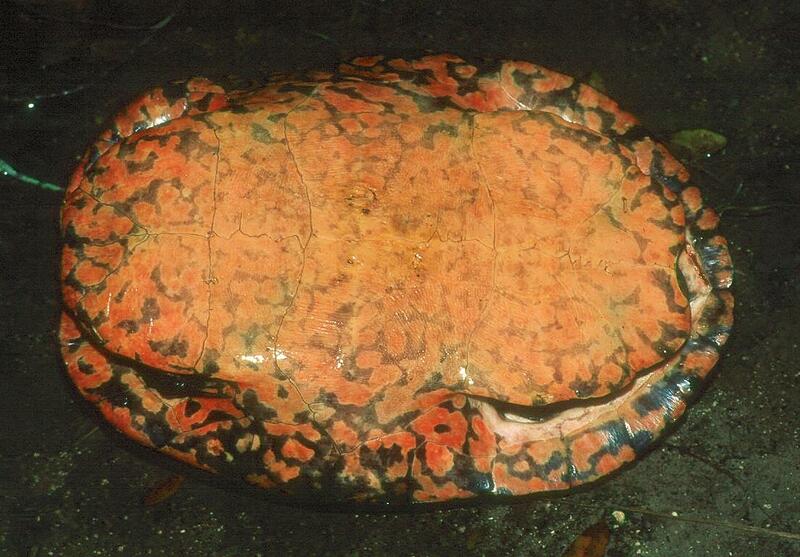
As is the case for all emydids (turtles within the family Emydidae), this turtle has a total of 25 marginal scutes (including the cervical scute) on the perimeter of the carapace (upper shell). The elongated carapace (20-30.5 cm or 8-12 inches in length in adults) is slightly serrated posteriorly. The highest point of the carapace (somewhat domed relative to other cooters) is usually anterior to the middle. The first vertebral scute is longer than (or as long as) broad, while vertebral scutes 2-5 are broader than long. The carapace is usually black, with red or yellow markings on both marginal and lateral scutes. The second lateral scute has a light, central band, that often forms a “Y”-shaped blotch. The marginal scutes possess central red bars dorsally and dark smudge-like blotches at seams ventrally. The plastron is reddish orange in color and is either plain or with a medial pattern. The skin is black with yellow stripes. Stripes on the head form an arrow on the snout; this so-called “prefrontal arrow” is formed by the junction of the center head (sagittal) stripe and the two (supratemporal) stripes that run along the side of the head. Additionally, the head has 1-3 (paramedial) stripes between the supratemporal stripes, and in this species these paramedial stripes are usually reduced and always end behind the eyes (Figure 1.). Hatchlings (2.9-3.4 cm or 1.1-1.3 inches in carapace length) are more brightly patterned than adults, with rounded, slightly keeled carapaces.
The Florida red-bellied turtle can be differentiated from other turtles of the Pseudemys concinna-floridana complex [eastern river cooter (Pseudemys c. concinna), Suwannee cooters (P. concinna suwanniensis), Coastal Plain cooter (P. c. floridana), & peninsula cooter (P. floridana peninsularis)] by possessing prominent, tooth-like cusps on the upper jaw; turtles within the Pseudemys concinna-floridana complex are characterized by lacking or having only short cusps on the upper jaw.
Both the Alabama red-bellied turtle (Pseudemys alabamensis) and a subspecies of northern red-bellied turtle (i.e., P. rubriventris bangsi) are listed as Endangered under the federal Endangered Species Act. Therefore, differentiation of turtles within the red-bellied turtle (Pseudemys rubriventris) complex is of conservation importance (Figure 1.). In P. alabamensis, although the second lateral scute has a light, central band that also often forms a “Y”-shape (as in the P. nelsoni), its paramedial head stripes typically pass forward of the eye. In P. rubriventris, the second lateral scute has a broad light central transverse band, forked at upper or lower end or both [forming a Y or ʎ or X] and the paramedial head stripes end between the eyes.
In Georgia, the Florida red-bellied turtle is found within freshwater marshes, ponds, lakes, and some low gradient rivers (e.g., the Suwannee & St. Mary’s rivers) and spring runs; while freshwater is preferred, this species can also be found in brackish water (≤ 30% saltwater), albeit less commonly so. Optimal habitat is characterized by non-flowing water (such as shallower lake margins) with abundant emergent and submergent vegetation, especially water lilies, while grassy areas are avoided. This turtle is absent or rare (may be found in low densities) in sandy-bottomed, sparely vegetated lakes, or in lakes with abundant open water and proportionally less vegetation. Like most emydids, this species basks extensively; for basking substrate Florida red-bellied turtles utilize logs and stumps, but mats of vegetation are also frequently used.
Adults are highly herbivorous; food items include cyanobacteria, diatoms, filamentous green algae, aquatic moss, and other aquatic plants. Adults may occasionally feed on alligator eggs and scavenge on dead fish. Juveniles, probably more carnivorous than adults, are known to feed on aquatic insects and other small invertebrates.
Undoubtedly an evolutionary response to frequent predation by alligators, compared to other closely related emydid turtles, the carapace of this species is much more highly domed in shape conferring greater crushing resistance (i.e., against an alligator’s bite). Sex of individual Florida red-bellied turtles is determined by the temperature at which the egg incubates during embryonic development while in the nest; for P. nelsoni, the pivotal temperature is 82.4°F (28°C) – males are predominately produced at this temperature and lower, while females are predominately produced at this temperature and higher (i.e., temperature sex determination pattern TSD – 1a). Female Florida red-bellied turtles often dig their nest within either sandy soil located at a moderate distance from water or within the decaying vegetation of occupied or vacant alligator nests. If her eggs are laid before that of the alligator’s, the turtle’s eggs are afforded the same protection the female alligator gives her own eggs, but this strategy also risks the possibility that the turtle’s eggs might be destroyed when the female alligator tears open the nest mound to release her own hatchlings.
Because Florida red-bellied turtle adults are highly herbivorous, they are not generally attracted to baited traps. Basking traps often prove most effective in the capture of this species. Use of such turtle traps are only legal in Georgia by issuance of a permit by the Georgia Department of Natural Resources. Alternatively, census of this species could be conducted through visual survey (spotting basking turtles with binoculars while floating within a non-powered boat [i.e., a canoe or kayak]) within the Suwannee and St. Mary’s rivers, prairies of the Okefenokee Swamp, or brackish intercoastal waterways.
The Florida red-bellied turtle occurs predominantly within slow-moving waters throughout peninsular Florida and extreme southeastern Georgia. Although first described from Florida as a new species in Florida in 1938, the occurrence of this turtle within the St. Mary’s River drainage was not recorded until 1977 and the occurrence of this species within Georgia (Okefenokee Swamp) was not recognized until 1980. In Georgia the species occurs along associated wetlands of both the Suwannee and St. Mary’s rivers, throughout the Okefenokee Swamp, on Cumberland Island, and within the intercoastal brackish waters.
The Florida red-bellied turtle occurs predominantly within slow-moving waters throughout peninsular Florida and extreme southeastern Georgia. Although first described from Florida as a new species in Florida in 1938, the occurrence of this turtle within the St. Mary’s River drainage was not recorded until 1977 and the occurrence of this species within Georgia (Okefenokee Swamp) was not recognized until 1980. In Georgia the species occurs along associated wetlands of both the Suwannee and St. Mary’s rivers, throughout the Okefenokee Swamp, on Cumberland Island, and within the intercoastal brackish waters.
The Florida red-bellied turtle is at the northern periphery of its range where it occurs in extreme southeastern Georgia and is rarely encountered. Though thought to be secure, the precise status of Georgia populations is unknown; occurrences of the species are currently tracked within the Georgia Department of Natural Resources’ (DNR) conservation database. As is the case for all non-protected freshwater turtle species in Georgia, there is no closed season for the harvest of the Florida red-bellied turtle in Georgia. However, Georgia’s freshwater turtle regulations (Chapter 391-4-16) do provide some restriction to harvest; no freshwater turtle eggs may be harvested from the wilds of Georgia and no more than 10 freshwater turtles (any combination of species) may be possessed without a commercial turtle permit. Further, turtle traps can only legally be deployed in Georgia within public or private waters by a permitted nuisance wildlife control operator or through the issuance of a commercial fishing permit in conjunction with a commercial turtle-farming permit issued by the Georgia DNR. Take from the wild in Florida (the only other state in which this turtle occurs), requires a permit.
The long-term survey and monitoring of select Georgia populations should be initiated and periodically monitored in order to establish baseline demographics and to identify possible future population declines. Impacts to riparian habitats from upland land use should be minimized; forestry best management practices including the implementation of stream management zones within the turtle’s range should be implemented during forestry operations in order to minimize erosion of the uplands and sedimentation input into adjacent stream channels.
Carr, A. F. 1938. Pseudemys nelsoni, a new turtle from Florida. Occasional Papers of the Boston Society of Natural History 8: 305-310.
Jackson, D. R. 2010. Pseudemys nelsoni Carr 1938 – Florida red-bellied turtle. 041. In: Conservation Biology of Freshwater Turtles and Tortoises: A Compilation Project of the IUCN/SSC Tortoise and Freshwater Turtle Specialist Group A.G.J. Rhodin, P.C.H. Pritchard, P.P. van Dijk, R.A. Saumure, K.A. Buhlmann, J.B. Iverson, and R.A. Mittermeier, Eds. Chelonian Research Monographs No. 5, doi:10.3854/crm.5.041.nelsoni.v1.2010
Powers, A. and C. R. Smith. 1977. Geographic distribution: Chrysemys nelson [Barker Co., FL]. Herpetological Review 8(3): 84.
Shoop, C. R. and C. Ruckdeschel. 1986. New herpetological records for Cumberland Island, Georgia. Herpetological Review 17(2): 51.
Vitt, L. J. and A. E. Dunham. 1980. Geographic distribution: Chrysemys nelson [Ware Co, GA]. Herpetological Review 11(3): 80.
Thomas M. Floyd
T. Floyd, November 2023: original account