Loading profile. Please wait . . .
Stewartia malacodendron L.
Silky Camellia




Federal Protection: No US federal protection
State Protection: Rare
Global Rank: G4
State Rank: S2
Element Locations Tracked in Biotics: Yes
SWAP 2015 Species of Greatest Conservation Need (SGCN): Yes
SWAP 2025 Species of Greatest Conservation Need (SGCN): Yes
2025 SGCN Priority Tier: High Conservation Concern
Element Occurrences (EOs) in Georgia: 45
Habitat Summary for element in Georgia: Along streams on lower slopes of beech-magnolia or beech-basswood-Florida maple forests
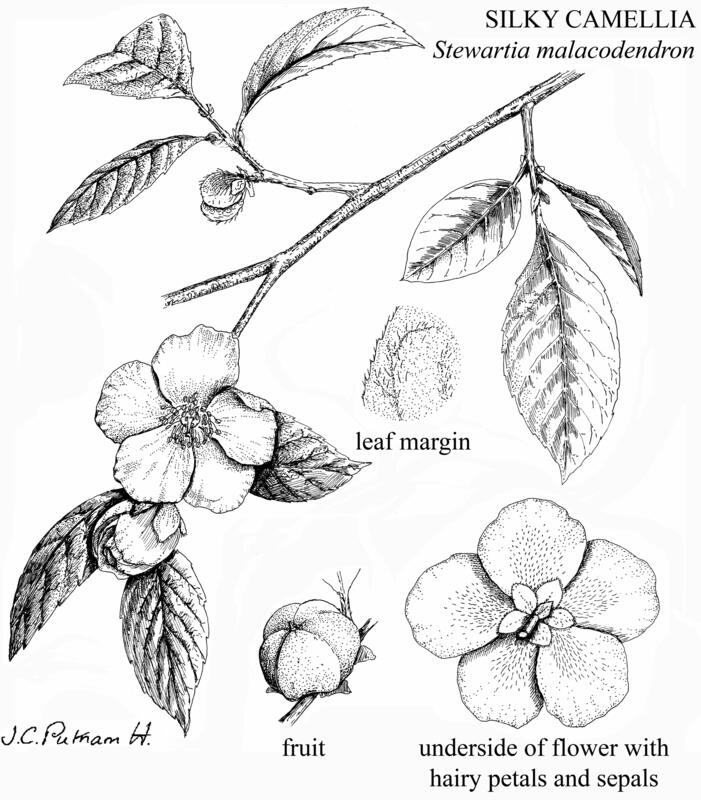
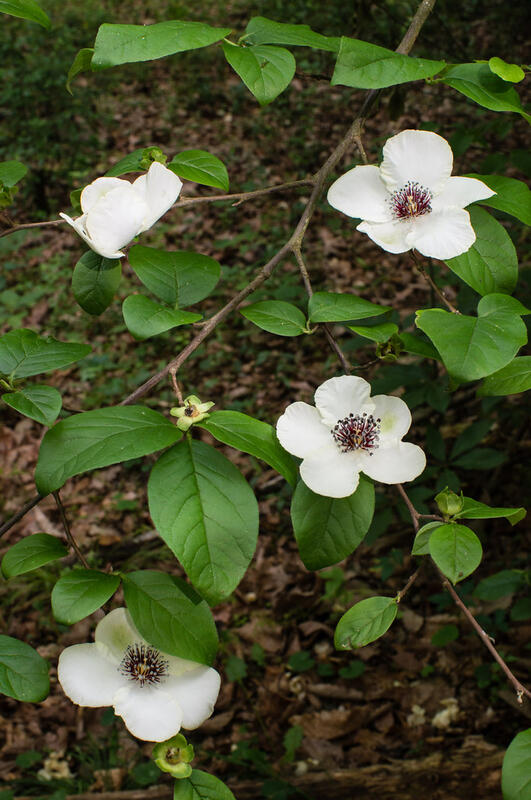
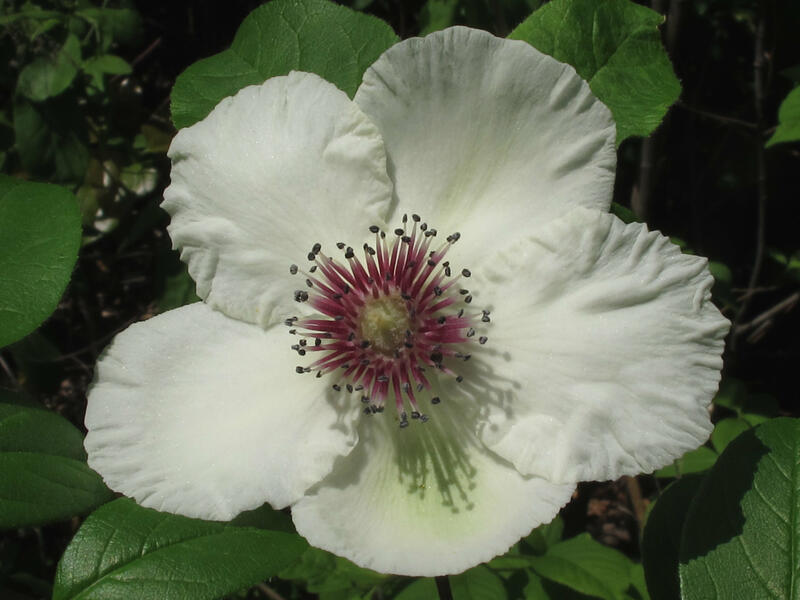
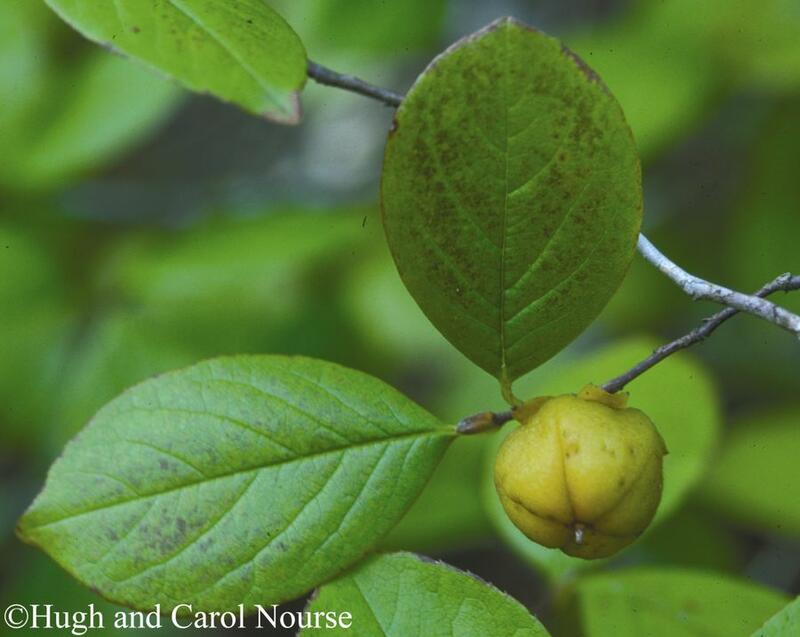
Deciduous shrub or small tree up to 19 feet (6 meters) tall, usually much shorter, with a single, often leaning or arching trunk. Branches and leaves are held mostly in one plane, creating a spray-like effect. Young twigs and leaves are covered with silky hairs. Mature leaves are 2 - 4 inches (5 - 11 cm) long, alternate, oval with pointed tips and finely toothed margins, with fine hairs on the margins and along the veins on the lower surface. Flowers are about 3 inches (7 - 8 cm) wide, on short stalks rising from the angle of leaf and stem; the flower stalks are twisted so that the flowers are held along the upper sides of branches. Petals are 5 in number, white, crinkled, silky-hairy on the outer (lower) surface. The stamens have reddish-purple filaments and blue anthers. Sepals are 5 in number, silky-hairy on the outer surfaces. Fruits are woody, rounded, slightly angled capsules about 0.5 inch (1.2 - 1.8 cm) long and wide, with 4 - 5 chambers and 2 - 4 seeds per chamber.
Mountain Camellia (Stewartia ovata, Georgia Watch List) occurs in the mountains and Piedmont in moist hardwood forests and bluff forests. Its leaves are up to 6 inches (6 - 15 cm) long on winged stalks, its flowers have 5 - 7 petals and sepals, and the fruit is strongly angled. For more information, see: http://beta.floranorthamerica.org/Stewartia_ovata
Franklinia (Franklinia alatamaha) or the “lost Gordonia,” also in the tea family, was discovered by William Bartram in the 1770s near the Altamaha River in southeast Georgia. It has not been seen in the wild since 1804. For more information, see: http://beta.floranorthamerica.org/Franklinia
Mountain Camellia (Stewartia ovata, Georgia Watch List). For more information, see: http://beta.floranorthamerica.org/Stewartia_ovata
Rich ravine and slope forests, often with Beech, Oak, Basswood, and Spruce Pine. Lower slopes of sandhills above bogs and creek swamps.
Silky Camellia's showy, white flowers and colorful stamens attract bees and butterflies that gather pollen; the flowers do not produce nectar. Members of the genus are believed to be self-fertile. The 4- or 5-chambered fruits open along the angles, exposing 2 - 4 seeds per chamber; the seeds have double dormancy. The seeds are dispersed by birds and squirrels.
Surveys are best conducted during flowering (April–June) and fruiting (June–October).
Georgia, Florida, Alabama, Mississippi, Louisiana, Texas, Arkansas, Tennessee, South Carolina, North Carolina, and Virginia. It is rare throughout its range.
Clearing and logging on hardwood slopes and in ravines, impoundment of streams, plant poaching.
| Threat 1 | Threat 2 | Threat 3 | |
|---|---|---|---|
| General Threat | Natural system modifications | Agriculture & aquaculture | Residential & commercial development |
| Specific Threat | None | None | None |
Stewartia malacodendron is ranked S2 by the Georgia Department of Natural Resources, indicating that the species is imperiled in Georgia. It is listed as Rare by the State of Georgia. About 40 populations have been documented in Georgia, but only 9 have been confirmed since 2000. Four populations occur on conservation lands, 9 on military bases.
Avoid burning, logging, and mechanical clearing on hardwood slopes and in ravines. Avoid damming streams. Plants do not transplant well; protect plants from digging and prosecute poachers.
Chafin, L.G. 2007. Field guide to the rare plants of Georgia. State Botanical Garden of Georgia and University of Georgia Press, Athens.
Foote, L.E. and S.B. Jones, Jr. 1989. Native shrubs and woody vines of the southeast. Timber Press, Portland, Oregon.
GADNR. 2020. Element occurrence records for Stewartia malacodendron. Georgia Department of Natural Resources, Wildlife Resources Division, Social Circle, Georgia.
Godfrey, R.K. 1988. Trees, shrubs, and woody vines of northern Florida and adjacent Georgia and Alabama. University of Georgia Press, Athens.
Gordon, K.L. 2020. Plant of the week: Silky Camellia (Stewartia malacodendron L.). U.S. Forest Service, United States Department of Agriculture. https://www.fs.fed.us/wildflowers/plant-of-the-week/stewartia_malacodendron.shtml
International Dendrology Society. 2009. Stewartia. International Dendrology Society Yearbook. https://www.dendrology.org/publications/tree-profiles/stewartia-study-days-hardy-theaceae-and-the-genus-stewartia/
Lance, R. 2004. Woody plants of the southeastern United States: a winter guide. University of Georgia Press, Athens.
NatureServe. 2020. Stewartia malacodendron species account. NatureServe Explorer. Arlington, Virginia.https://explorer.natureserve.org/Taxon/ELEMENT_GLOBAL.2.156280/Stewartia_malacodendron
Nelson, G. 1996. Shrubs and woody vines of Florida. Pineapple Press, Sarasota, Florida.
Patrick, T.S., J.R. Allison, and G.A. Krakow. 1995. Protected plants of Georgia. Georgia Department of Natural Resources, Natural Heritage Program, Social Circle.
Prince, L.M. 2002. Circumscription and biogeographic patterns in the eastern North America–east Asia genus Stewartia (Theaceae: Stewartieae): insight from the chloroplast and nuclear DNA sequence data. Castanea 67(3): 290-301. https://www.jstor.org/stable/4034351?seq=1#metadata_info_tab_contents
Prince, L.M. 2009. Stewartia malacodendron species account. Flora of North America, vol. 8. http://beta.floranorthamerica.org/Stewartia_malacodendron
Sanders, B. 2004. William Bartram’s botanical discoveries in Georgia. Tipularia 19: 8-17.
Weakley, A.S. 2015. Flora of the southern and mid-Atlantic States. University of North Carolina Herbarium, University of North Carolina, Chapel Hill. http://www.herbarium.unc.edu/flora.htm
Linda G. Chafin
L. Chafin, Sept. 2008: original account
K. Owers, Feb. 2010: added pictures
L. Chafin, May 2020: original account.