


Loading profile. Please wait . . .
Gratiola amphiantha D. Estes & R.L. Small
Pool-sprite (Snorkelwort)




Federal Protection: Listed Threatened
State Protection: Threatened
Global Rank: G2
State Rank: S2
Element Locations Tracked in Biotics: Yes
SWAP 2015 Species of Greatest Conservation Need (SGCN): Yes
SWAP 2025 Species of Greatest Conservation Need (SGCN): Yes
2025 SGCN Priority Tier: Highest Conservation Concern
Element Occurrences (EOs) in Georgia: 73
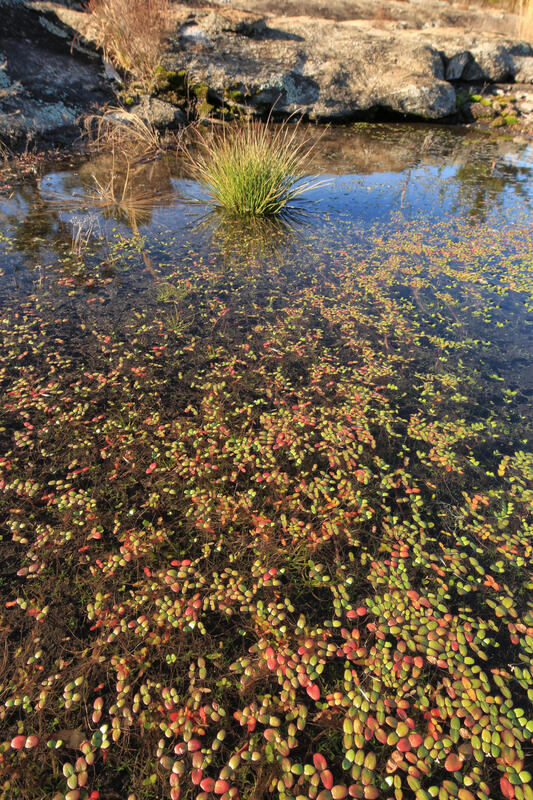
Habitat Summary for element in Georgia: Vernal pools on granite outcrops
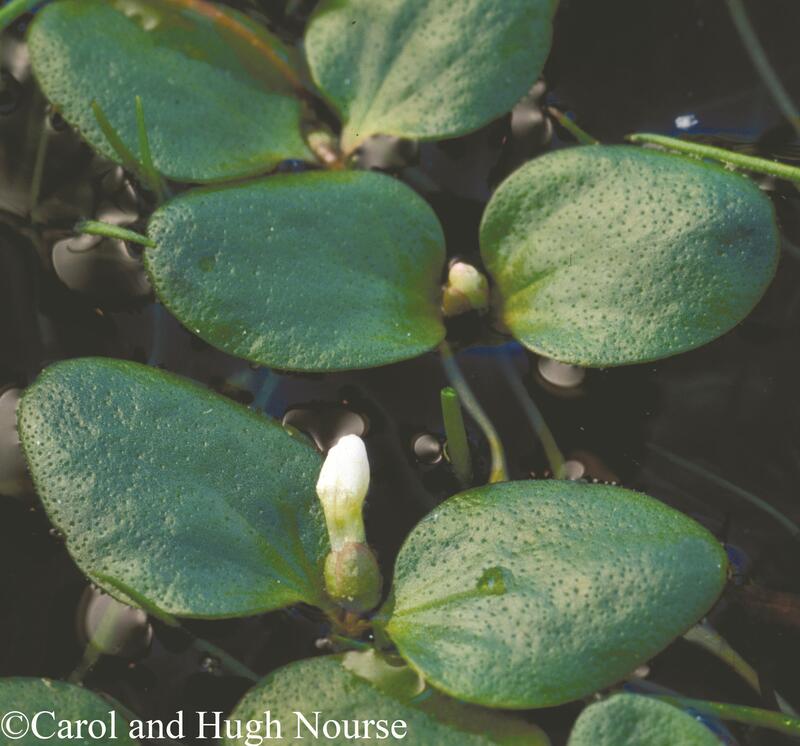
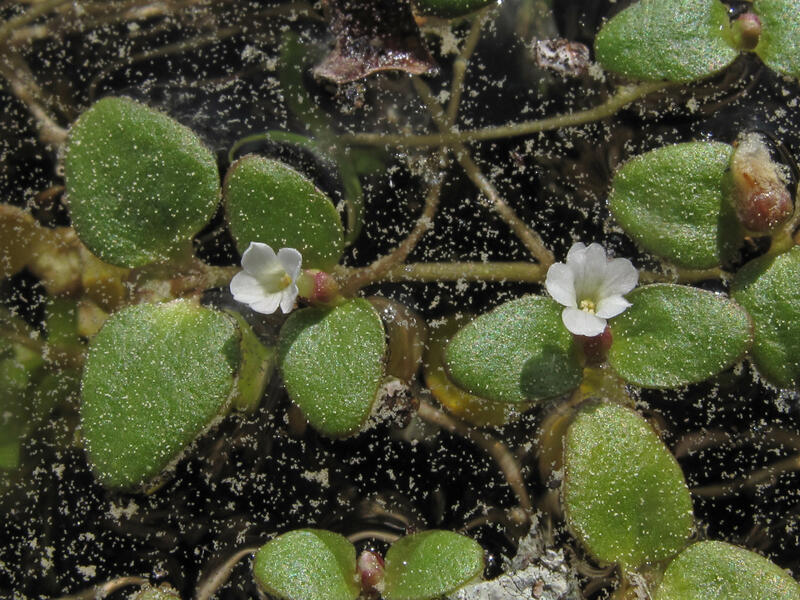
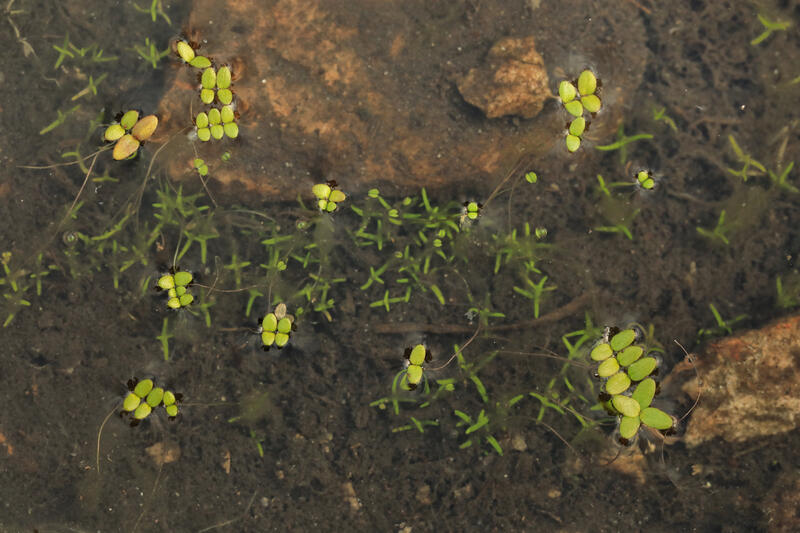
Amphianthus pusillus (synonym Gratiola amphiantha) is an aquatic, annual herb with two types of leaves. Floating leaves are about 0.25 inch (4 - 8 mm) long, oval with rounded tips, paired at the end of a thread-like stem that rises from the bottom of the pool habitat. Submerged leaves are about 0.2 inch (5 mm) long and very narrow with a pointed tip; they are held in a rosette at the top of a very short, underwater stem rooted in the bottom of the pool. Flowers are about 0.1 inch (3 - 4 mm) long, white to pale purple, with a short tube and 5 spreading lobes; flowers are held between the floating leaves and also among the submerged rosette leaves. Fruits are capsules about 0.1 inch (3 mm) wide, somewhat flattened, with 2 lobes.
Water Starwort (Callitriche heterophylla) also occurs in pools on granite outcrops; its floating leaves are spoon-shaped and in whorls or rosettes rather than pairs; its submerged leaves are narrow and scattered along a long underwater stem.
Amphianthus pusillus is the only species in that genus. Molecular analysis conducted in 2008 resulted in the transfer of this species to the genus Gratiola, where it is known as Gratiola amphiantha. There is one other rare species of Gratiola in Georgia:
Gratiola graniticola (Granite Hedge-hyssop, synonym G. neglecta) is ranked S3 by the GA Department of Natural Resources, indicating that it is vulnerable to extirpation in the state. It also occurs in solution pools on granitic outcrops, particularly Lithonia gneiss. It is an emergent plant, with erect, aerial stems bearing several pairs of opposite leaves. For more information, see: http://beta.floranorthamerica.org/Gratiola_graniticola
Shallow, flat-bottomed depressions (solution pools, vernal pools) on granitic outcrops, with thin, gravelly soils and winter–spring inundation. Pools must be deep enough to hold water for several weeks and must be in full sun to support Pool Sprite.
Pool Sprite is an annual that completes its life cycle – seed germination, leaf emergence, flowering, fruit production, and death – in just 3 or 4 weeks. In dry years, it may not appear at all, the seeds lying dormant until wetter weather. The depth or duration of water in the pools needed for germination is not known. Typically, seeds germinate following the increasingly heavy rains of late fall or early winter; young plants grow slowly during the winter but begin to form flower buds by early February. Growth accelerates as temperatures warm. The length of Pool Sprite’s stem depends on the depth of the water; the stem will continue to elongate until the paired leaves and flower are floating on the surface of the pool. By late February, flowering of both floating and submerged flowers is well underway, peaking in mid-March. As the pools begin to dry in April, the usually closed submerged flowers are exposed and begin to open. All stages of the plant may be visible in April, from buds to mature fruit, with larger plants having from 10 - 15 flowers and fruits. As the pools dry up, the fruits shed their seeds, and the plants wither and disappear by late May and June. Pool Sprite may also produce seeds asexually, a reproductive method which reduces genetic diversity and population viability.
Surveys are best conducted during flowering (March–April) and fruiting (April–May); plants are visible in the winter and spring then wither and disappear after fruiting.
Piedmont of Georgia, South Carolina, and Alabama.
Quarrying, development, trash dumping, mulching, and off-road vehicle use
| Threat 1 | Threat 2 | Threat 3 | |
|---|---|---|---|
| General Threat | Human intrusions & disturbance | Invasive & other problematic species, genes & diseases | Climate change & severe weather |
| Specific Threat | None | None | None |
Pool Sprite is ranked S2 by the Georgia Department of Natural Resources, indicating that is imperiled in the state. It is state-listed and federally listed as Threatened. Pool Sprite has been recently documented (2000 or later) about 50 times in 17 Georgia Piedmont counties, but only 10 of these populations are protected in preserves or parks.
Protect Piedmont granite outcrops from quarrying, trash dumping, and off-road vehicle use. Restrict foot traffic to designated trails. Create buffers and limit development around outcrops.
Chafin, L.G. 2007. Field guide to the rare plants of Georgia. State Botanical Garden of Georgia and University of Georgia Press, Athens.
Estes, D. and R.L. Small. 2007. Two new species of Gratiola (Plantaginaceae) from eastern North America and an updated circumscription for Gratiola neglecta. Journal of the Botanical Research Institute of Texas 1(1): 149-170. https://www.jstor.org/stable/41971407
Estes, D. and R. L. Small. 2008. Phylogenetic relationships of the monotypic genus Amphianthus (Plantaginaceae, Tribe Gratioleae) inferred from chloroplast DNA sequences.Systematic Botany 33:1 176. https://www.jstor.org/stable/41971407?seq=1#metadata_info_tab_contents
Freeman, C.C. 2008. Gratiola amphiantha species account. Flora of North America, vol. 17. http://beta.floranorthamerica.org/Gratiola_amphiantha
GADNR. 2019. Element occurrence records for Amphianthus pusillus. Georgia Department of Natural Resources, Wildlife Resources Division. Social Circle, Georgia.
Godfrey, R.K. and J.W. Wooten. 1981. Aquatic and wetland plants of the southeastern United States, volume 2. University of Georgia Press, Athens.
Hilton, J.L. and R.S. Boyd. 1996. Microhabitat requirements and seed/microsite limitation of the rare granite outcrop endemic Amphianthus pusillus (Scrophulariaceae). Bulletin of Torrey Botanical Club 123(3):189-96. https://www.jstor.org/stable/2996794?seq=1#metadata_info_tab_contents
NatureServe. 2019. Amphianthus pusillus comprehensive report. NatureServe Explorer. Arlington, Virginia. http://explorer.natureserve.org/servlet/NatureServe?searchName=Amphianthus%20pusillus
Nourse, H. and C. Nourse. 2007. Favorite wildflower walks in Georgia. University of Georgia Press, Athens.
Patrick, T.S., J.R. Allison, and G.A. Krakow. 1995. Protected plants of Georgia. Georgia Department of Natural Resources, Natural Heritage Program, Social Circle.
USFWS. 2019. Little Amphianthus (Amphianthus pusillus) species profile and related documents. U.S. Fish and Wildlife Service. https://ecos.fws.gov/ecp0/profile/speciesProfile?sId=6445
Weakley, A.S. 2015. Flora of the southern and mid-Atlantic States. University of North Carolina Herbarium, University of North Carolina, Chapel Hill. http://www.herbarium.unc.edu/flora.htm
Linda G. Chafin
L. Chafin, Dec. 2007: original account
K. Owers, Jan. 2010: updated status and ranks, added pictures
L. Chafin, Jan. 2020: updated original account