


Loading profile. Please wait . . .
Croton elliottii Chapman
Pondshore Croton




Federal Protection: No US federal protection
State Protection: No Georgia state protection
Global Rank: G3
State Rank: S2
Element Locations Tracked in Biotics: Yes
SWAP 2015 Species of Greatest Conservation Need (SGCN): Yes
SWAP 2025 Species of Greatest Conservation Need (SGCN): Yes
2025 SGCN Priority Tier: High Conservation Concern
Element Occurrences (EOs) in Georgia: 65
Habitat Summary for element in Georgia: Pond margins and wet savannas
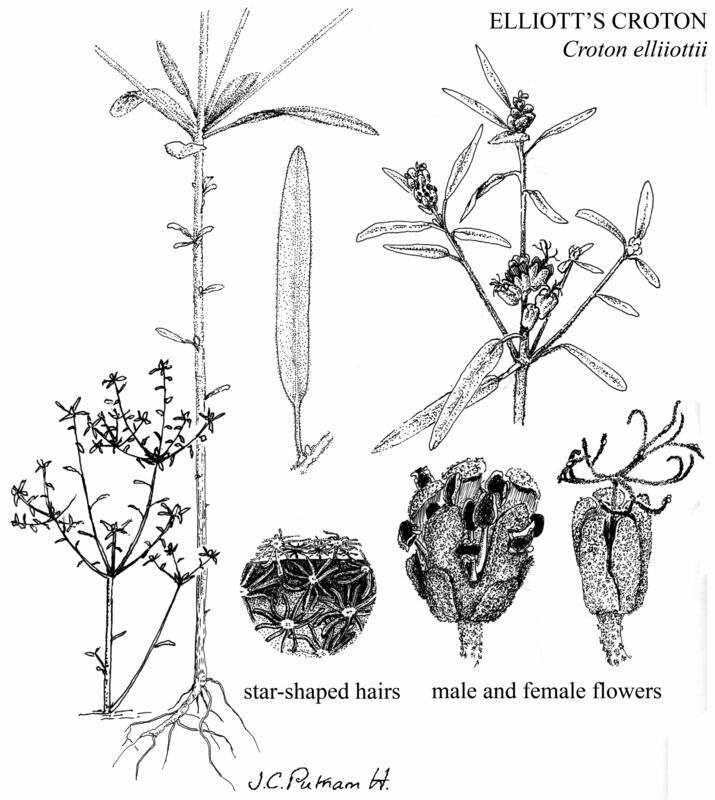
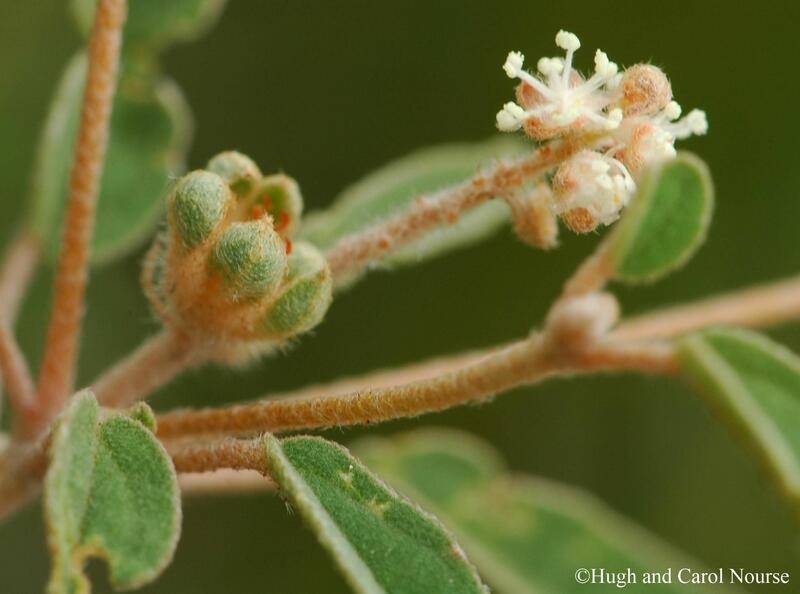
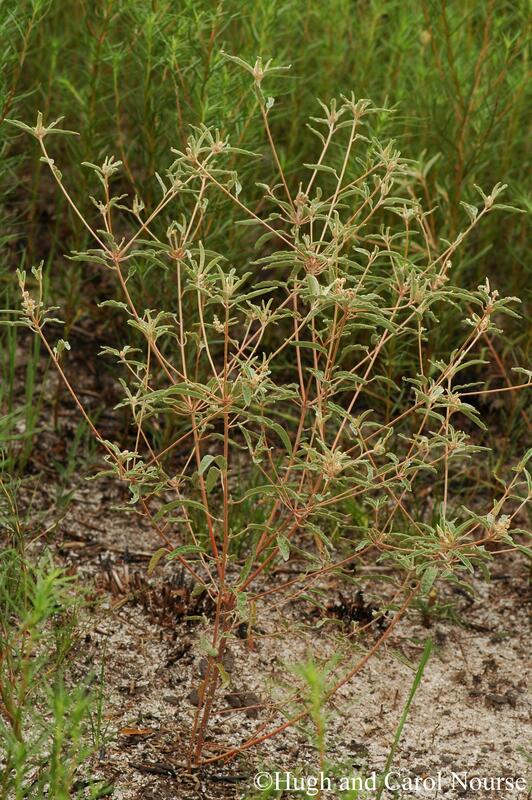
Annual, monoecious herb 12 - 32 inches (30 - 80 cm) tall with a taproot and a single, hairy, rusty-brown, repeatedly forking stem, each branch usually tipped by a flower cluster. Leaves are 0.8 - 2.4 inches (2 - 6 cm) long and up to 0.6 inch (0.2 - 1.5 cm) wide, alternate, narrowly oblong with smooth margins, blunt rounded tips, and rounded bases; the lower leaf surface is pale green and densely covered with gray, star-shaped (branched) hairs; the upper leaf surface is darker green and less densely hairy. The leaf stalks are orange-brown and hairy; all the hairs on leaves and leaf stalks are a single color – gray. Flower clusters are compact, containing both female and male flowers. Female flowers have 5 - 7 oblong sepals with hooded, upcurved tips (there are no petals). Male flowers have 5 oval sepals, 5 narrow petals, and 7 - 10 stamens. Fruits are 0.2 inch (4 - 5 mm) wide, with 3 rounded lobes, each lobe with 1 shiny seed. Stems, leaves, leaf stalks, sepals, and fruits are covered with star-shaped (branched) hairs.
Members of the genus Croton are distinguished by the star-shaped hairs on their leaves and stems and by the lack of the milky latex that occurs in many other members of the Spurge family; also most other spurges occur in dry, upland sites. Croton elliottii is the only Croton that occurs on the exposed shores of ponds. Hogwort (Croton capitatus) leaves are large, up to 6 inches (15 cm) long, and have pointed tips; it occurs in disturbed areas such as old fields.
Croton monanthogynus (Prairie-tea) is on Georgia's Plant Watch List (https://georgiabiodiversity.org/portal/plant-watch-list). It occurs in blackland prairies and on limestone outcrops and also in disturbed areas over limestone bedrock where it can be weedy. It occurs infrequently throughout Georgia.
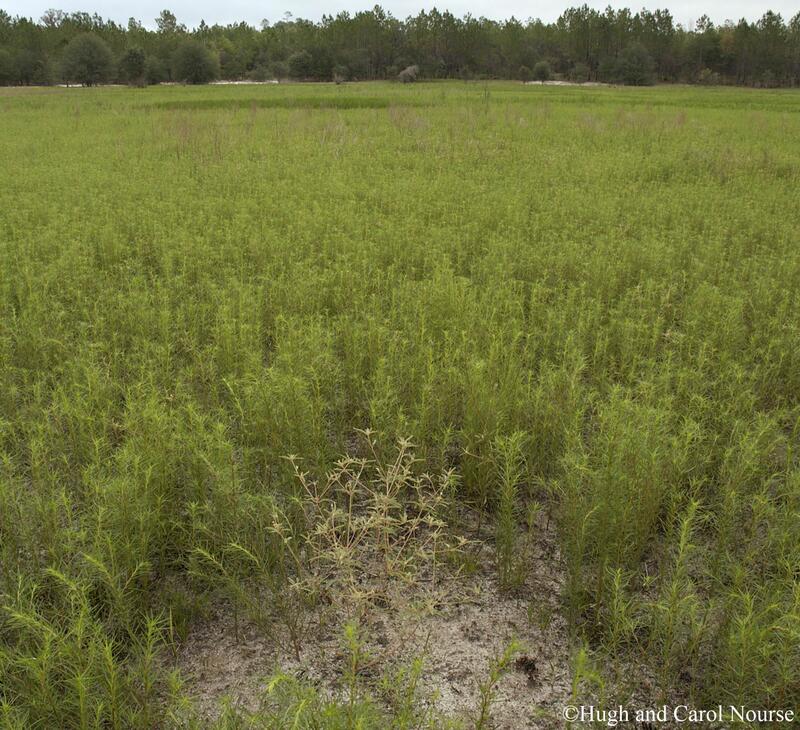
Croton elliottii occurs on exposed shores and bottoms of shallow, sinkhole ponds (limesinks) and clay-based Carolina bays that experience periodic drawdowns of water levels.
Croton elliottii is a monoecious annual plant; individual plants have separate female and male flowers in each flower cluster. The female flowers are probably pollinated by insects but there is no published information about this species' reproduction (other monoecious species in this genus have floral nectaries that attract insects and are insect-pollinated). Self-pollination is avoided since the female and male flowers on a given plant mature at different times from each other. Other Croton species have seeds that bear elaiosomes and are dispersed by ants, but it is unknown if this is true of Croton elliottii.
Croton elliottii is thought to benefit greatly from prolonged winter flooding followed by a very dry growing season. Its seeds may persist in the seed bank for years between drawdown events then germinate by the hundreds or even thousands when water levels drop. When drawdowns occur, Croton elliottii is one of many herbaceous species that emerge, forming a grass- and forb-dominated wet meadow. After flowering and pollination, its fruits develop rapidly and seeds are quickly shed. If their pond habitat remains flooded, plants may not be seen for years–until water levels drop again and seeds germinate.
Croton elliiottii also germinates abundantly following fires that burn across flatwoods ponds during drawdowns. Whether this is an actual response to fire or if fires are more likely to occur during the drawdowns that favor this species is not known.
Surveys are best conducted when plants are most abundant during a dry summer that follows a prolonged winter flooding. Flowers and fruits are not strictly necessary for identification since the habitat, growth form, and abundance of branched hairs on all plant surfaces are diagnostic.
Georgia, Florida, Alabama, and South Carolina.
Many of Georgia’s flatwoods ponds have been destroyed by draining and filling and conversion to agriculture and pine plantations. The unique hydrology of flatwoods ponds that support Croton elliottii is threatened by excessive withdrawal for irrigation from the Floridan aquifer. Fire suppression may also be a threat as are hydrologic changes due to altered temperature and rainfall patterns related to climate change.
| Threat 1 | Threat 2 | Threat 3 | |
|---|---|---|---|
| General Threat | Natural system modifications | Natural system modifications | Climate change & severe weather |
| Specific Threat | None | None | None |
More than 40 ponds are known to support this species, with population sizes ranging from a few plants to thousands of plants. Almost all of these populations occur on a single conservation area in southwest Georgia.
Apply prescribed fire to flatwoods and savannas every 2 - 3 years during the growing season, allowing fires to burn across ponds. Avoid placing roads and firebreaks through flatwoods and in the transition zones between ponds and surrounding habitat. Avoid draining ponds, lowering water tables, and otherwise altering hydrology. Protect flatwoods and savannas from development and conversion to pine plantations.
Chafin, L.G. 2007. Field guide to the rare plants of Georgia. State Botanical Garden of Georgia and University of Georgia Press, Athens.
Edwards, L., J. Ambrose, and L.K. Kirkman. 2013. The natural communities of Georgia. University of Georgia Press, Athens.
Ferguson, A.M. 1901. Crotons of the United States. Missouri Botanical Garden Annual Report 12: 33-73. https://www.jstor.org/stable/2400055?seq=1#metadata_info_tab_contents
GADNR. 2020. Element occurrence records for Croton elliottii. Georgia Department of Natural Resources, Wildlife Resources Division, Social Circle, Georgia.
Godfrey, R.K. and J.W. Wooten. 1981. Aquatic and wetland plants of southeastern United States, Vol. 2, dicotyledons. University of Georgia Press, Athens.
Levin, G.A. and L.J. Gillespie. 2016. Species account for Croton elliottii. Flora of North America, Volume 12. http://www.efloras.org/florataxon.aspx?flora_id=1&taxon_id=250101922
NatureServe. 2019. Croton elliottii comprehensive report. NatureServe Explorer. Arlington, Virginia. http://explorer.natureserve.org/servlet/NatureServe?searchName= Croton%20elliottii
Weakley, A.S. 2015. Flora of the southern and mid-Atlantic States. University of North Carolina Herbarium, University of North Carolina, Chapel Hill. http://www.herbarium.unc.edu/flora.htm
Linda G. Chafin
L. Chafin, Sept. 2007: original account
K. Owers, Jan. 2010: updated status and ranks, added pictures
L. Chafin, Feb 2020: updated original account