


Loading profile. Please wait . . .
Pseudacris collinsorum Ospina, Tieu, Apodaca, and Lemmon, 2020
Collinses' Mountain Chorus Frog




Federal Protection: No US federal protection
State Protection: No Georgia state protection
Global Rank: G4
State Rank: S2
Element Locations Tracked in Biotics: Yes
SWAP 2015 Species of Greatest Conservation Need (SGCN): No
SWAP 2025 Species of Greatest Conservation Need (SGCN): Yes
2025 SGCN Priority Tier: Data Deficient
Element Occurrences (EOs) in Georgia: 25
Habitat Summary for element in Georgia: Hardwood forests with fishless breeding pools
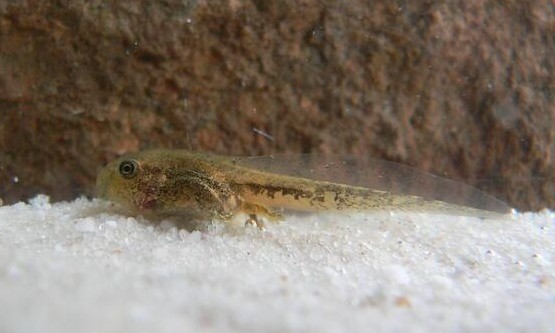
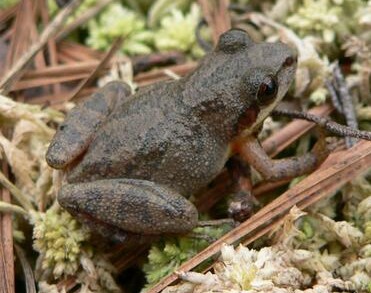
Collinses' mountain chorus frog is a medium-sized chorus frog with total lengths (snout to vent lengths or SVL) measuring 2.5 – 3.2 cm (1 – 1.25 in). This species has minimal webbing between the toes and the most distinct digital disks (toe pads) of any of the chorus frogs (genus Pseudacris). The background color is gray or brown with darker brown markings on the snout, between the eyes, on the back, as well as transverse stripes on the hind limbs (smaller, discontinuous bands are present on the forelimbs). While Collinses' mountain chorus frog may possess the “inverted parentheses” dorsal stripe pattern commonly seen in the Appalachian mountain chorus frog (Pseudacris brachyphona), the external color pattern of P. collinsorum is more variable than its sister taxon. Although two broad, spotted, irregular dorsal stripes sometimes merge anteriorly on the back and run separately posteriorly to form an inverted “U,” the dorsal pattern of P. collinsorum frequently consists of only broken stripes or a dorsal pattern is lacking altogether. Solid, brown bands run from each tympanum (external ear), merging at the snout. An inverted triangle, or “T”-shaped spot is positioned between the eyes. The typically unmarked cream-colored belly occasionally has a few dark speckles in some individuals; the underside of the limbs have a yellowish coloration which is most pronounced in breeding individuals. The throat (vocal sac) of the male is more darkly pigmented (dusky to jet black). Newly transformed froglets have the adult pattern. P. collinsorum larvae (tadpoles) measure 2.2-3 cm (0.85-1.2 in) [stage 36, Gosner standard stages of anuran development], and are lightly pigmented brown, sometimes with dorsal spots, but have unmarked tails and fins (eyes are located dorsolaterally). The mating call is a rasping, wrrink, wrrink…wrrink, sometimes compared to the sound of a squeaky wagon wheel and can be heard from a distance of up to ¼ of a mile (~0.4 km).
In Georgia, Collinses' mountain chorus is sympatric (overlapping geographic distributions) with two other chorus frogs which it superficially resembles – the spring peeper (P. crucifer) and the upland chorus frog (P. feriarum). However, these species can be differentiated based on appearance (especially, dorsal pattern), vocalizations, and/or differences in habitat affinity. Marks on the back of the spring peeper (1.9 – 3.2 cm [0.75 – 1 .25 in] SVL) typically form an “X” shape, albeit often imperfectly. This species gets its common name from its distinctive call – a high-pitched, whistling peep, peep…peep repeated at intervals of about a second or sometimes a trilling peep. Marks on the back of the upland chorus frog (1.9 – 3.5 cm [0.75 – 1 .4 in] SVL) are extremely variable – a middorsal pattern consisting of a series of stripes, partial stripes, or spots. The call of this species is often compared to the sound of successively running one’s finger across the teeth of a hard plastic comb – a regularly repeated, crrreeek, crrreeek….crrreeek. As the upland chorus frog usually calls from fairly open wetland habitats, it is allotopic (occupying different microhabitats) with Collinses' mountain chorus frog; in fact, when occupied wetland areas are cleared, P. collinsorum is replaced by P. feriarum. Although upland chorus frogs and Collinses' mountain chorus frogs occur in proximity to one another (i.e., sympatric), these species seldom breed in the same wetland habitats.
While the sister taxon, P. brachyphona, is associated almost entirely with deciduous woodlands, terrestrial habitats of P. collinsorum consist of dry to dry-mesic forests primarily dominated by pine and oak species within the Blue Ridge, Ridge and Valley, Cumberland Plateau, and Piedmont physiographic provinces of Georgia. Collinses' mountain chorus frog is usually not found away from woodland habitats. Both temporary pools and slow-moving temporary waters are utilized for breeding wetlands, but permanent waters are avoided. Although some accounts have documented calling males from open fields, this species typically prefers wooded areas. Suitable breeding wetlands include shallow, flooded temporary pools, grassy pastures in the vicinity of small springs, road-side ditches, and swampy areas along woodland streams
Food items of adult and juvenile Collinses' mountain chorus frogs consist of ground-dwelling invertebrates including beetles, spiders, true bugs, ants, leaf hoppers, flies, centipedes, caterpillars, and earthworms. P. collinsorum tadpoles feed on periphyton and phytoplankton which they scrape from the surfaces of aquatic vegetation and detritus and may also scavenge nutrients from the remains of dead tadpoles.
Though infrequently encountered within upland habitats, adult Collinses' mountain chorus frogs are known to emigrate downhill to wetland habitats to breed and immigrate back upslope following the breeding season where they forage and seek shelter in surrounding terrestrial habitats. While females only visit a breeding site on a single night to mate and oviposit (lay) eggs, males remain at the breeding sites for the entire breeding season, have been documented moving between wetland pools during the breeding season, and potentially mate multiple times within a given year. Eggs average 0.28 inches (7 mm) in diameter, are deposited in small, soft gelatinous masses of 3-50 eggs, and are typically attached to woody debris or submerged vegetation. Females deposit several hundred to over 1,000 eggs during a given breeding season. Eggs hatch in 7-10 days. Newly emerged larvae (tadpoles) measure ~1/5 inch (4.5-5 mm) in total length; metamorphosis of tadpoles (~0.3 inches [8 mm] snout to vent length) is complete 45-60 days following hatching and young individuals (~0.43-0.5 inches [11-13 mm] snout to vent length) have been observed in terrestrial habitats during the summer months following hatching.
Though Collinses' mountain chorus frog specimens are elusive and exceptionally difficult to locate during much of the year, this species regularly elicits advertisement calls throughout the duration of its breeding season (February - April) that extends over several weeks, aural surveys targeting calling males within appropriate wetland habitats are recommended as the primary method to locate populations of this species. Such aural surveys not only can be used to better define the species’ geographic distributional extend (within Georgia and elsewhere), but can also be utilized to evaluate relative population abundances and species conservation status over time.
Historically, the mountain chorus frog (as originally described as P. brachyphona in 1889) was thought to have a distribution mostly defined by the Appalachian Mountains, and occurring within the Allegheny, Cumberland, and Blue Ridge mountains from southwestern Pennsylvania to north of the Fall Line in Alabama and adjacent extreme northeastern Mississippi and into Georgia. However, recent genetics research has determined that what was formerly considered a single species, is now considered two separate species; P. collinsorum is separated from P. brachyphona (Appalachian mountain chorus frog) by the Tennessee River and the southern portion of the Blue Ridge Mountains. Pseudacris collinsorum occurs 330-1050 ft (100-320 m) above sea level across northern Alabama, northeastern Mississippi, southeastern Tennessee, southwestern North Carolina, and northwestern Georgia. This species’ distribution falls within areas where precipitation during the driest season is relatively high (~ 10.25 – 19.7 inches or ~260-500 mm), thus allowing for occurrence in predominately drier habitats.
There is circumstantial evidence of a decline in the Pseudacris brachyphona complex (particularly in the Appalachian mountain chorus frog within West Virginia, Pennsylvania, Maryland, and elsewhere) since the 1930s due to loss of habitat. Residential and commercial development and associated conversion (ditching and draining) of seasonal wetlands pose a threat to P. collinsorum.
| Threat 1 | Threat 2 | Threat 3 | |
|---|---|---|---|
| General Threat | Natural system modifications | Residential & commercial development | None |
| Specific Threat | Other ecosystem modifications | Housing & urban areas | None |
Collinses' mountain chorus frog has been documented from the Chattahoochee National Forest, as well as Dawson Forest WMA and Brasstown Valley Resort. Though likely secure, the precise status of Georgia populations is unknown; occurrences of the species are currently tracked within the Georgia Department of Natural Resources’ (DNR) conservation database.
This species undoubtedly occurs on other conservation lands and surveys should be conducted throughout the probable distributional extent of this species. Further concerted survey effort for the species throughout its presumed range over several years is suggested to determine the full extent of the species distribution, abundance, and conservation status in Georgia.
Floyd, T. M. and E. S. Kilpatrick. 2002. Pseudacris brachyphona (Mountain Chorus Frog). Verification of historical occurrence [Cherokee Co., NC]. Herpetological Review 33: 48.
Ethier, J. P., A. Fayard, P. Soroye, D. Choi, M. J. Mazerolle, and V. L. Trudeau. 2021. Life history traits and reproductive ecology of North American chorus frogs of the genus Pseudacris (Hylidae). Frontiers in Zoology 18, 40 (2021). https://doi.org/10.1186/s12983-021-00425-w
McCoy, S. T. S., J. H. K. Pechmann, L. A. Williams. 2021. Post-breeding movement, habitat selection, and natural history of Collinses' mountain chorus frog in North Carolina. Southeastern Naturalist 20(3): 399-419. https://doi.org/10.1656/058.020.0302
Ospina, O. E., L. Tieu; J. J. Apodaca, E. M. Lemmon. 2020. Hidden diversity in the mountain chorus frog (Pseudacris brachyphona) and the diagnosis of a new species of chorus frog in the southeastern United States. Copeia (2020) 108 (4): 778–795. https://doi.org/10.1643/CH2020009
Martof, B. and R. L. Humphries. 1955. Observations of some amphibians from Georgia. Copeia 1955(3): 245-248.
Schwartz, A. 1955. The chorus frog Pseudacris brachyphona in North Carolina. Copeia 1955: 138.
Thomas M. Floyd
T. Floyd, January 2024: original account